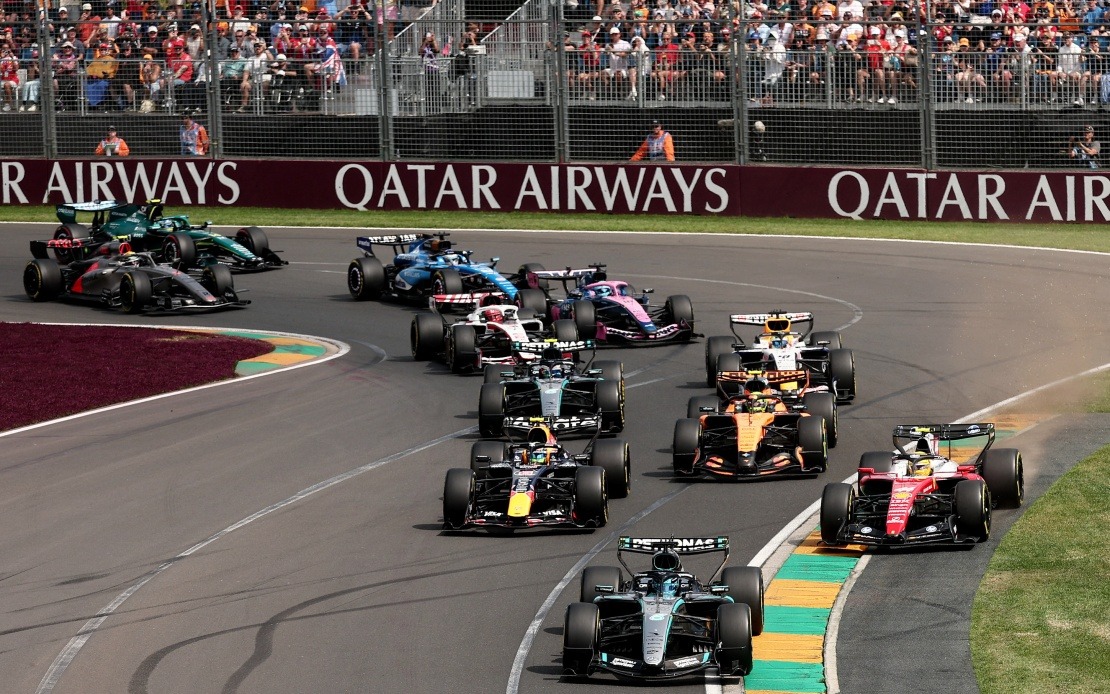
George Russell's championship hopes suffered another significant blow at Spa-Francorchamps on Sunday when mechanical failure forced his retirement from the Belgian Grand Prix, triggering an expletive-laden radio tirade that laid bare his mounting frustration with Mercedes' reliability woes this season. The British driver now trails his teenage teammate Kimi Antonelli by 50 points after the Italian secured his sixth victory of the ten races contested so far, a deficit that threatens to become insurmountable with just a handful of rounds remaining before the summer break.
Russell's day unravelled on multiple fronts, beginning with an engine glitch on the opening lap that exposed him to the chasing pack and ultimately led to a collision with Lewis Hamilton that ended his race prematurely. The incident capped a frustrating weekend that had already seen him qualify half a second behind Antonelli, a margin that team engineers initially attributed to his driving approach before investigating further and discovering the real culprit was a technical malfunction within the power unit itself. The disconnect between engineering assessment and reality underscores the complexity of diagnosing issues within Formula 1's modern hybrid propulsion systems and the psychological toll such miscommunications inflict on drivers seeking answers.
In an unbroadcast radio transmission, Russell's exasperation boiled over with his direct criticism of the car's state of battery charge management down the straights. "I had no battery down the straight," he declared, before escalating to full condemnation of the weekend's broader technical problems. This wasn't merely the frustrated outburst of a driver suffering a poor race result; it represented the accumulation of a season marked by repeated mechanical setbacks that have systematically undermined his competitiveness. Russell's statement that he is now "numb to disappointment" carries particular weight, suggesting that hope and expectation have been gradually eroded by broken promises and technical explanations that fail to materialise into improved reliability.
Mercedes team principal Toto Wolff responded to Russell's criticism with measured diplomacy, acknowledging the legitimate emotional toll that mechanical failures exact on elite competitors while simultaneously seeking to maintain morale and confidence in the team's ability to recover. Wolff's recognition that even the most accomplished drivers experience difficult spells provides important context for understanding the psychological pressures inherent in Formula 1, where mechanical unreliability compounds the already intense mental demands of racing at the highest level. The team principal's assertion that Mercedes remains 100 per cent committed to Russell's championship bid carries weight given the organisation's historical reputation, yet actions and results matter more than words at this juncture.
The specific technical issue Wolff identified—reduced energy available for deployment at turn 18—reveals the intricate balance required in modern power unit management, where harvesting and deploying electrical energy involves complex interactions between driver inputs, software calibration, and hardware response. The fact that engineers spotted this problem at Spa rather than at subsequent venues like Budapest, which lacks the energy-sapping characteristics of the Belgian circuit, represented a silver lining in an otherwise disappointing weekend. However, as Wolff himself acknowledged, identifying the problem offers little consolation to a driver watching his championship hopes fade, particularly when the issue appears to account for half the qualifying gap to his teammate.
The timing of Russell's technical troubles could hardly be worse for his title aspirations. With Antonelli demonstrating both speed and consistency at a level that belies his junior status, Mercedes faces the uncomfortable reality that their second driver may have surpassed their lead driver in overall capability—or at minimum in performance when both are operating with equal machinery. The 50-point deficit represents a dramatic swing in a championship that appeared more competitive just weeks earlier, and Russell's mounting mechanical problems have systematically tilted the balance away from him.
For Malaysian and Southeast Asian motorsport enthusiasts, Russell's predicament illustrates how thoroughly modern Formula 1 has become a competition where reliability engineering rivals driver skill as a determinant of championship success. The sport's technical regulations, while designed to promote innovation and efficiency, have created power units of extraordinary complexity that teams continue to master at varying rates. Mercedes' struggles this season stand in stark contrast to their recent dominance, suggesting that the transition to new technical regulations has unsettled their previously reliable operation more profoundly than competitors.
Russell's desperation heading into the Hungarian Grand Prix at the Öveges utca before the summer shutdown suggests Mercedes must make rapid progress, as further mechanical failures could mathematically eliminate him from serious title contention. The driver's stated reliance on "praying" that his team identifies solutions before Budapest carries an uncharacteristic note of helplessness from someone accustomed to controlling outcomes through his own racecraft. This psychological shift—from optimism to acceptance of circumstance—may prove as damaging to his championship as the mechanical failures themselves.
Wolff's commitment to rebuilding Russell's optimism faces a significant test in the coming days. The team principal's experience managing driver expectations and maintaining morale through difficult periods will be crucial, as will the technical team's ability to demonstrate tangible improvements rather than offering explanations that prove hollow when the cars take to the track. The stakes extend beyond this season's championship; Mercedes' reputation for technical excellence and driver development depends on their capacity to resolve these issues decisively.
The broader significance of Russell's retirement and the underlying technical problems reaches beyond individual championship standings to encompass Mercedes' competitive positioning in a fiercely contested Formula 1 landscape. With Antonelli's emergence as a front-running talent and rivals demonstrating superior reliability, the team faces mounting pressure to reassert its engineering credentials. For Russell personally, the path forward demands either a dramatic reversal in his mechanical fortune or a psychological resilience that allows him to extract maximum performance from whatever car improvements materialize before Budapest and the subsequent continental campaign resumes.

