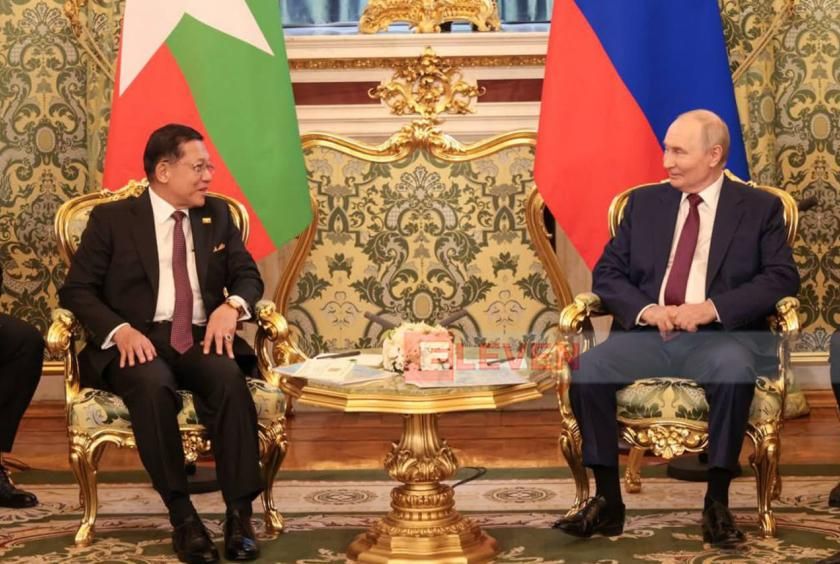
Russian President Vladimir Putin has positioned his country as a willing partner in Myanmar's energy sector development, offering cooperation across offshore petroleum exploration, liquefied natural gas exports, and nuclear power generation. The declaration came during a joint media appearance with Myanmar President U Min Aung Hlaing on August 18, underscoring Moscow's intent to deepen economic and strategic engagement with Southeast Asia's largest military-governed state at a moment of significant geopolitical flux.
The energy sector cooperation represents only one dimension of an expanding bilateral relationship that Putin characterised as resting on decades of shared history. He drew particular attention to the Soviet Union's substantial contributions to Myanmar's development between the 1950s and 1960s, noting that hospitals and universities constructed during that era continue to serve Myanmar's population. This historical framing positions contemporary cooperation as a natural continuation rather than a novel initiative, potentially lending legitimacy to Russian involvement in strategically sensitive sectors like energy and defence.
Beyond hydrocarbon exploration, Putin outlined an ambitious portfolio of infrastructure and industrial projects already underway or under discussion. Coal-fired power stations and oil refinery facilities are currently under construction, whilst negotiations are advancing on a deep-sea port in southern Myanmar—a project carrying obvious implications for regional shipping patterns and naval access. Steel and fertiliser manufacturing plants represent additional components of this industrial expansion, reflecting Russian interest in establishing manufacturing capabilities within Myanmar rather than merely extracting raw materials.
The liquefied natural gas dimension deserves particular attention for Malaysian and broader Southeast Asian stakeholders. Putin explicitly stated that Russia holds considerable potential to export LNG to Myanmar, with the possibility that imported gas could be re-exported to other regional markets. This could alter regional energy dynamics if realised, particularly given Malaysia's own LNG export operations and the competitive implications for regional suppliers. The viability of such arrangements depends on pricing, logistics, and Myanmar's internal energy requirements—variables that remain opaque but warrant monitoring.
Nuclear energy cooperation, sealed through an agreement signed the previous year, represents perhaps the most strategically significant dimension of the bilateral relationship. Putin characterised this as a key project for both nations, though few details emerged regarding the project's scale, timeline, or proliferation safeguards. Given Myanmar's limited industrial base and the substantial capital requirements for nuclear facilities, such a project would represent a dramatic shift in the country's energy infrastructure and technological capabilities, whilst simultaneously creating points of dependency on Russian expertise and supply chains.
The signing of twelve memorandums of understanding during President U Min Aung Hlaing's visit reflects the mechanical pace at which these bilateral relationships are formalising. However, the gap between signed agreements and actual implementation remains substantial across Russia's engagements globally. Myanmar's experience with major infrastructure projects has been mixed, with several Chinese-backed ventures facing delays, cost escalations, and community opposition. Russian projects may encounter similar obstacles, particularly in rural areas where resource extraction affects local populations and environmental systems.
Military and security cooperation forms an implicit but unmistakable strand of this relationship. Putin referenced frequent military exercises conducted in Myanmar's waters and regular visits by Russian naval vessels, pointing to operational military engagement that transcends traditional defence supplier relationships. This dimension carries implications for regional security architecture, particularly given Myanmar's geographic position relative to major sea lanes and its strategic location from Indian and Chinese perspectives. The frequency of Russian naval activities in Myanmar waters suggests Moscow is cultivating operational presence in Southeast Asia at a time when Western naval operations in the region are generating considerable regional attention.
Technological cooperation across digital infrastructure, cybersecurity, and high-technology fields constitutes another pillar. Putin noted that Russian companies have proposals spanning Myanmar's digital sector and cybersecurity, sectors where technology transfer and access to critical systems intersect. The implications for Myanmar's information security and potential intelligence relationships warrant careful consideration, particularly given Western concerns about Russian cyber operations and the vulnerabilities of developing-country digital infrastructure.
People-to-people exchange mechanisms underscore Moscow's comprehensive approach to cementing bilateral relationships. Putin highlighted the visa-free arrangement facilitating movement of scientists, students, athletes, and tourists between the nations. The presence of four hundred Myanmar students currently studying in Russian universities, coupled with the historical figure of seventeen thousand Myanmar graduates from Russian institutions, creates constituencies within Myanmar with direct familiarity with Russian society and investment in bilateral ties. The pending opening of a Myanmar consulate in Vladivostok and the establishment of cultural and religious centres in Russian regions further institutionalise these connections.
Language and cultural initiatives represent softer dimensions of this engagement strategy. Russian-language education at Myanmar universities and military institutions, alongside approval for an Orthodox Christian church construction in Yangon, illustrate how strategic partnerships now encompass cultural and religious dimensions. This approach mirrors Russia's broader international strategy of cultivating comprehensive engagement rather than transaction-specific relationships.
For Malaysian policymakers and business communities, the deepening Russia-Myanmar partnership warrants attention across multiple registers. Energy cooperation, particularly if LNG export arrangements materialise, could affect regional energy markets and pricing dynamics. Military-technical cooperation may shift Myanmar's strategic orientation, with implications for regional stability and Thai-Myanmar-Malaysian maritime arrangements. Technology transfer in cybersecurity and digital infrastructure could create intelligence vulnerabilities extending beyond Myanmar's borders within Southeast Asia's interconnected digital ecosystems. The breadth and depth of Russian engagement suggests Moscow views Myanmar not as a peripheral engagement but as a strategic foothold within Southeast Asia during a period of intensifying great-power competition.

