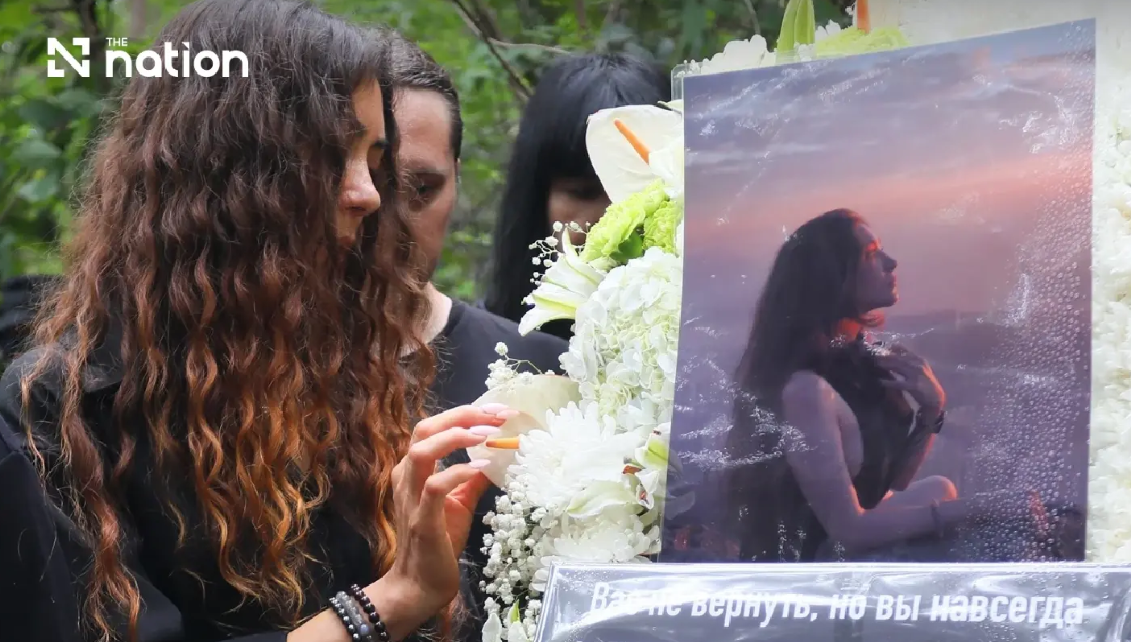
Sharina Nazimova stood at a memorial site in Huai Yai subdistrict, Bang Lamung district of Chon Buri province on Thursday, August 6, as mourners gathered to honor her two children and three members of a Thai family whose deaths have shaken communities across the region. The ceremony brought together Thai and international visitors alongside government representatives, police officers and civil servants, all paying respects to the five victims whose lives were allegedly taken by the same perpetrators. For Nazimova, the occasion represented both a solemn acknowledgment of her loss and an opportunity to publicly recognize the assistance her family has received during their darkest hours.
The Buddhist memorial service reflected the spiritual traditions that had shaped Diana and Roman's upbringing. Nazimova had raised both siblings as a single parent and had instilled Buddhist values in them, making a Buddhist rite an appropriate farewell. Chanting monks performed sacred prayers and merit-making rituals, their voices filling the memorial space as attendees observed moments of silent reflection. The religious ceremony provided a framework for collective mourning, allowing both family members and strangers who had followed the case to gather in shared remembrance.
Attendees placed white carnations, lilies and roses at the site, flowers chosen deliberately for their symbolic significance in honoring the deceased. White blooms traditionally represent purity, respect and peaceful transition across many cultures, sentiments that seemed particularly meaningful at a gathering focused on remembrance and closure. Among the floral tributes lay a personal detail that underscored the individuality of each victim: a cup of coffee placed in memory of Diana's favorite beverage. This intimate gesture, a nod to shared moments between mother and daughter, visibly moved those present and transformed the memorial from an abstract ceremony into a deeply personal farewell.
The emotional weight of the occasion became apparent as Nazimova wept during the proceedings, receiving comfort from relatives, friends and compassionate strangers. Her public expression of grief acknowledged the profound pain of losing both children under such traumatic circumstances. Rather than withdraw into private mourning, however, she used the platform to articulate gratitude toward the Thai nation itself. She thanked Thai citizens, government institutions, law enforcement officers and volunteer organizations, acknowledging that their collective response had provided her family with strength and dignity during an exceptionally difficult period. Such public appreciation, extended across cultural and national boundaries, underscored how tragedy can forge human connections that transcend typical social divisions.
The investigation that preceded this memorial service had moved with considerable urgency and coordination. Police arrested two primary suspects, Thana "Pong" Kerdthong, 43, and Thongchai "Thong" Srinil, 39, in Wang Sombun district of Sa Kaeo province on July 31 following an intensive manhunt. Investigators determined that the men had encountered Diana and Roman beside a roadway, falsely identified themselves as police officers, and forcibly detained the siblings before transporting them to a forested location. The apparent motivation was theft of the siblings' motorcycle, a seemingly mundane criminal objective that culminated in multiple fatalities.
The investigation's scope expanded significantly after the initial arrests. When the two suspects led authorities to the burial site of the Russian siblings, investigators discovered additional human remains in a nearby grave belonging to a Thai family of three. This revelation transformed what initially appeared to be a localized incident into a broader criminal investigation suggesting a pattern of violence. Police statement that the suspects provided conflicting accounts of events, with investigators indicating that their explanations had not been fully accepted and were undergoing verification against forensic evidence and other investigative materials. This methodical approach to evidence evaluation reflects procedures intended to ensure that prosecutions rest on solid evidentiary foundations rather than uncorroborated suspect testimony.
For Southeast Asian residents, this case carries multiple resonances. Thailand's tourism-dependent economy has long concerned officials about violent incidents involving international visitors, and high-profile crimes against foreign nationals typically generate intense scrutiny of local law enforcement responses. The apparent competence and relative speed of the investigation, combined with public expressions of support for the bereaved family, suggest Thai authorities prioritized both investigative rigor and community relations. The expanded discovery of the Thai family victims also highlights a darker reality: violent crimes may victimize locals at equivalent rates to foreign nationals, yet international cases often receive disproportionate media attention and investigative resources.
The memorial service itself served purposes beyond mourning. For the Thai public and government agencies, hosting a dignified ceremony for foreign victims and their families demonstrates commitment to treating all residents and visitors with equal respect. For the international community, witnessing a foreign mother's public gratitude toward her host nation during extreme grief provides reassurance that tragedy need not breed antagonism or accusations of indifference. Nazimova's remarks, emphasizing kindness and support rather than criticism or blame, contrast with scenarios where bereaved families publicly excoriate authorities or suggest inadequate protection for foreign nationals.
The case also underscores vulnerabilities that affect both locals and visitors throughout Southeast Asia. Impersonation of law enforcement to facilitate robbery and violence represents a particularly insidious criminal tactic precisely because it exploits inherent power imbalances and the trust citizens typically place in uniformed authorities. Diana and Roman's fatal encounter began with a basic trust that individuals presenting themselves as police would act within legal boundaries. This dimension suggests that beyond prosecuting these specific suspects, public awareness campaigns regarding verification procedures when encountering individuals claiming official authority might prevent similar incidents.
Looking forward, the case will continue through Thailand's judicial system, with court proceedings expected to determine guilt and impose sentences on the two accused men. Investigators face the substantial task of establishing conclusively which suspect bore direct responsibility for each victim's death, particularly given their conflicting statements. The five victims—two Russian siblings and three Thai family members—represent distinct losses that will reverberate through different communities. For the Thai public, questions about how such violence occurred within their country, despite relatively advanced law enforcement capabilities, may prompt broader discussions about crime prevention and police training. For the international community, the case serves as a sobering reminder that travel carries inherent risks, even in relatively developed jurisdictions with established tourist infrastructure.
Nazimova's presence at the Chon Buri memorial and her articulation of gratitude suggest a mother attempting to find meaning and connection within unimaginable loss. By publicly thanking the Thai nation rather than withdrawing into isolated grief, she has modeled a response to tragedy that emphasizes shared humanity over recrimination. The ceremony itself, combining Buddhist spiritual practices with international mourning traditions, created space for multiple communities to acknowledge their connection to these five lives and to their bereaved families. Whether such dignified responses can reshape how similar tragedies are experienced and processed across the region remains an open question, but this memorial suggests that compassion and mutual support offer pathways through grief that blame and accusation cannot match.

