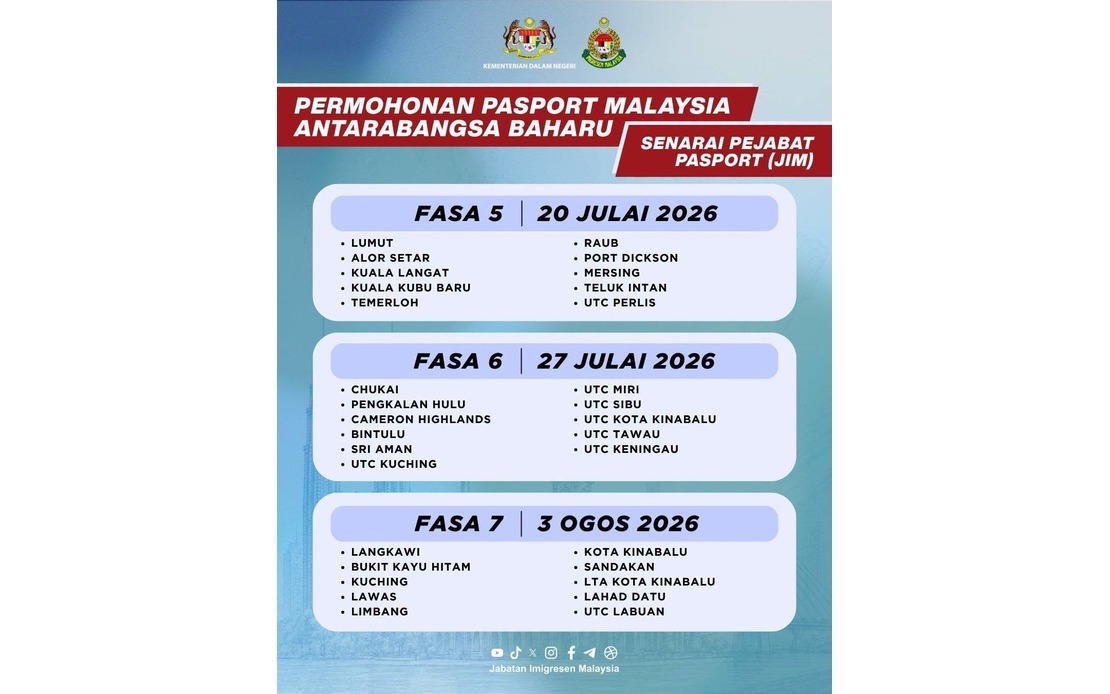
The Immigration Department has begun rolling out its newly designed Malaysian international passport across Sabah and Sarawak, marking a significant milestone in the nationwide distribution programme. The phased approach, which commenced on July 27, represents the expansion of services to Malaysia's eastern states after successful launches in other regions. This represents the next critical phase of a broader modernisation initiative that aims to equip all Malaysian citizens with travel documents incorporating state-of-the-art security technology.
Under the structured implementation plan, authorities have designated two distinct phases for the eastern Malaysian states. Phase 6, which started immediately, encompasses eight urban transformation centres: Bintulu, Sri Aman, Kuching, Miri and Sibu in Sarawak, alongside Kota Kinabalu, Tawau and Keningau in Sabah. The following phase, commencing on August 3, will extend coverage to additional facilities including Lawas and Limbang in Sarawak, Sandakan and Kota Kinabalu International Airport in Sabah, plus Lahad Datu and the Labuan Urban Transformation Centre. This carefully sequenced rollout ensures that specific offices handle the transition on their designated dates, preventing confusion and service disruptions across the region.
The new Malaysian passport represents a substantial upgrade from its predecessor, incorporating 94 distinct security features designed to combat counterfeiting and fraud. Prime Minister Datuk Seri Anwar Ibrahim officially launched the enhanced document on June 30, signalling the government's commitment to modernising its identity and travel document infrastructure. Since July 1, Malaysian citizens aged 18 and above have had the option to apply for the new passport, whether seeking an initial document or renewing an expiring one. The flexibility in validity periods—offering either five or ten-year options—allows applicants to select durations aligned with their travel patterns and requirements.
The nationwide implementation follows a carefully calibrated strategy that prioritised high-volume processing centres initially. The programme commenced at 14 strategic passport-issuing offices handling the greatest application volumes, establishing operational protocols and staff training before expanding the service network. Subsequent expansion extended availability to 71 offices nationwide, with the complete transition anticipated to conclude by early August. This methodical approach has allowed immigration authorities to identify and resolve technical issues, streamline procedures, and ensure consistent service quality across all locations before the full-scale implementation concludes.
For citizens planning to apply for or renew their passports, the Immigration Department has emphasised the importance of checking which offices are participating in their respective phases. This verification step prevents wasted journeys and allows applicants to schedule their visits strategically. The department has specifically cautioned against unnecessary urgency, noting that existing passport documents remain valid for use up to six months before their expiry dates. This reassurance is particularly relevant for citizens whose current passports retain sufficient validity, eliminating any pressure to apply immediately and allowing the department to manage demand systematically across all offices.
The introduction of the new passport carries particular significance for East Malaysian residents, who have historically experienced longer processing times and fewer service locations compared to Peninsular Malaysia. The expansion into Sabah and Sarawak addresses longstanding service delivery challenges and demonstrates commitment to equitable access to government services across all Malaysian territories. For the region's substantial international business community, academics, and frequent travellers, the enhanced security features provide reassurance regarding document authenticity and acceptance at immigration checkpoints worldwide.
From an administrative perspective, the phased rollout reflects lessons learned from earlier implementation phases. Immigration authorities have accumulated operational insights regarding staffing requirements, processing times, equipment needs, and customer flow management. These insights have informed the current expansion strategy, with the expectation that services will function smoothly across Sabah and Sarawak by early August. The completion of nationwide rollout will mark the transition from a supplementary dual-system—where citizens could obtain either old or new passports—to a unified, modern immigration document system.
The timing of the Sabah and Sarawak rollout is strategically significant given the region's economic importance and international connectivity. Both states serve as major gateways for regional trade, tourism, and cross-border movement. Enhanced passport security features carry particular relevance in this context, as sophisticated travel documents strengthen Malaysia's standing in international travel and trade frameworks. The improved documents also reduce friction at border crossings and airport immigration counters, supporting economic activity and leisure travel.
Citizens planning applications should note that the new passport provides extended validity options compared to previous practice, offering potential cost savings over longer periods. The ten-year validity option, in particular, appeals to frequent travellers and those with stable domestic circumstances who prefer minimising future application requirements. The Immigration Department's measured approach to implementation, combined with clear communication about participating offices and timelines, positions the programme for successful completion. By maintaining existing passport validity for extended periods, authorities have created a transition window that accommodates diverse citizen circumstances while ensuring steady migration toward the modernised document system.

