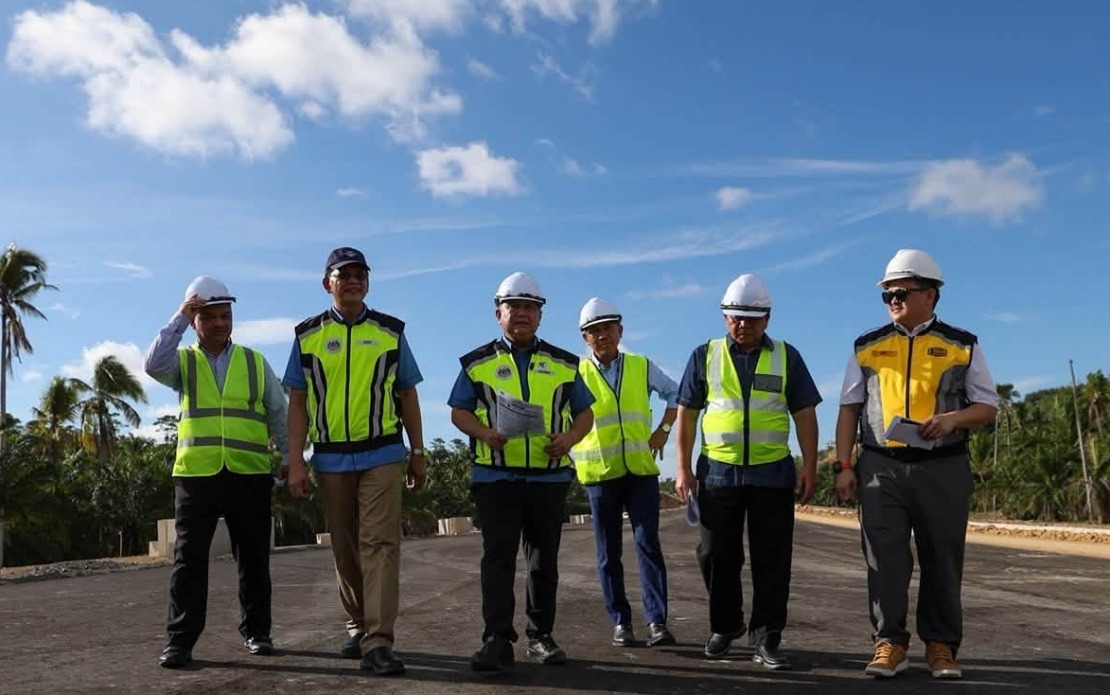
The contractor overseeing the Sabah section of the Pan Borneo Highway has formally submitted a recovery plan to mitigate construction delays that have already accumulated to 32 days. Works Minister Datuk Seri Alexander Nanta Linggi disclosed the submission in Kota Kinabalu, signalling intensified efforts to bring the RM167.48 million project back on schedule and deliver the 7.3-kilometre alignment between Rampayan Laut and Sarang by the contractual completion deadline of September 29, 2026.
As of late June, the work package had achieved 61.76 per cent physical progress, yet remained trailing the original schedule by 4.35 percentage points. This gap underscores the scale of remedial action required to meet government commitments. The recovery plan represents a collaborative response involving the Works Ministry, Sabah's Public Works Department, the project consultant, and the contractor—all committed to whittling down the accumulated shortfall to a more manageable 14 days by August 2026, according to Nanta's statement.
Underlying the delays are systemic coordination challenges that have bedevilled major infrastructure projects across the region. The relocation of utility services—essential before road construction can proceed—has proven particularly protracted. Three key utility providers have been cited: Sabah Electricity Sdn Bhd supplying power infrastructure, the Sabah State Water Department managing water distribution networks, and Celcom Timur Sabah Sdn Bhd overseeing telecommunications assets. When multiple service providers operate in the same geographical area without seamless synchronisation, the cumulative effect can derail project timelines significantly. In addition to utility complications, land acquisition procedures have posed separate obstacles, a recurring bottleneck in Malaysian infrastructure development where legal and administrative processes can extend timelines unpredictably.
The minister's emphasis on improving stakeholder coordination reflects broader lessons from pan-Borneo highway implementation. The project represents one of Malaysia's largest regional infrastructure undertakings, connecting Sabah and Sarawak through an extensive network designed to unlock economic potential in previously underserved districts. When delays occur at individual work packages, they reverberate across the entire programme's schedule and budget architecture. Nanta's call for integrated, proactive problem-solving signals recognition that piecemeal responses prove insufficient when infrastructure dependencies are this intricate.
Beyond the technical and logistical dimensions, the alignment carries substantial strategic importance for Sabah's economic geography. By shortening travel distances to Simpang Mengayau or Kudat by up to 30 kilometres, the completed route will fundamentally reshape accessibility to the state's northern regions. Conventional travel times will compress by 30 to 60 minutes, a meaningful reduction that transforms economic viability calculations for businesses and investors considering operations in these areas. The faster connectivity will directly enhance accessibility to what officials term the Tourism Belt and the Northern Sabah Coastal Tourism Master Plan—development corridors that have remained constrained by infrastructure limitations.
The employment and investment implications are substantial for Sabah's communities. Improved road infrastructure typically catalyses downstream economic activity by reducing transport costs, expanding market reach for local producers, and attracting investment in tourism and resource-based industries. For a state where geographic isolation has historically limited commercial opportunity, the Pan Borneo Highway represents transformational infrastructure that can narrow the development gap with more accessible Malaysian regions. The local community stands to benefit through direct employment during construction, ongoing maintenance opportunities, and longer-term prosperity from enhanced business activity.
Nanta's framing of quality and integrity standards alongside scheduling objectives reflects a maturing approach to infrastructure governance in Malaysia. Rather than prioritising speed alone, the minister stressed that project delivery must meet rigorous quality benchmarks and safety requirements. This perspective acknowledges that infrastructure delivered to poor standards creates long-term maintenance burdens and safety hazards that ultimately cost economies more than delays in initial completion. For Malaysian readers accustomed to infrastructure projects that sometimes sacrifice quality for speed, this messaging represents an important commitment to sustainable asset creation.
The recovery plan's success will depend critically on whether the three utility companies and land acquisition authorities can genuinely accelerate their contributions. Past experience suggests that institutional coordination between government bodies, private utility operators, and project management structures often falters because no single entity has override authority. The Works Ministry's positioning as coordinator indicates it will assume a more active facilitation role, though real acceleration requires genuine buy-in from SESB, JANS, and CTSB, each of which operates under different regulatory and commercial constraints.
Regionally, this project carries implications for pan-Borneo connectivity and Malaysia's broader infrastructure ambitions. Sabah and Sarawak have historically operated as somewhat peripheral to peninsular Malaysia's economic core, despite possessing significant natural resources and tourism potential. The Pan Borneo Highway represents a deliberate effort to integrate these states more tightly into national economic networks. When individual work packages encounter delays, they implicitly delay the realisation of these broader strategic objectives, making contractor accountability and stakeholder coordination increasingly vital to national development timelines.
For Malaysian investors and businesses eyeing opportunities in Sabah's northern corridor, the September 2026 target date matters significantly for investment decision-making. Infrastructure completion timelines directly influence when new ventures become commercially viable. The 32-day delay already incurred represents a five-week compression of the window before project completion, creating urgency for all parties to demonstrate genuine commitment to the recovery plan. If additional slippage occurs, confidence in project delivery will erode, potentially affecting investor appetite for downstream opportunities that depend on the completed highway.
Looking forward, the Works Ministry faces a challenging balance between maintaining realistic completion expectations and ensuring that quality standards do not become sacrificial offerings on the altar of speed. The recovery plan submission itself is positive—it demonstrates active problem-solving rather than passive acceptance of delays. Execution, however, remains the definitive test. Over the coming 14 months until the August 2026 checkpoint when delays should theoretically reduce to 14 days, stakeholder coordination and utility provider responsiveness will determine whether this infrastructure project joins Malaysia's pantheon of successfully delivered megaprojects or becomes another cautionary tale of ambition outpacing institutional capacity.

