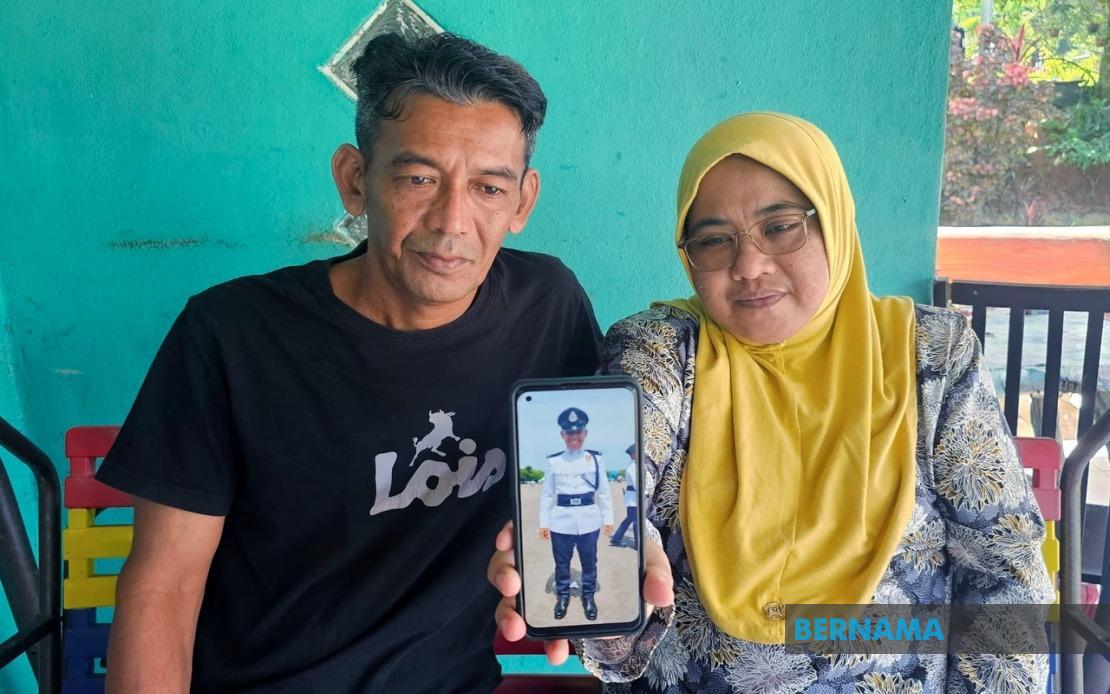
A family's joy at preparing for their son's return home has turned to devastating loss following the death of Constable Muhammad Raimi Ismarubee, 26, in a workplace electrocution incident at the Weston Police Station in Beaufort, Sabah. The tragedy unfolded on August 6, when the young policeman and two colleagues were handling a metal pole used for coconut harvesting outside the station near Sekolah Kebangsaan Weston. His parents, Ismarubee Ismail, 51, and Nor Azila Zakaria, 46, who reside in Felda Kerteh 2, Dungun, Terengganu, learnt of their son's death through a phone call from a colleague mere hours after receiving a routine message from him about his work.
The timing of the tragedy compounds the family's anguish. Muhammad Raimi had been planning to take leave and return home this month to spend time with his family, though he had been waiting for more affordable flight options before committing to specific dates. His last visit to his native Terengganu was in January, nearly eight months before his death. In a message sent to his father at 2 pm on the day of the incident, Muhammad Raimi had shared news of a successful drug arrest operation, his work seeming routine and ordinary. By 6 pm, the young officer was dead, leaving his parents grappling with the sudden and tragic reversal of fortune.
Muhammad Raimi had only recently begun his police career, having joined the force at the Weston Police Station in September 2024, less than a year before his death. As the second of three children in his family, he had emerged as a significant financial contributor to his household, sending money to his parents and siblings almost every month. His siblings regarded him as a source of crucial support, particularly for their educational needs. The young constable had purchased a laptop for his siblings' studies and consistently ensured they had the resources necessary to succeed academically, demonstrating a sense of responsibility beyond his years.
His mother revealed that Muhammad Raimi had harbored ambitious personal plans for the coming years. He had expressed his intention to become engaged to a woman from Sabah in 2025, yet he had chosen to delay marriage proceedings until his youngest sibling completed the Sijil Pelajaran Malaysia examination. This decision reflected his priorities: he wanted to ensure his family remained a focal point before transitioning into married life. His parents remembered him as an exemplary son who balanced his professional obligations with his family commitments, sending regular updates and maintaining close ties despite the geographical distance separating Sabah and Terengganu.
The incident at Weston Police Station claimed three lives in total, underscoring the gravity of the workplace safety failure. Alongside Muhammad Raimi, Corporal Chiu Teck Siong, 40, and Lance Corporal Mohamad Nur Hafiz Ibrahim, 29, also died in the electrocution. The three officers were engaged in what would normally be considered routine station maintenance, handling a metal pole used for harvesting coconuts on the station grounds near a school. The incident raises critical questions about workplace safety protocols and risk assessments at police installations, particularly regarding the handling of conductive materials in potentially hazardous environments.
For the family, the practical arrangements following his death proceeded swiftly. The police department made arrangements to transport Muhammad Raimi's remains to his family home in Felda Kerteh 2, where he was laid to rest at the Felda Kerteh 2 Muslim Cemetery on August 7, the same day his parents spoke to media about their loss. The funeral took place less than 24 hours after they learned of his death, leaving little time for the shock to settle or the reality to fully absorb.
The incident reflects broader concerns within Malaysia's law enforcement community about occupational hazards facing uniformed personnel. Police officers face diverse workplace risks ranging from the obvious dangers of criminal encounters to less visible hazards such as electrocution, particularly in environments where electrical infrastructure and maintenance equipment interact. The death of three officers in a single incident at a remote station in Sabah suggests that safety standards may not be uniformly applied or adequately enforced across different police facilities.
For readers in Malaysia and Southeast Asia, this tragedy serves as a reminder of the hidden costs borne by families whose members choose careers in public service. Muhammad Raimi's parents, like many in similar circumstances, had invested emotional energy in anticipating their son's homecoming, only to have those hopes extinguished in an instant. His siblings have lost not only a brother but a financial supporter and role model. The young woman he had planned to marry in Sabah has lost her intended, and his colleagues have lost comrades.
The incident also highlights the experiences of Malaysian workers, particularly young professionals, stationed far from their families. Many Malaysians work in distant locations for economic necessity or career advancement, maintaining long-distance relationships with their families and visiting periodically during leave. The frequency of such arrangements makes incidents like this one uncomfortably relevant to many Malaysian households, where separation is a normal feature of working life but the permanent separation caused by workplace accidents remains an ever-present, if typically unspoken, risk.

