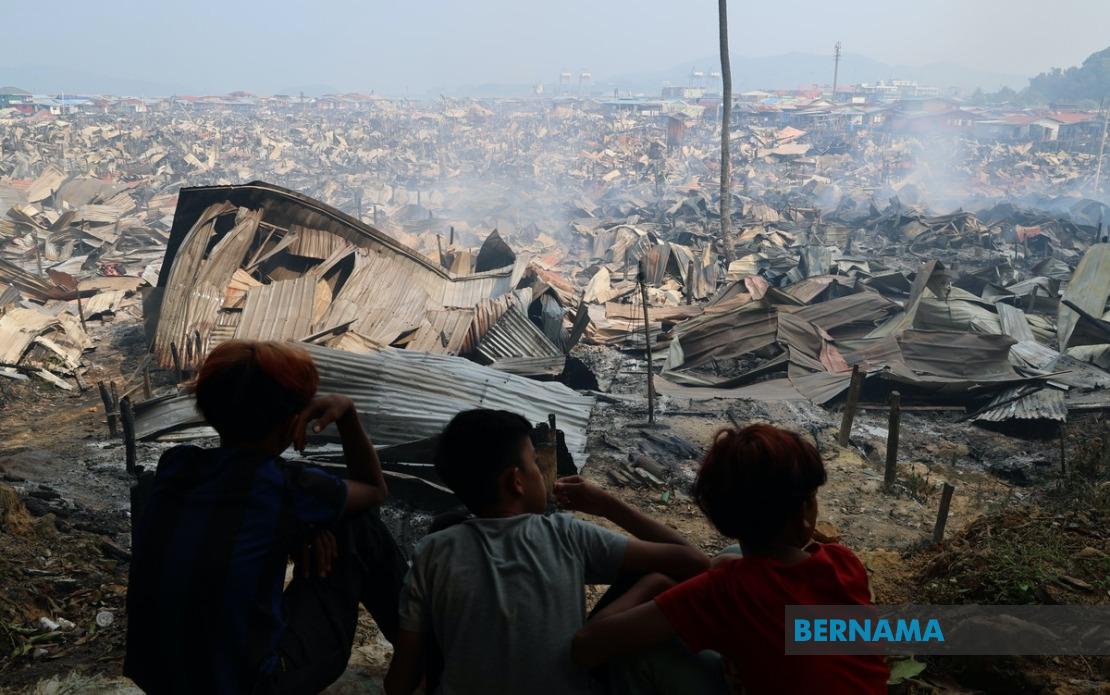
The Sabah government has committed to providing RM3,000 in financial assistance to every affected household head in the aftermath of a catastrophic fire that ravaged Kampung Lok Buta in Numbak, Kota Kinabalu. The blaze, which ignited shortly after 1.40 am on August 30, consumed more than 200 residences in the densely populated settlement, displacing hundreds of families overnight and claiming the lives of three young children. Chief Minister Datuk Seri Hajiji Noor made the announcement during a visit to displaced residents sheltering at the Likas Multipurpose Hall temporary relief centre, underscoring the state administration's commitment to rapid humanitarian response.
The RM3,000 relief package represents a collaborative funding mechanism, with each thousand-ringgit contribution coming from separate sources. The state government will provide RM1,000, matched by an equivalent allocation from the federal government, while Yayasan Kebajikan Sabah—the Sabah Welfare Foundation—contributes the remaining RM1,000. This tri-partite approach demonstrates coordination between state and federal authorities in mobilising emergency resources, a significant factor given the scale of the disaster and the immediate needs of affected families who have lost virtually all their possessions. Hajiji emphasised that the assistance was intended to provide immediate relief as families navigate the trauma and material losses from the fire.
Beyond the immediate cash transfer, the state government intends to facilitate a comprehensive rebuilding programme in partnership with Majlis Amanah Rakyat (MARA), a federal agency traditionally focused on indigenous business development but increasingly involved in community rehabilitation efforts. The Chief Minister indicated that decisions regarding reconstruction would be made deliberately rather than hastily, with authorities evaluating whether residents should return to the original Kampung Lok Buta site or be relocated to alternative locations deemed more suitable. This measured approach suggests officials are considering factors such as fire safety infrastructure, building standards, and urban planning principles that may have been inadequate in the original settlement.
In a humanitarian gesture extending beyond Malaysian citizens, the state government will also provide RM1,000 to non-Malaysian heads of household affected by the fire. This inclusion reflects recognition that informal settlements in Malaysian cities often house migrant workers and their families, who represent vulnerable populations with limited access to government safety nets. By extending assistance regardless of citizenship status, Sabah authorities have signalled commitment to comprehensive disaster relief grounded in humanitarian rather than purely bureaucratic principles, though the differentiation in quantum—RM3,000 versus RM1,000—still distinguishes between citizens and non-citizens.
The distribution of immediate necessities forms another pillar of the relief strategy. Beyond cash transfers, the government will furnish affected families with essential food supplies and household items to meet urgent daily needs during the transition period. This practical support acknowledges that newly displaced families face immediate challenges procuring basic goods while processing their losses and accessing the monetary assistance, which itself may require time for disbursement through government channels. The combination of cash, goods, and reconstruction planning attempts to address both immediate survival needs and medium-term recovery requirements.
The tragedy claimed three young lives, each death adding profound human dimension to the material devastation. Nana Abdullah, four years old, and her six-year-old brother Mohd Asrul perished alongside their eight-year-old cousin Nurfarahdilah Mohd Tajihah. These fatalities highlight the particular vulnerability of children in informal settlements where fire safety measures—smoke alarms, accessible exits, emergency services access—may be compromised by crowded conditions and substandard construction practices. The loss of life elevates this incident beyond a property disaster to a public safety crisis demanding examination of why such fire hazards persist in established residential areas within the state capital.
Kampung Lok Buta's transformation into a disaster zone raises broader questions about informal housing and fire preparedness across Malaysian urban settlements. Like many established villages within expanding cities, the community likely grew organically with limited formal planning, creating conditions where closely packed wooden structures and narrow pathways facilitate rapid fire spread while hindering emergency vehicle access. Kota Kinabalu, as Sabah's commercial and administrative hub, contains numerous similar settlements where informal expansion has outpaced infrastructure development. This particular fire provides impetus for local authorities to conduct systematic fire risk assessments across comparable neighbourhoods and implement preventive measures before tragedy strikes elsewhere.
The state government's reconstruction commitment involves complex logistical and planning challenges. Determining appropriate locations for relocated housing requires balancing residents' desire to remain in established communities with planners' insistence on safer, more orderly development. MARA's involvement suggests the programme may incorporate economic development components beyond mere shelter provision, potentially offering microfinance, vocational training, or small business support to help residents rebuild livelihoods alongside homes. However, the timeline for such reconstruction remains unclear, leaving families uncertain about when permanent housing will materialise and whether they will return to their original neighbourhood.
For Malaysia's broader disaster management framework, the Kampung Lok Buta fire underscores vulnerabilities in fire prevention and emergency response within informal urban settlements. The speed of destruction—more than 200 homes consumed in a single incident—demonstrates how rapidly fire spreads through densely packed, poorly constructed areas. This incident may catalyse policy discussions about mandatory fire safety standards for informal housing, improved emergency services positioning and response times in vulnerable areas, and community-based fire prevention programmes. Other Malaysian states facing similar informal settlement patterns should anticipate comparable risks and proactively strengthen fire preparedness.
The financial assistance announced by Hajiji, while substantial for individual households, represents merely one component of genuine recovery and system improvement. The true measure of government response will emerge in coming months as reconstruction plans develop, residents receive disbursed funds, and implementation of long-term safety measures proceeds. Whether this tragedy catalyses meaningful change to prevent similar disasters, or simply generates temporary relief before patterns reassert themselves, depends on sustained commitment to addressing underlying causes of vulnerability rather than merely treating symptomatic relief.

