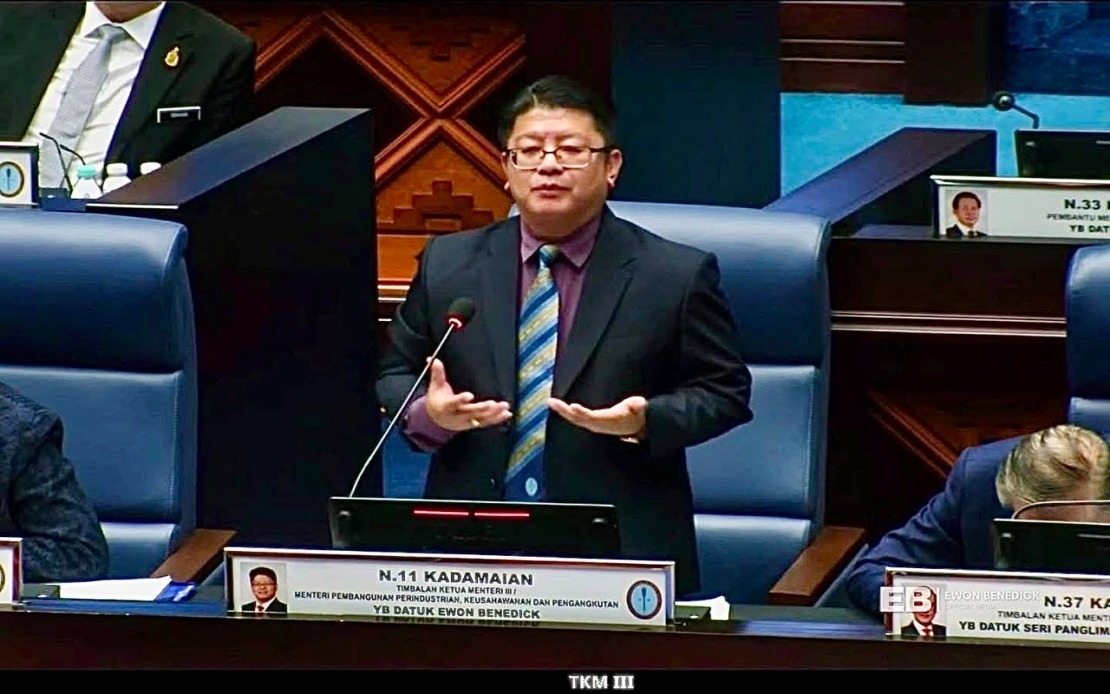
The Sabah state government has moved decisively to resolve congestion at Sepanggar Port by introducing a revised fee structure designed to discourage container owners from using port facilities as long-term storage depots. Deputy Chief Minister III Datuk Ewon Benedick disclosed to the Sabah State Legislative Assembly on July 23 that this policy intervention has already yielded tangible results, with 103 containers that had languished at the facility for extended periods now cleared away.
The scale of the accumulation problem had been considerable before action was taken. Some containers had remained stationary for more than 407 days, while the vast majority of problematic units had exceeded the 21-day threshold considered excessive for a working port environment. This represents a significant operational drain on a facility intended for efficient cargo throughput rather than serving as a de facto warehouse for low-incentive storage. The sheer duration of some abandonments underscores how thoroughly the previous pricing regime had failed to discourage such practices.
According to Ewon, who holds the transport portfolio within the Ministry of Industrial Development, Entrepreneurship and Transport, the root cause lay in pricing structures that had simply become too permissive. The original fee schedules failed to reflect the genuine opportunity cost of allocating valuable port real estate to stationary containers. Owners found it more economical to leave containers languishing at Sepanggar than to pay market rates at dedicated external storage facilities, creating a perverse incentive that starved the port of operational space. This disconnect between port charges and competitive storage alternatives had persisted until the recent intervention.
The new framework combines financial deterrence with regulatory backstop. The government has coupled the revised fee schedule with an explicit 21-day threshold, after which containers become subject to disposal proceedings conducted according to established port regulations. This dual mechanism proved immediately effective: once port authorities publicly signalled their willingness to enforce container removal, proprietors swiftly reclaimed their units rather than face forfeiture. The speed of response suggests the pricing threshold itself now functions as a credible enforcement signal.
The operational benefit extends beyond mere decluttering. Space previously occupied by these stagnant containers now becomes available for legitimate cargo handling and throughput, restoring Sepanggar's productive capacity. For a port facility serving Sabah's trade and industrial base, this reallocation of terminal space to active commerce carries genuine economic weight. Container yards are inherently space-constrained assets; recovering utilisation efficiency translates directly into expanded capacity for legitimate port operations without requiring infrastructure investment.
However, the initiative has sparked pushback from port users who contend the new charges impose undue burdens. Recognising this tension, Ewon indicated his ministry remains receptive to recalibrating the fee structure through negotiated dialogue. The government has established a formal task force that incorporates representatives from port user associations, shipowners' organisations, and shipping industry bodies, creating a structured forum for monthly consultations. This institutionalised engagement mechanism signals commitment to finding equilibrium between operational discipline and commercial accessibility.
Beyond the immediate container crisis, the July 23 legislative session also progressed constitutional machinery governing port operations. The Sabah State Legislative Assembly approved the Sabah Ports (Privatisation) (Amendment) Bill 2026 by majority voice vote. The amendment responds to recent administrative reorganisation within the Sabah government: port affairs have been transferred from the Ministry of Works and Utilities to the Ministry of Industrial Development, Entrepreneurship and Transport, necessitating corresponding updates to the legal framework. Additionally, the revision harmonises terminology across related statutes, particularly aligning definitions of 'Minister' between the Sabah Ports (Privatisation) Enactment 1998 and the Sabah Ports Authority Enactment 1981.
The legislative agenda extended beyond port management. The assembly also passed the Sabah Native Affairs Council (Amendment) Bill 2026 and the District Chief, Native Chief and Headman Bill 2026, tabled by Sabah Local Government and Housing Minister Datuk Dr Mohd Arifin Mohd Arif. These measures reflect broader governance consolidation across multiple sectors. The Native Affairs Council amendment expands the body's advisory remit to encompass customary education and indigenous legal traditions, institutionalising mechanisms for heritage preservation. The statute creates a dedicated Native Affairs Officer position recruited from the state civil service, responsible for receiving and managing complaints involving customary law offences within the Native Courts system.
The District Chief, Native Chief and Headman Bill 2026 establishes comprehensive statutory provisions governing the appointment, tenure, responsibilities and accountability structures for these traditional leadership positions. Appointments flow through the District Officer to the responsible minister, with explicit grounds for dismissal including incapacity, bankruptcy, criminal or customary convictions, misconduct, or loss of residency within the designated area. This legalisation of appointment and removal procedures brings traditional governance structures into alignment with contemporary administrative standards, clarifying hierarchies and eliminating ambiguities about institutional authority.
For Malaysian observers, these legislative manoeuvres in the Sabah State Legislative Assembly exemplify how state governments deploy administrative tools to address logistical friction points within their economies. The container congestion problem at Sepanggar reflects widespread challenges facing port facilities across Malaysia and Southeast Asia, where sub-optimal pricing incentives have historically encouraged extended dwell times and inefficient space utilisation. Sabah's approach—combining financial pressure with regulatory clarity—offers a replicable model for other regional ports facing similar accumulation challenges.
The broader governance amendments demonstrate how Malaysian states continuously refine their institutional architecture as political portfolios shift and administrative efficiencies require harmonisation across related enactments. The transfer of port jurisdiction, the expansion of native affairs oversight, and the codification of traditional leadership structures collectively illustrate the ongoing recalibration of state governance frameworks. These moves, while technical in appearance, carry practical implications for administrative clarity and institutional accountability.
Looking forward, the success of Sabah's container initiative will likely depend on sustaining the political will to enforce the 21-day threshold and maintaining disciplined fee structures. The negotiated engagement with port user associations offers opportunity to find sustainable equilibrium rather than imposing solutions that generate enduring resentment. If Sabah can achieve this balance—maintaining operational efficiency while accommodating legitimate commercial concerns—the port model could enhance the state's competitive position as a regional logistics hub and contribute measurably to trade facilitation across East Malaysia.

