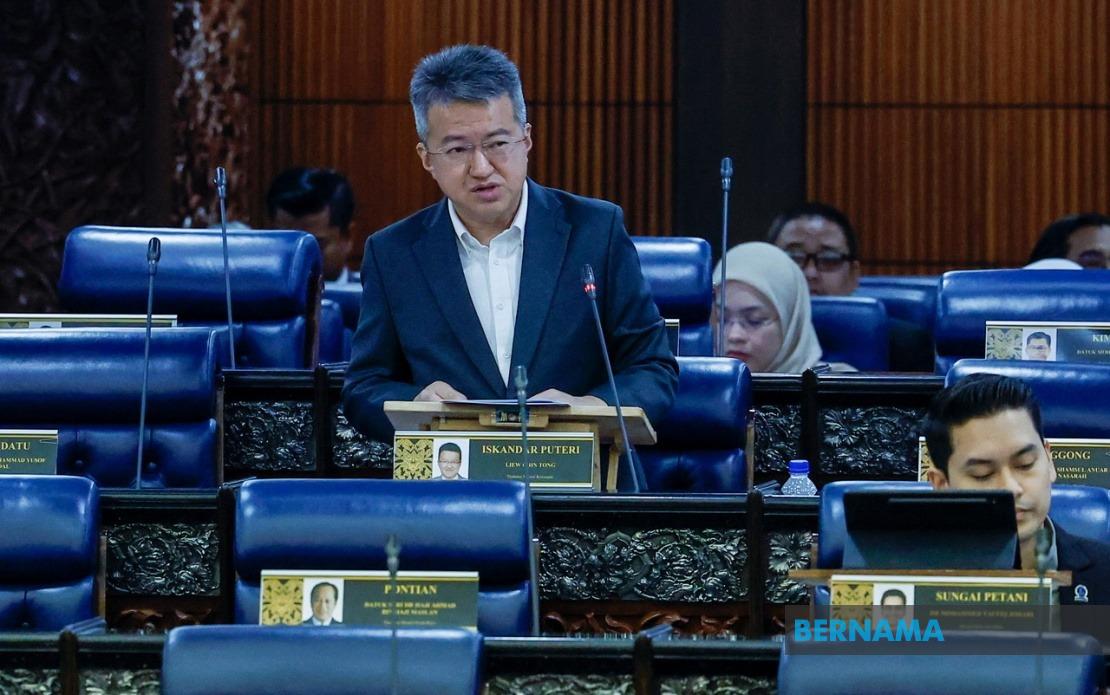
The federal government has moved to dispel concerns that Sabah's interim special grant boost will come at the expense of the state's broader development budget. Deputy Finance Minister Liew Chin Tong provided the clarification during parliamentary proceedings on July 14, emphasizing that the RM1.5 billion increase announced by Prime Minister Datuk Seri Anwar Ibrahim in May represents an addition to, rather than a reallocation within, Sabah's existing allocations. The assurance addresses longstanding sensitivities around federal resource distribution to the East Malaysian state, where development parity with Peninsular Malaysia remains a politically charged issue.
Liew's statement responds directly to concerns raised by WARISAN-Kota Belud MP Isnaraissah Munirah Majilis regarding the mechanics and constitutional underpinnings of the special grant arrangement. The deputy minister clarified that Sabah's development allocation has actually strengthened under this year's budget, climbing from RM6.7 billion to RM6.9 billion. This nominal increase, though modest in percentage terms, reflects the federal government's stated commitment to sustaining infrastructure investment in Sabah whilst simultaneously honouring the additional special grant commitment. The distinction matters significantly for state administrators planning capital expenditure, as it signals continued access to dedicated development channels rather than a consolidation of funding streams.
The portfolio of projects underpinned by this allocation reflects Sabah's pressing infrastructure needs. Major initiatives include continuation of the Pan Borneo Highway, a marquee development project linking the East Malaysian states, alongside investments in rural connectivity through road networks. Rural electrification and water supply programmes remain priorities, addressing service gaps that persistently disadvantage communities beyond urban centres. Meanwhile, investments in health infrastructure through hospital construction and clinic upgrades, coupled with educational facility refurbishment and police station development, indicate a multi-sector approach to closing the development gap that has historically characterized Sabah relative to more developed Malaysian states.
Among the tangible financial commitments detailed by Liew, electricity subsidies emerge as a particularly substantial ongoing obligation. Despite transferring regulatory authority over electricity supply to Sabah's state government in 2024, the federal administration continues underwriting operational costs. The projected subsidy allocation for 2026 stands at RM880 million, representing a significant recurring expenditure commitment that shields consumers from market-rate pricing. This arrangement underscores the complex interplay between devolution of regulatory responsibility and maintenance of fiscal support, a tension increasingly evident across Southeast Asian federations grappling with power sector economics.
Water infrastructure funding has similarly expanded in real terms. The allocation for rural water supply programmes more than doubled proportionally, increasing from RM103.5 million in 2025 to RM143 million in the current year. This reorientation reflects recognition of water security as fundamental to rural quality of life and agricultural productivity. For Malaysian policymakers observing climate variability and population pressures across the region, such targeted investment signals strategic intent to preempt service deficits before they crystallize into broader development challenges. Sabah's geographic characteristics—including its substantial rural hinterland and dispersed settlement patterns—make reliable water infrastructure particularly critical to inclusive development outcomes.
Liew also highlighted the continuing role of federal cash assistance programmes in supporting Sabah's lower-income households. The Sumbangan Tunai Rahmah (STR) and Sumbangan Asas Rahmah (SARA) cost-of-living support schemes are estimated to deliver approximately RM1.2 billion to Sabah beneficiaries. These direct transfer mechanisms complement investment in productive infrastructure, addressing immediate household budget pressures whilst longer-term capital projects generate employment and economic dynamism. The scale of these transfers indicates recognition that infrastructure development and social safety nets operate on complementary timelines, with vulnerable populations requiring immediate support even as transformative projects mature.
The constitutional framework governing these arrangements has become increasingly complex, with Liew acknowledging the federal government's appeal against aspects of the Kota Kinabalu High Court's ruling on special grant provisions. The dispute centres on interpretation of Articles 112C and 112D of the Federal Constitution, which delineate the federal government's obligations to Sabah and the procedural requirements for determining grant amounts. Despite the ongoing legal contest, Liew emphasized federal commitment to honouring the constitutional principle underlying special grants, even whilst challenging specific judicial interpretations. This nuanced posture suggests recognition that Sabah's position within Malaysia's federation rests on negotiated arrangements that demand scrupulous federal respect, regardless of disagreements over particular implementations.
The payment procedures for the new special grant follow established protocols refined through previous disbursements in 2022, 2023, and 2025. Adherence to these procedural frameworks—requiring coordination between federal and state authorities—ensures transparency and creates institutional memory around grant management. For Sabah's state government, such predictability facilitates fiscal planning even amid constitutional uncertainties. The federal-state partnership in administering these mechanisms reflects an evolving maturity in Malaysia's federalism, where institutional practice sometimes advances ahead of formal legal clarity.
Looking ahead, Liew signalled the federal government's commitment to negotiating a more durable mechanism for determining special grant quantum in future years. Rather than treating each allocation cycle as a discrete political decision, establishing a formulaic approach tied to objective criteria could reduce uncertainty and insulate the arrangement from electoral cycles. Such an evolution would align with international best practice in fiscal federalism, where predictable revenue-sharing mechanisms enable subnational governments to engage in medium-term planning. For Sabah, currently positioned as a swing state within Malaysia's competitive electoral landscape, such institutionalization could paradoxically strengthen its negotiating position by reducing the appearance that grants flow from partisan calculation rather than constitutional obligation.
The broader context of these assurances involves Sabah's historical role within Malaysia's federation and the political economy of East Malaysian integration. Since joining the federation in 1963 alongside Sarawak, Sabah has maintained a distinct bargaining position anchored in constitutional provisions recognizing its particular circumstances. The special grant mechanism represents one manifestation of this accommodation, alongside provisions governing taxation, immigration, and religious authority. As Southeast Asia observes intensifying fiscal pressures and competing demands for development spending across the region, Malaysia's approach to managing centre-state fiscal transfers offers instructive lessons regarding the sustainability of federal arrangements when developmental imbalances persist.
For Malaysia's broader development trajectory, the commitment to ring-fence Sabah's development allocations whilst introducing the special grant increment signals recognition that regional inequality remains an unfinished policy challenge. Investors monitoring Malaysia's institutional stability and demographic dynamism increasingly focus on whether the federation successfully maintains cohesion through inclusive development and perceived fairness in resource distribution. Sabah's development progress—or lack thereof—thus carries implications extending beyond the state itself to assessments of Malaysia's capacity to sustain its federal compact and deliver equitable growth across its constituent territories.

