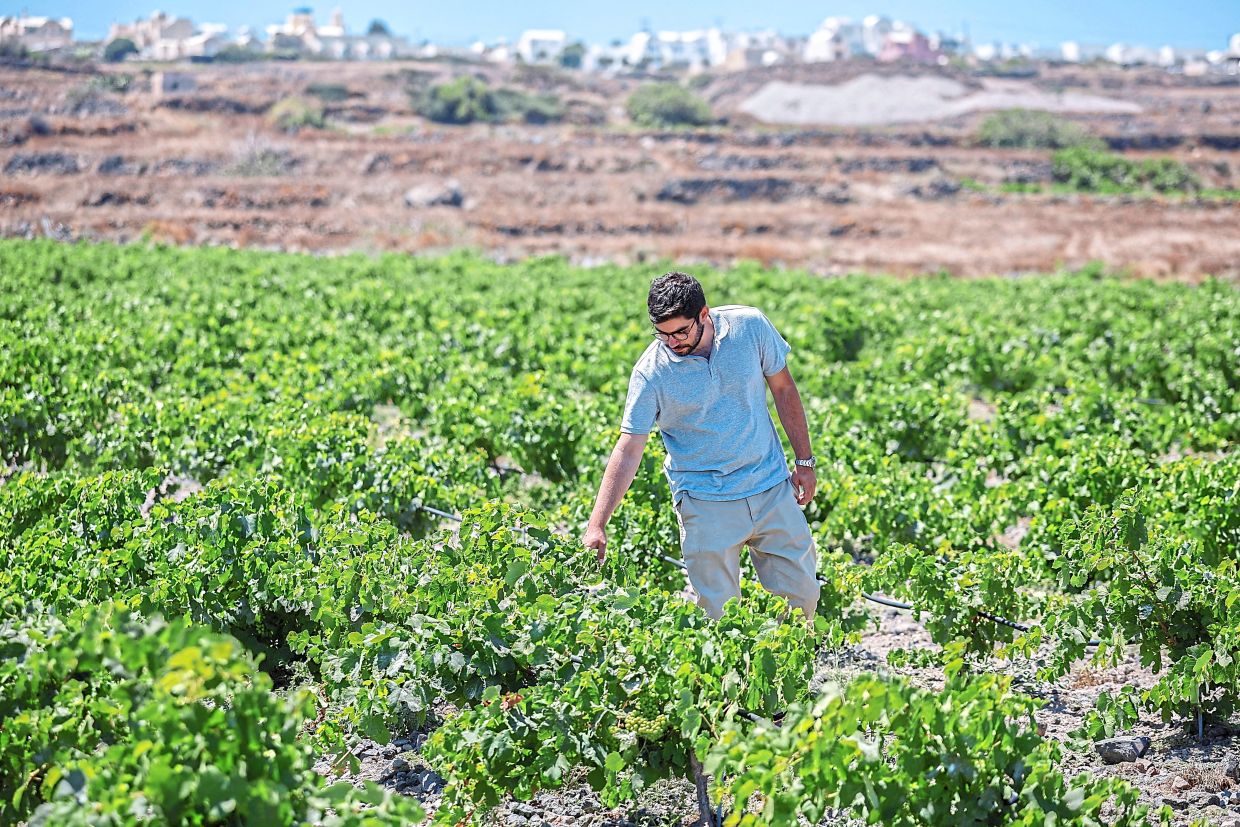
The ancient vineyard terraces of Santorini, which have produced distinctive volcanic wines for centuries, face an unprecedented crisis as climate change reshapes the Mediterranean landscape. Among the terraced slopes, one particular vine—trained into a protective basket shape and nurtured for 90 years—has finally succumbed to relentless heat and drought, its demise emblematic of a broader threat to an industry that defines the island's cultural and economic identity. This dying plant is far more than an agricultural loss; it represents the breaking point of traditional viticultural methods that once thrived in the harsh but stable conditions of the Greek islands.
Since 2023, Santorini has experienced a confluence of climate stressors that have fundamentally altered the island's agricultural calculus. The combination of severely reduced rainfall and record-breaking summer temperatures—the highest in six decades according to Aristotle University viticulture professor Stefanos Koundouras—has compressed grape production, driven prices upward, and created acute competition for dwindling freshwater resources. What was once a manageable seasonal challenge has become a structural problem that threatens the viability of family vineyards that have operated for generations. The transformation is particularly acute on Santorini because the island's geography, isolation, and dependent tourism economy leave little margin for adaptation or resilience.
Yiannis Boutaris, a sixth-generation winemaker whose Domaine Sigalas winery operates under the Kir-Yianni family umbrella, has emerged as one of the industry's most innovative responders to this crisis. Rather than retreat, Boutaris is pioneering a suite of adaptations that blend cutting-edge hydrology with respect for tradition. His most ambitious initiative involves a pilot project with local authorities and scientific institutions to recycle wastewater from residential and hospitality sectors—a practice already established in California's wine regions—to irrigate vineyard blocks. This approach addresses two interconnected problems simultaneously: it reduces demand pressure on increasingly scarce freshwater supplies while providing a predictable, year-round irrigation source that can support production during the growing season.
Beyond wastewater recycling, Boutaris is experimenting with atmospheric water harvesting, a technique that captures ambient moisture through hydrogels and extracts it as usable water by harnessing heat from solar panels. This method represents the frontier of climate-resilient agriculture, converting environmental liability into productive resource. Simultaneously, he is testing geometric reorganisation of his vineyards, shifting from the scattered traditional planting pattern to regimented rows that enable more efficient irrigation application and reduce labour intensity during increasingly hot conditions. These experiments reflect a philosophical stance that preserves winemaking tradition while acknowledging that the biophysical parameters within which that tradition evolved have fundamentally shifted.
Yiannis Papaeconomou, managing younger vines now in their sixth year of growth, is pursuing complementary strategies within the same adaptive framework. His subsurface irrigation system delivers water beneath the soil surface rather than overhead, minimising evaporative loss during peak heat periods. He is also employing modified trellising systems that optimise water distribution efficiency and reduce the stress load on individual plants during physiologically demanding seasonal transitions. These techniques, while individually modest, collectively represent a reorientation toward what might be termed climate-intelligent viticulture—preserving the essential character of wine production while adapting technical implementation to radically different environmental conditions.
The water crisis afflicting Santorini is not isolated to viticulture but rather expresses itself across multiple competing economic interests on the island. During the warm months when tourist arrivals peak, hotels, swimming pool operators, and agricultural producers engage in an increasingly contentious scramble for water supplies that are simply insufficient to satisfy all demand. This competition dynamic is not merely an efficiency problem but a governance and equity challenge that will shape the island's economic future. The pressure on water resources will intensify as climate patterns continue their trajectory toward hotter, drier Mediterranean summers, potentially forcing difficult decisions about resource allocation between tourism, resident consumption, and agriculture.
The broader Mediterranean wine industry faces implications that extend far beyond Santorini's specific circumstances. Professor Koundouras warns that if current warming and drying trends persist, wine production across southern Europe—particularly in regions surrounding the Mediterranean Sea—could experience sustained degradation in both yield and quality. European winemakers have already documented measurable changes in grape chemistry, phenology, and disease pressure in recent vintages, with some regions seeing unexpected shifts in the optimal timing of harvests. The risk is that certain traditional wine regions could eventually become climatically incompatible with the specific cultivars and styles that define their reputational and commercial value. This prospect has mobilised research institutions and industry associations across the continent to investigate adaptation strategies, of which the Santorini experiments form part of a larger collaborative response.
The wastewater recycling initiative represents a particularly intriguing response because it reframes waste as a resource while reducing the environmental burden associated with conventional desalination technology, which is energy-intensive and produces saline discharge that can harm coastal ecosystems. Treated wastewater irrigation systems, when properly managed, offer a circular economy solution aligned with European Union sustainability directives and emerging preferences among conscious consumers for wine produced through environmentally responsible methods. However, the success of such projects depends on reliable municipal infrastructure, consistent regulatory frameworks, and community acceptance of agricultural reuse of treated human waste—hurdles that vary considerably across Greek municipalities.
What distinguishes Boutaris and Papaeconomou's approach is their framing of adaptation not as surrender to climate inevitability but as creative engagement with new constraints. Their stated commitment to maintaining winemaking tradition while fundamentally altering cultivation methods reflects an understanding that cultural continuity is compatible with, and perhaps requires, technical innovation. This philosophical positioning matters because it influences whether other producers in the region will embrace similar adaptations or resist them as violations of authenticity. The visibility and commercial success of these pioneering operations will likely determine the trajectory of adaptation across Santorini's fragmented winemaking sector.
The broader sustainability question extends to whether Greek viticulture can maintain economic competitiveness under radically altered climate conditions. Grape prices on Santorini have risen sharply relative to northern Greece, where cooler conditions have preserved more abundant production and therefore lower unit costs. This price divergence incentivises continued production despite climate stress, but it also creates temptation to sacrifice quality for volume, a path that would erode the island's commercial differentiation. Conversely, if Santorini wines command premium prices based on scarcity and distinctive volcanic character, producers might intentionally reduce output, accepting lower aggregate production to preserve margins and brand reputation. The economic equilibrium that emerges from this tension will shape the island's agricultural future for decades.
For Malaysian and Southeast Asian observers, the Santorini situation offers sobering lessons about climate vulnerability in commoditised agriculture dependent on place-specific qualities. Malaysia's own tropical agricultural sector faces distinct challenges from shifting rainfall patterns, rising average temperatures, and increasing frequency of extreme weather events. The adaptive strategies pioneered in Santorini—particularly wastewater recycling, subsurface irrigation, and precision water management—could inform approaches to climate-proofing Malaysian crops including cocoa, rubber, and palm oil. The philosophical commitment to balancing tradition with innovation, rather than treating them as opposites, provides a template for how developing economies can pursue climate adaptation without abandoning cultural and economic identity.

