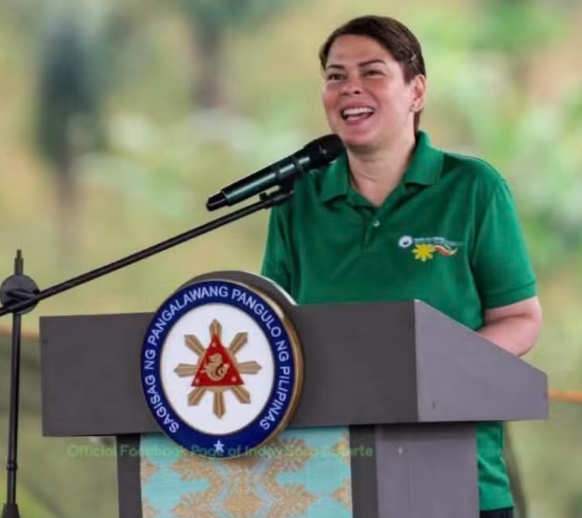
Vice President Sara Duterte has emphatically dismissed mounting speculation about her possible departure from office, declaring that stepping down would constitute a profound betrayal of the millions of Filipinos who placed their trust in her at the ballot box. Speaking candidly in a media encounter that circulated through social channels, Duterte made clear her resolve to weather the political storm currently engulfing her administration, describing any resignation as fundamentally at odds with her commitment to those who supported her candidacy.
The vice president's forceful rebuttal comes as she confronts one of the most serious constitutional challenges facing a Philippine elected official in recent years. The impeachment proceedings, initiated by the House of Representatives, centre on allegations spanning three distinct categories: misuse of confidential funds allocated to her office, accumulation of wealth that ostensibly cannot be adequately explained through legitimate sources, and accusations of making grave threats. These charges, if successfully prosecuted before the Senate impeachment court, carry the potential for removal from office and statutory disqualification from holding public position.
In her remarks, Duterte directly invoked her electoral mandate, emphasising that the 32.2 million votes cast in her favour created a democratic bond that transcends partisan politics or personal circumstance. This framing positions resignation not merely as a personal decision but as a violation of a solemn pact between elected official and electorate. The calculation underlying this public stance appears designed to mobilise her substantial political base and frame any departure as capitulation to political enemies rather than acknowledgment of legitimate oversight concerns.
Perhaps most strikingly, Duterte issued a direct challenge to President Ferdinand Marcos Jr, essentially inviting him to utilise whatever constitutional or administrative mechanisms might theoretically be available to remove her from the vice presidency. This confrontational posture suggests escalating tension within the Philippine government's upper echelons, despite the two officials running together on a unified ticket during the previous election cycle. The vice president's language—suggesting that the President is welcome to "do everything" necessary to effect her removal—implies either supreme confidence in her political position or a deliberate escalation of public conflict.
The Philippine political landscape has grown increasingly fractious in recent months, with various factions manoeuvring around the impeachment question. Duterte's legal representatives moved swiftly to reinforce her public declaration by explicitly contradicting resignation rumours within their own camp. According to her defence team, no discussions regarding resignation have transpired between themselves and their client, effectively closing off any suggestion that behind-the-scenes negotiations might be underway to facilitate a face-saving exit.
For Malaysian observers and the broader Southeast Asian audience, this Philippine constitutional drama carries several noteworthy dimensions. The impeachment mechanism itself reflects the region's varied approaches to executive accountability, with the Philippines maintaining a legislative impeachment process somewhat distinct from parliamentary systems elsewhere in Southeast Asia. The public defiance demonstrated by Duterte offers insight into how elected officials in the region navigate institutional challenges while maintaining political support bases.
The Senate impeachment court's recent completion of the House prosecution's evidence presentation regarding Article IV represents a significant procedural milestone. This progress suggests that substantive judgment on at least one category of allegations may emerge within foreseeable timeframe, potentially forcing resolution of the political uncertainty that has characterised recent months. The court's composition and decision-making will ultimately determine whether Duterte's confident assertions prove well-founded or premature.
The dynamics at play also illuminate the complex relationship between the Philippine presidency and vice presidency. Unlike some regional systems where these offices function as integrated executive units, the Philippine arrangement permits—and occasionally encourages—considerable tension between the two positions. Duterte's willingness to challenge the President directly reflects this structural reality, though such public confrontation remains relatively unusual among sitting officials.
Duterte's political base, concentrated heavily in her native Mindanao region and among voters who value her father's authoritarian governing style, appears sufficiently robust to sustain her through this trial. The mobilisation of this constituency through social media platforms and political networks has become evident in recent weeks, suggesting grassroots support remains substantial despite the severity of the allegations she confronts.
As the impeachment trial continues its proceedings, the Philippine nation faces an extended period of constitutional and political uncertainty. Duterte's public defiance may energise her supporters while simultaneously hardening opposition sentiment, making legislative compromise increasingly difficult. The trajectory of this case will likely influence broader conversations about executive accountability and the limits of presidential power throughout Southeast Asia, particularly given the Philippines' democratic influence within the region and its visible struggles with governance and institutional integrity.

