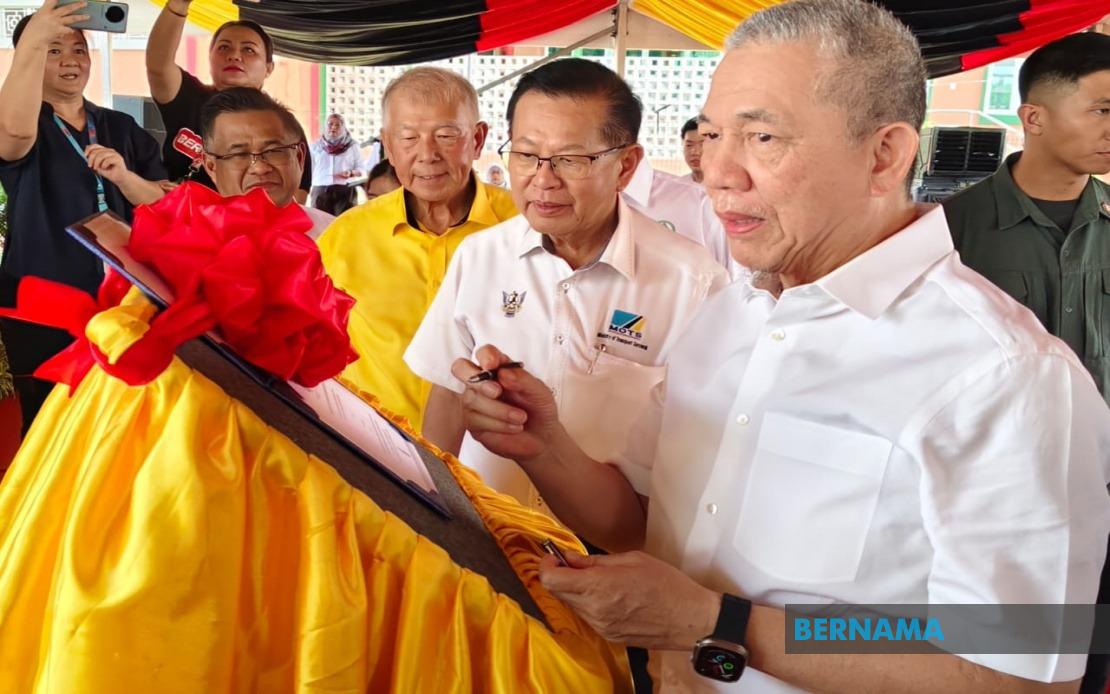
Deputy Prime Minister Datuk Seri Fadillah Yusof has announced a substantial infrastructure push across Sarawak, with 52 projects totalling RM9.46 million approved under the Cakna MADANI Programme to mitigate coastal and riverbank erosion whilst simultaneously reducing flood vulnerability across the state. The initiative reflects growing recognition of environmental threats facing Sarawak's communities, particularly in vulnerable low-lying and riverine areas where seasonal flooding and steady land degradation have disrupted livelihoods and damaged critical infrastructure for decades.
The portfolio demonstrates varied implementation momentum across Sarawak's districts. Of the 52 approved schemes, 12 have already reached completion, indicating successful delivery of early-stage interventions. A further 13 projects are currently under active construction, positioning them to generate tangible protection within months. However, the majority—27 initiatives—remain in pre-implementation phases, suggesting a staged rollout designed to manage resource allocation and workforce capacity across the state's dispersed geography.
Miri district exemplifies this localized approach, hosting three Cakna MADANI interventions tailored to its specific environmental challenges. Fadillah's inspection of the Riverbank Stabilisation Project at Tab Cinaq Cemetery illustrated the granular nature of these efforts. The RM134,682 scheme centres on constructing a 50-metre retaining wall, a technically straightforward yet operationally critical measure designed to arrest riverbank deterioration and safeguard both the cemetery facility and neighbouring residential and commercial zones. Commencing in May and scheduled for November completion, the project exemplifies the compressed implementation timelines characteristic of these rapid-response initiatives.
Beyond immediate erosion control, the federal government has simultaneously architected a more comprehensive long-term flood management architecture for Sarawak. Twenty-nine separate flood mitigation projects, collectively valued at RM3.834 billion, have received approval and incorporate multiple intervention categories spanning the Flood Mitigation Plan (RTB), High Priority Flood Mitigation (TBBT) schemes, specialized coastal erosion programmes, and river conservation initiatives. This hierarchical approach—combining quick-win stabilization projects with multi-year infrastructure transformation—reflects sophisticated understanding that environmental resilience requires both urgent interventions and patient capital deployment.
The composition of these 29 larger projects reveals substantial fiscal commitment to continuation of proven methodologies alongside innovation in new approaches. Eighteen projects representing RM3.567 billion constitute continuations of existing programmes, indicating confidence in established techniques and recognition that transformative flood resilience requires sustained investment beyond single budgetary cycles. The complementary 11 new initiatives, budgeted at RM267 million, suggest federal willingness to pilot emerging technologies and methodologies in Sarawakian contexts.
The RTB Sungai Miri exemplifies the extended implementation horizons characterizing major flood mitigation infrastructure. As a continuation project commanding RM31 million in total expenditure, it commenced construction during October 2023 and has already achieved 58.11 per cent physical progress according to Fadillah's latest assessment. Projected completion in November 2026 indicates a thirty-six-month construction window, typical for riverine engineering works requiring geological surveys, environmental assessments, and complex coordination with local stakeholders and riparian communities.
Sarawak's exposure to compounding environmental pressures makes these investments strategically significant. As Southeast Asia's largest state by area, Sarawak encompasses extensive riverine networks and a lengthy coastline vulnerable to both fluvial and marine inundation. Climate change projections consistently indicate intensifying rainfall patterns and rising sea levels, phenomena that amplify existing flood and erosion hazards across the state's predominantly low-lying settlement zones. Communities distributed across rural and urban areas alike face mounting risks to agricultural production, residential safety, and economic activity.
For Malaysian readers monitoring infrastructure spending across regions, these Sarawak allocations warrant comparative attention. The RM9.46 million rapid-response pool, combined with the RM3.834 billion long-term flood mitigation architecture, positions Sarawak among the highest-priority states for federal environmental infrastructure investment. This reflects both the scale of environmental challenges and political prioritization following sustained advocacy from state and federal stakeholders regarding deteriorating erosion and flooding patterns.
Fadillah's dual portfolio—serving simultaneously as Deputy Prime Minister and Energy Transition and Water Transformation Minister—underscores federal positioning of water security alongside energy transformation as interconnected development challenges. This administrative pairing signals that flood mitigation and water resource management constitute core pillars of Malaysia's medium-term development strategy, not peripheral concerns delegated to lower bureaucratic hierarchies. Sarawak's substantial allocation thus reflects broader federal commitment to mainstreaming environmental resilience across policy frameworks.
The geographic dispersal of these projects across Sarawak's multiple districts and communities suggests deliberate equity considerations in fund allocation. Rather than concentrating investment in major urban centres, the Cakna MADANI approach targets numerous smaller initiatives across rural and semi-urban zones. This distribution strategy acknowledges that erosion and flooding impose disproportionate hardship on peripheral communities possessing limited autonomous capacity to execute protective infrastructure independently.
Implementation success across these 52 initiatives will depend critically on coordination between federal authorities, Sarawak state government bodies, local municipal councils, and affected communities. Project supervision, quality assurance, timely fund disbursement, and environmental compliance monitoring require sustained institutional capacity throughout implementation phases. Early completion of twelve projects provides encouraging baseline evidence, yet sustaining delivery momentum across the remaining forty initiatives presents operational challenges inherent in dispersed infrastructure programmes.
Looking forward, these Sarawak investments establish precedents and institutional learning that may inform environmental resilience strategies across other Malaysian states facing comparable erosion and flooding pressures. Peninsular Malaysia's vulnerable low-lying zones and Sabah's rapid urbanization in flood-prone areas could potentially benefit from operational experiences and technical knowledge accumulated through Sarawak's ongoing Cakna MADANI implementation.

