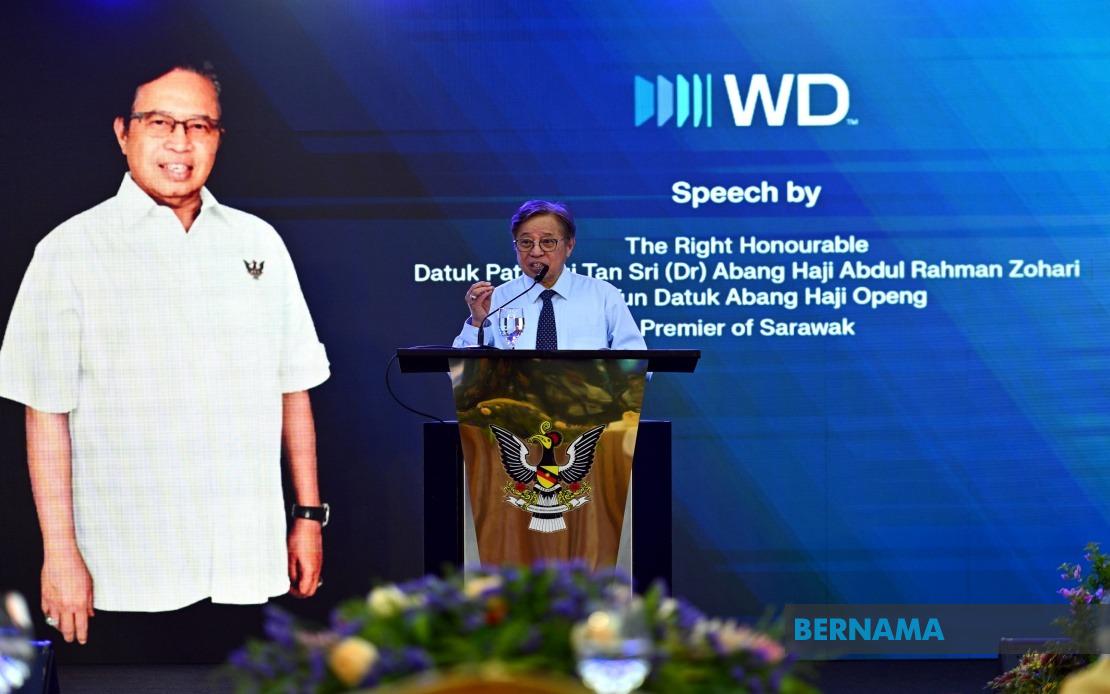
Sarawak's willingness to accept an increase in its special grant hinges entirely on whether the federal government has the fiscal capacity to deliver, according to Premier Tan Sri Abang Johari Tun Openg. Speaking after the New Horizon for Western Digital (WD) Sarawak programme in Kuching on July 2, Abang Johari struck a pragmatic tone, acknowledging both the state's aspirations and Kuala Lumpur's budgetary constraints. The stance reflects the delicate balance Sarawak must maintain in its relationship with the federal government, particularly as discussions around the special grant—enshrined in Article 112D of the Federal Constitution—continue at senior levels.
The special grant mechanism represents one of the key provisions within the Malaysia Agreement 1963 (MA63), the foundational document that brought Sarawak and Sabah into the Malaysian federation. For Sarawak, which has historically positioned itself as a substantial contributor to national oil and gas revenues, the size and growth trajectory of this grant carry symbolic and practical significance. Abang Johari's measured response suggests Sarawak recognises the broader fiscal pressures facing the federal government and is unlikely to adopt an adversarial negotiating posture on the matter. However, his repeated emphasis on "if the Federal Government can afford it" also signals that the state will not simply accept the status quo indefinitely.
No substantive negotiations have yet occurred, Abang Johari clarified, though the topic surfaced informally during his recent meeting with Prime Minister Datuk Seri Anwar Ibrahim in Bintulu. This gradual, consultative approach contrasts with more confrontational models of centre-state relations and suggests both parties are attempting to manage the issue within cooperative frameworks. The lack of detailed discussion so far may also reflect the complexity of the broader fiscal picture—with the federal government managing multiple competing demands from all thirteen states and managing post-pandemic recovery objectives.
Prime Minister Anwar had previously indicated to the Dewan Rakyat during Question Time on June 30 that negotiations surrounding the Sarawak special grant were progressing and remained aligned with MA63 principles. This public acknowledgement, made in the national parliament, serves to legitimise Sarawak's claim while maintaining the impression of ongoing good-faith engagement. For Malaysian federalism more broadly, how these negotiations conclude carries implications for state-federal relations across the country, as other states may monitor outcomes and adjust their own negotiating positions accordingly.
Beyond the fiscal discussion, Abang Johari seized the opportunity to articulate Sarawak's longer-term economic vision, pivoting toward technology and data infrastructure as engines of future prosperity. The thirty-year partnership between Sarawak and Western Digital exemplifies the state's successful courting of high-value manufacturing and technology investment. Glass substrate-based data storage technology, the focus of the partnership's latest phase, represents a natural evolution for an economy seeking to move beyond traditional commodity exports.
Sarawak's competitive advantages in this emerging sector are substantial and rooted in fundamental geography and resource endowments. Abundant hydroelectric capacity and access to clean water—essential for semiconductor and data centre operations—position the state favourably against regional competitors. As artificial intelligence adoption accelerates globally, demand for data storage infrastructure has become a strategic priority for technology leaders worldwide, creating genuine opportunities for locations that can combine renewable energy, technical expertise, and favourable business conditions.
Western Digital's continued investment in Sarawak, now encompassing next-generation glass substrate recording technology, validates the state's proposition to global technology firms. This technology enables substantially higher data storage density, a crucial capability as organisations worldwide accumulate ever-larger datasets. The company's commitment across three decades demonstrates that Sarawak has successfully maintained the conditions necessary to retain major anchor investments in a fiercely competitive global market.
Abang Johari's framing of data as potentially exceeding oil in future economic value reflects a sophisticated understanding of global economic transitions. Sarawak, which has historically derived substantial revenue from petroleum resources, recognises that oil dependency carries long-term risks. Diversifying into data infrastructure, biotechnology, and advanced manufacturing aligns with forward-looking development strategies across Southeast Asia. For Malaysian readers, Sarawak's trajectory offers a case study in how resource-rich regions can transition toward knowledge-intensive industries while leveraging existing competitive advantages.
The broader context matters for understanding these developments. Malaysia's federal structure distributes fiscal powers and revenue streams in ways that have periodically generated tension between states and the centre. Sarawak, with its oil and gas wealth and distinctive constitutional position under MA63, occupies a particular role in these relationships. How the federal government manages the special grant question will signal broader commitments to honouring constitutional provisions and respecting state autonomy—concerns that resonate across Malaysia's federation.
Looking forward, Abang Johari's conditional openness to a higher grant suggests negotiating room exists. The state is neither making maximalist demands nor accepting indefinite stasis. This positioning creates space for creative solutions that could involve adjustments to the grant quantum, tied perhaps to economic growth metrics, or alternative mechanisms for federal-state cooperation on priority areas like infrastructure and technology development. For investors like Western Digital, such stability and constructive governance relationships provide confidence for long-term commitments.
The convergence of fiscal federalism discussions with Sarawak's technology pivot illustrates how economic strategy and political negotiations intertwine at the state level in Malaysia. Higher revenues from advanced manufacturing and data services could ultimately reduce Sarawak's dependence on the federal special grant, offering a different pathway to greater state financial autonomy. Meanwhile, successful attraction of global technology investment enhances Sarawak's negotiating position with the federal government and demonstrates tangible returns from maintaining competitive business conditions. For the broader Malaysian economy, Sarawak's success in these domains has positive spillover effects, particularly for Southeast Asian competitiveness in global technology sectors.

