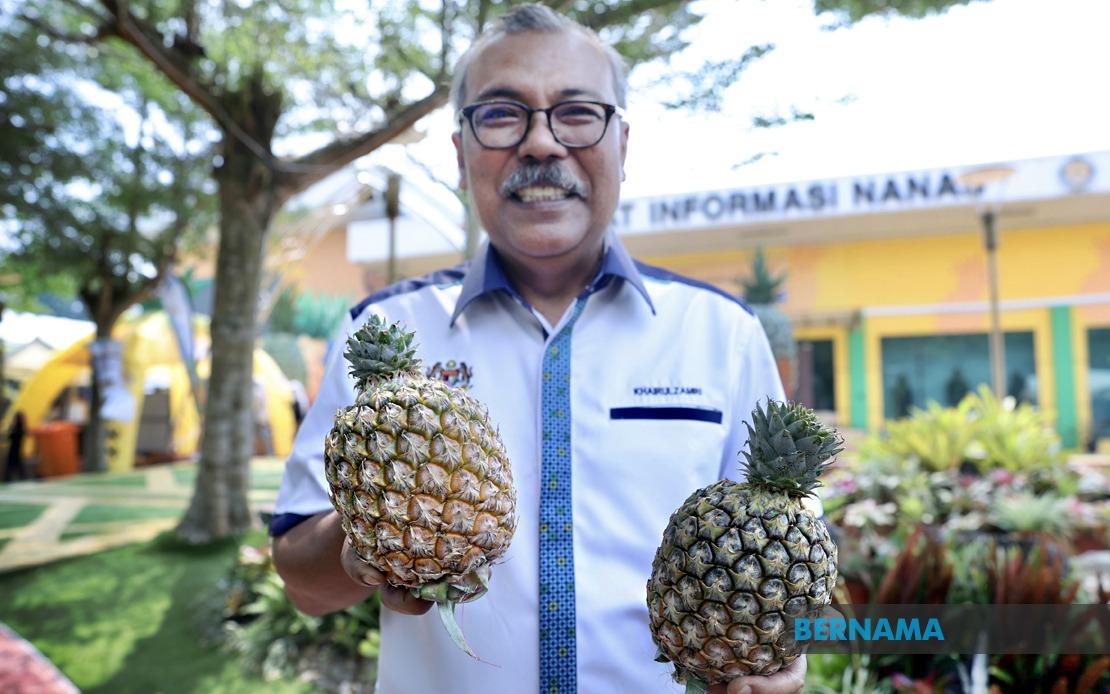
A premium pineapple variety cultivated in Sarawak has emerged as a centrepiece attraction at MAHA 2026, the ongoing Malaysia Agriculture Expo at MAEPS in Serdang, signalling fresh momentum in the country's efforts to modernise and diversify its agricultural output. Seven tonnes of the Sarawak Gold pineapple, designated SG1, have been transported from Sarawak to Laman Nanas, the dedicated pineapple pavilion at the expo, allowing visitors to experience the fruit's distinctive characteristics and market appeal firsthand.
According to Mohd Khairuzamri M. Salleh, director-general of the Malaysian Pineapple Industry Board (LPNM), the SG1 represents a significant advancement in tropical fruit production, having been first identified and developed in Miri. He outlined several technical advantages that distinguish the variety from established alternatives in the global market. The fruit achieves sweetness comparable to the internationally recognised MD2 pineapple, while its aesthetic qualities prove equally compelling—the crown develops an unusual rose-like configuration that enhances visual appeal and consumer recognition. Each fruit maintains uniform quality and flavour throughout, addressing a persistent challenge in agricultural production where consistency across batches often remains elusive.
The cultivation timeline offers perhaps the most compelling advantage for Malaysian growers. Whereas the widely cultivated MD2 variety requires fourteen months from initial planting to commercial harvest, the SG1 matures within just nine months. This accelerated cycle translates directly into improved farm economics, enabling growers to achieve multiple harvests per year and substantially compress their return on investment. For smallholder farmers and large-scale operations alike, the compressed timeframe reduces exposure to disease, weather-related losses, and market price volatility—critical considerations for producers operating in Southeast Asia's unpredictable tropical climate.
Density advantages further strengthen the commercial case for SG1 adoption across Malaysian plantations. The variety tolerates remarkably dense planting arrangements, accommodating between 25,000 and 30,000 plants per acre compared to conventional spacing requirements for other varieties. This high-density capability allows growers to maximise output per unit of land without proportional increases in water, fertiliser, or labour inputs. For Malaysia, where arable land remains finite and development pressures continue mounting, this efficiency gain carries particular significance. The LPNM is currently executing an expansion strategy to introduce SG1 cultivation across Peninsular Malaysia, with seedlings anticipated to reach commercial growers throughout the country by 2027.
International market validation has already begun, providing further confidence in the variety's commercial viability. Trial shipments from Sarawak to Singapore have successfully navigated export protocols and demonstrated consumer acceptance in neighbouring markets. The fruit's robust characteristics and disease resistance position it competitively for entry into high-value destinations including China and New Zealand, territories where Malaysian agricultural exports command premium pricing. Such market access would diversify Malaysia's fruit export portfolio, currently dominated by tropical staples, and establish the country as a supplier of differentiated, value-added products rather than commodities.
Beyond the fresh fruit market, the LPNM's broader strategic messaging at MAHA 2026 emphasises the entire value chain potential within pineapple agriculture. The exposition's theme, "Value Creation for Food Security," reflects deliberate efforts to recalibrate public and industry perception of pineapple cultivation as a multifaceted enterprise rather than a single-product operation. Industry officials describe the production model as "one planting, three harvests"—a formulation highlighting the range of outputs derivable from a single crop cycle. Fresh fruit represents the primary harvest, yet commercial applications extend substantially beyond the consumer produce market.
Secondary harvests encompass pineapple propagules used for replanting, which reduce nursery costs and propagation timelines for subsequent production cycles. Equally significant are the emerging value-added pathways developed from processing waste and plant residues. Spent pineapple leaf fibres are being transformed into textiles and apparel, responding to global demand for sustainable, plant-based fashion materials. Cellulose from pineapple plant matter feeds into speciality paper production, commanding premium prices in niche markets. Dried and processed fruit pulp and leaves serve as high-protein, sustainable ruminant feed, providing feed producers an economical alternative to imported supplements while creating markets for agricultural residues that would otherwise be discarded.
These circular economy applications address multiple Malaysian policy imperatives simultaneously. They enhance the profitability of pineapple farming by monetising components historically treated as waste, reducing agricultural sector pressure on environmental resources through waste utilisation, and supporting Malaysia's positioning within global sustainability-conscious supply chains. International retailers and manufacturers increasingly demand supply chain transparency and environmental credentials from their agricultural suppliers; vertical integration of waste utilisation transforms pineapple farming from a conventional commodity operation into a demonstration of best-practice sustainable agriculture.
The timing of SG1's introduction coincides with broader sectoral challenges affecting Malaysian agriculture. Climate variability, labour availability, and land scarcity pressures all intensify demands for productivity improvements and operational efficiency gains. The SG1 variety directly addresses these pressures through its accelerated maturation cycle, high-density suitability, and demonstrated resilience. For policymakers and agricultural planners, the variety exemplifies the capacity of targeted crop improvement research to generate practical solutions benefiting smallholder and commercial producers alike.
MAHA 2026, running through September 6 at MAEPS, encompasses approximately 2,000 exhibitors and is projected to attract over four million visitors during its nine-day duration. The exposition provides a critical marketplace where agricultural producers directly engage consumers, industry buyers, and government officials, generating commercial connections and facilitating technology transfer. The SG1's prominent showcase at Laman Nanas positions Malaysian pineapple innovation at the centre of these discussions, potentially catalysing faster adoption and demonstrating the sector's capacity for continuous improvement.
The SG1 pineapple case study illustrates how targeted agricultural research and development investment generates commercially viable innovations capable of transforming producer economics and export competitiveness. For Malaysian policymakers considering future investments in agricultural modernisation, the variety demonstrates measurable returns on research funding and suggests that such initiatives merit sustained prioritisation and resource allocation. As regional competitors intensify their own agricultural innovation efforts, Malaysia's ability to develop and commercialise such proprietary varieties will increasingly determine its competitive positioning within Asian agricultural markets.

