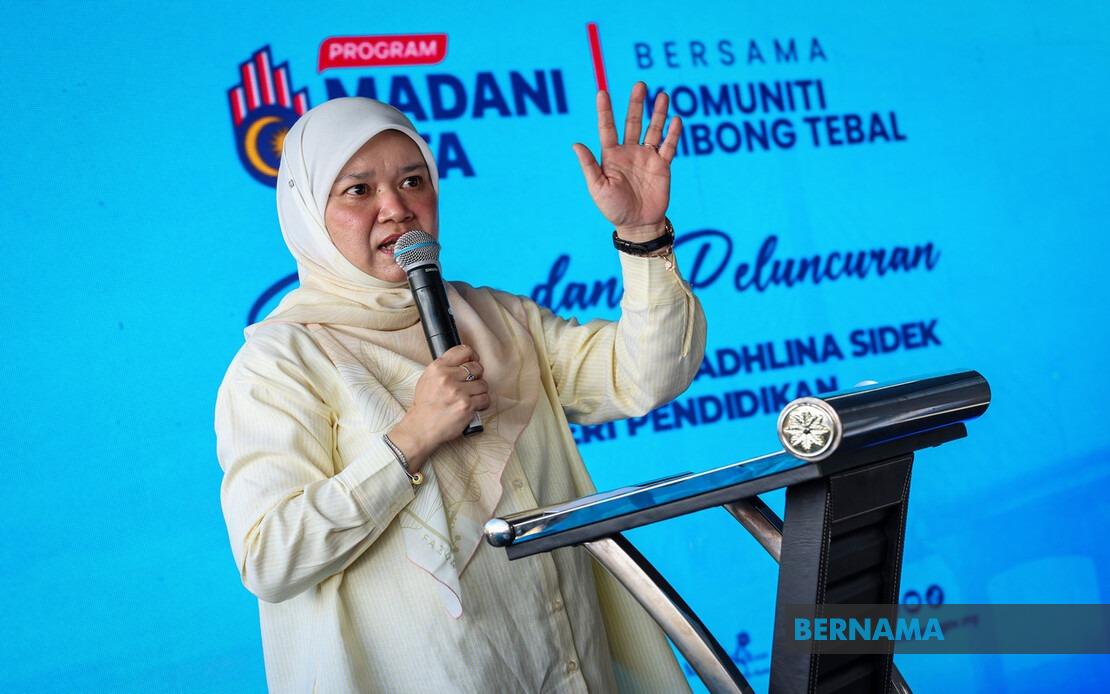
Education Minister Fadhlina Sidek has lauded the NADI Mahir school uniform initiative as a practical solution addressing the financial pressures families face when purchasing essential school supplies. Speaking in her capacity as Member of Parliament for Nibong Tebal, Fadhlina outlined how the instalment-based purchasing scheme removes a significant barrier that prevents some families from accessing basic educational necessities, particularly in households where upfront costs create hardship during the school year.
The National Information Dissemination Centre's NADI Mahir programme operates on a straightforward principle: parents can spread the cost of school uniforms across multiple payments rather than paying in full upfront. This approach recognises that many Malaysian families, especially in lower-income brackets, struggle with the concentrated expense of school preparations that coincides with the academic calendar. By restructuring how families pay for uniforms, the initiative directly addresses a common complaint among parents about back-to-school expenses.
Beyond easing household budgets, the scheme simultaneously creates viable business opportunities for local entrepreneurs. The uniforms themselves are manufactured by 120 graduates of NADI Mahir Jahit, a skills training programme that equips individuals with sewing expertise through NADI's Pintar Services. These entrepreneurs, having completed formal training and received support from NADI's guidance systems, now operate as self-sustaining small business operators. This dual benefit—consumer relief coupled with income generation—represents a deliberate policy approach that addresses multiple economic challenges simultaneously rather than solving problems in isolation.
The broader NADI ecosystem encompasses far more than uniform sales, extending into academic support, youth development, and emerging technology sectors. The NADI Tuisyen Rakyat tutoring programme has reached over 42,000 students across Malaysia, with the Nibong Tebal constituency alone boasting participation from more than 73 students. The initiative's academic impact appears measurable: the 2025 Sijil Pelajaran Malaysia examination results produced 65 outstanding students who had participated in NADI's tutoring support, suggesting the programme contributes meaningfully to student achievement across various academic levels.
Youth engagement represents another pillar of NADI's strategy, particularly through its e-sports platform. The NADI E-Sukan initiative functions as both entertainment and talent identification mechanism, fostering confidence and collaborative skills among young people who might otherwise lack structured competitive outlets. In Nibong Tebal specifically, local youth secured the national NADI E-Sukan MADANI Mobile Legends championship while achieving runner-up status at state level in Mobile Legends, alongside a second-place finish in the Penang state Cooking Star competition. These achievements suggest that NADI programmes successfully motivate young Malaysians across diverse interest areas, from gaming to culinary pursuits.
Artificial intelligence and emerging digital literacy occupy an increasingly prominent position within NADI's offerings. The 1 NADI 1 Prompt Engineer initiative specifically targets AI familiarity among everyday citizens, preparing Malaysians for a technology-driven economic landscape. With eleven participants engaged in this programme within Nibong Tebal alone, the initiative appears to be gaining traction despite being relatively nascent. As Malaysia positions itself within the global digital economy, exposure to AI fundamentals at community level through NADI programming potentially strengthens workforce adaptability and reduces the gap between formal education and industry demands.
The convergence of these initiatives—uniform financing, tutoring support, youth development, entrepreneurship training, and technological literacy—reflects a comprehensive social policy philosophy that recognises interconnected challenges require multifaceted solutions. Rather than treating school costs, educational quality, youth engagement, and workforce preparation as separate policy domains, NADI integrates them into a coordinated ecosystem. This approach acknowledges that families dealing with financial pressure benefit not only from purchasing assistance but also from improved academic support and enhanced educational opportunities for their children.
Fadhlina's public championing of these programmes carries significance beyond ceremonial endorsement. As Education Minister, her advocacy signals governmental commitment to supporting families beyond traditional classroom funding, while simultaneously promoting entrepreneurship and skills development. Her emphasis on NADI's community impact in Nibong Tebal suggests that these initiatives are generating visible results in constituency-level outcomes, which carries political weight in demonstrating responsive governance.
The economic implications extend beyond immediate family relief. When local entrepreneurs successfully sell school uniforms through instalment systems, they accumulate business experience, customer relationships, and financial credibility that facilitate expansion into related ventures. NADI's structured support—through training, monitoring, and market access—reduces entrepreneurial failure rates compared to unguided self-employment attempts. For a developing nation with significant youth unemployment and underemployment, converting trained individuals into sustainable income-generators represents economic policy with long-term compound benefits.
For Malaysian parents navigating annual school preparation costs, the NADI Mahir initiative addresses a genuine practical problem with economic sensitivity. The programme acknowledges that affordability barriers extend beyond tuition fees to encompass uniforms, equipment, and supplies that schools often mandate. By facilitating instalment payments, NADI removes a pressure point that sometimes forces families to choose between school supplies and other essential expenses. This structural support may contribute to improved school attendance and reduced dropout rates, particularly among vulnerable populations sensitive to cost-related barriers.
The programme's positioning within broader NADI services ensures that families accessing uniform assistance simultaneously encounter pathways toward academic tutoring, skills development, and youth opportunity platforms. This integration creates what might be termed "opportunity density"—clustering multiple beneficial services within single family contact points rather than fragmentation across disconnected agencies. For families with limited time or information access, such integration increases the probability of engaging with complementary programmes that might otherwise remain unknown.
Looking forward, the success metrics for NADI Mahir and associated initiatives will likely shape how Malaysian policymakers evaluate social programmes. If uniform instalment schemes consistently improve school attendance while entrepreneur participants sustain viable businesses, the model may expand to additional product categories or geographic areas. Similarly, demonstrated impact in academic achievement through NADI Tuisyen Rakyat could influence education ministry resource allocation and programme design philosophies.
Ultimately, the NADI Mahir initiative represents pragmatic policy design that recognises cost as a legitimate barrier to educational access while simultaneously treating social intervention as an opportunity for economic activation rather than mere subsidisation. By enabling parents to purchase uniforms through manageable instalments while creating income pathways for entrepreneurs, the programme demonstrates how well-structured initiatives can address multiple societal challenges with single integrated interventions—an approach increasingly relevant as Malaysian policymakers seek efficient solutions to complex social and economic problems.

