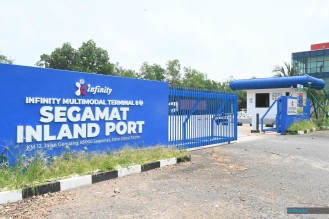
Segamat Inland Port is charting an ambitious course for container traffic expansion, aiming to process more than 6,000 twenty-foot equivalent units of cargo by the close of 2026 as its revival gains traction following a dormant period spanning over a decade. The facility, which commenced fresh operations on June 25 after being largely sidelined since the late 1990s, represents a strategic pivot in Malaysia's approach to decentralising logistics infrastructure and unlocking economic potential in underserved regions of the peninsula's southern tier.
During its inaugural month of full operation through July, the inland port managed approximately 1,000 TEUs of containerised and bulk cargo, establishing a foundation for scaling upward. Samuel Ho, the facility's manager representing Infinity Logistics & Transport—the entity responsible for day-to-day operations—outlined the trajectory toward the year-end milestone while explaining the strategic rationale underpinning the port's resurrection. The facility caters to industrial corridors spanning northern Johor, southern Pahang, southern Negeri Sembilan, and Melaka, regions that have historically lacked efficient inland cargo-handling infrastructure outside major coastal hubs.
The reactivation aligns with a broader government strategy termed the Road to Rail initiative, executed in partnership with national rail operator Keretapi Tanah Melayu Bhd. This programme seeks to transition freight movement toward rail networks, a shift predicated on both economic and safety imperatives. Rail transport presents a compelling alternative to truck-dependent logistics chains, offering enhanced safety profiles compared with road vehicles that remain vulnerable to accident risks and congestion-induced delays. Environmental considerations further strengthen the case: a single cargo train journey replaces approximately 80 container truck movements, delivering substantial diesel consumption reductions and lowering carbon emissions across regional supply chains.
Historically, Segamat's utility faced practical constraints stemming from single-track railway operations that subordinated freight scheduling to passenger train priorities, rendering the facility's commercial proposition precarious. This operational bottleneck has been substantially relieved following the completion of double-tracking infrastructure extending into Johor, a capital-intensive upgrade that fundamentally altered the feasibility calculus. The facility now accommodates up to four weekly cargo receiving and dispatch cycles, representing a four-fold improvement over the single-weekly frequency characteristic of the previous operational regime. This enhanced scheduling flexibility enables direct connectivity with major maritime gateways including Port Klang, Port of Tanjung Pelepas, and Johor Port in Pasir Gudang.
Management envisions Segamat as a catalyst for broader economic activation throughout northern Johor, particularly benefiting districts such as Batu Pahat and Kluang where manufacturing and warehousing sectors remain underdeveloped relative to western Peninsular counterparts. By positioning the facility as a principal gateway for rail-facilitated cargo distribution, operators anticipate spillover effects attracting industrial investment to surrounding zones. The facility's nascent phase currently operates across 20.23 hectares adjacent to Segamat Railway Station, with comprehensive development spanning three planned stages. Employment generation has already materialised, with over 200 local positions created during phase-one commissioning, a figure expected to escalate significantly upon full buildout.
Transport Minister Anthony Loke Siew Fook's presiding over the official launch ceremonies reinforced the facility's status as a priority national infrastructure initiative. His remarks emphasised Segamat's catalytic potential for northern Johor's economic transformation while acknowledging contributions toward supply-chain modernisation and transport system efficiency. Employment creation narratives specifically highlighted opportunities within security and logistics domains, complementing broader sectoral growth. Quantifiable traffic-reduction projections estimate monthly elimination of approximately 18,000 lorry movements—encompassing standard trucks and container-bearing trailers—from regional road networks. Such reductions promise material congestion alleviation, enhanced road safety through reduced accident exposure, and optimised utilisation of existing rail infrastructure.
The inland port's expansion trajectory intersects with Malaysia's evolving logistics competitiveness strategy, particularly as regional neighbours strengthen inland transport capabilities. The facility's success will partly depend on pricing competitiveness relative to conventional trucking, modal-shift incentives, and shipper confidence in reliability metrics. Universiti Tun Hussein Onn Malaysia has entered collaborative arrangements encompassing knowledge transfer, fieldwork exposure, and applied research initiatives focused on rail-based inland port operational excellence, potentially cultivating specialist expertise for sector expansion.
Segamat's operational resurrection carries implications extending beyond immediate regional logistics efficiency. The venture demonstrates feasibility of rehabilitating underutilised infrastructure leveraging incremental railway improvements, a model potentially replicable across other regions. However, realising the ambitious 6,000 TEU target requires sustained promotional efforts, shipper education, and competitive tariff structures that incentivise mode-switching from entrenched trucking networks. The facility represents a calculated wager that improved rail infrastructure, combined with strategic inland positioning, can fundamentally reshape goods-movement patterns across southern Peninsular Malaysia, delivering environmental, safety, and economic dividends while reducing logistics costs for industrial users clustered throughout the port's hinterland zone.

