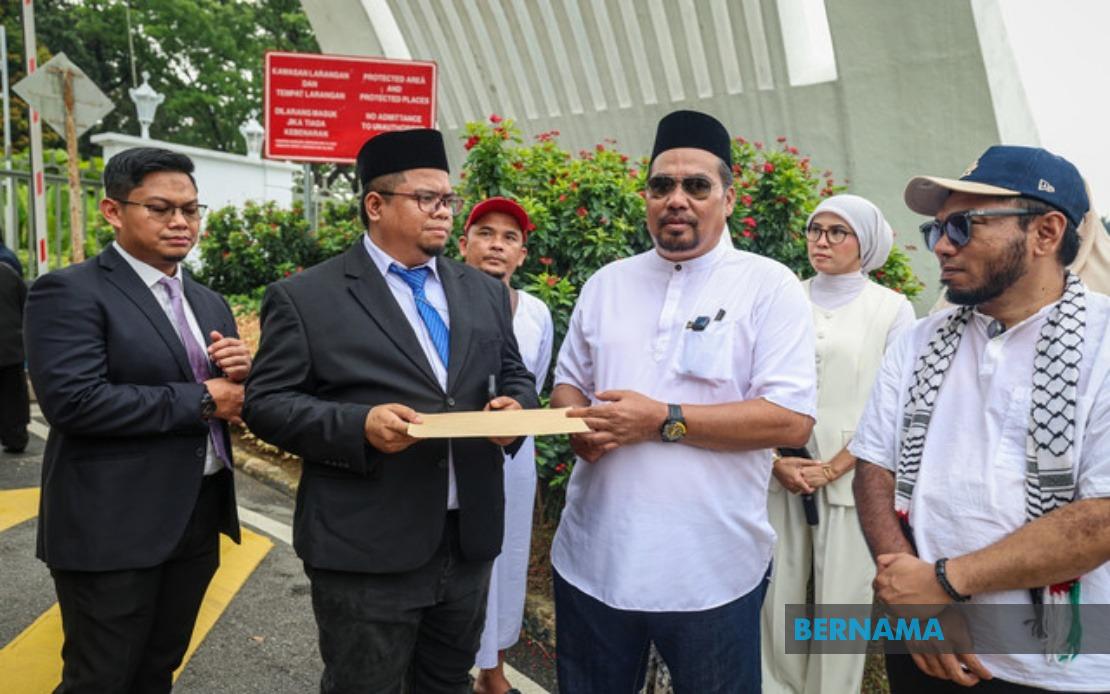
A prominent social media activist collective has escalated pressure on Malaysia's government to pursue criminal accountability for officials implicated in the governance failures at Tabung Haji, the nation's pilgrimage fund manager. Sekretariat Gerak Gempur Media Sosial Rakyat Malaysia, commonly known as SEKPUR, delivered a formal memorandum at Parliament on August 11th, seizing the moment when lawmakers gathered for a special sitting to discuss the findings of an extensive Royal Commission of Inquiry into the institution's troubled financial affairs. The submission underscores growing public impatience with the pace of institutional reform and raises questions about whether administrative correctives alone will satisfy demands for justice from Malaysia's Muslim and Bumiputera communities, whose savings form the bedrock of Tabung Haji's deposit base.
The 211-page RCI report, released publicly on July 29th, painted a portrait of systemic dysfunction spanning the six-year period from 2014 to 2020. Rather than isolated lapses in judgment, the findings revealed pervasive weaknesses embedded throughout the institution's management structures and operational frameworks. This extended timeline suggests that multiple layers of oversight either failed to detect mismanagement or proved powerless to arrest its progression. For millions of Malaysian Muslims who entrust their savings to Tabung Haji specifically because of its religious and custodial significance, these revelations carry particular sting, as they imply a breach of sacred trust rather than mere corporate incompetence.
SEKPUR's secretary Mohd Yani Alias delivered a carefully calibrated message when handing the memorandum to Zairudin Hashim, press secretary to the Minister in the Prime Minister's Department (Religious Affairs), at 12:35 pm. The activist emphasized that his organization stands indifferent to political affiliations when it comes to accountability, suggesting that those seeking leniency based on party connections will find no sympathy from civil society. This posture reflects a broader sentiment among grassroots movements that the religious character of Tabung Haji—and the vulnerable communities it serves—should transcend partisan considerations. The statement implicitly critiques any suggestion that high-ranking individuals might escape prosecution through political protection.
What distinguishes SEKPUR's intervention from routine parliamentary submissions is the invocation of the Yang di-Pertuan Agong's decree that those implicated in Tabung Haji's troubles must face justice through comprehensive legal processes. By anchoring their demand in the highest constitutional authority rather than merely bureaucratic reform, the activist group has framed accountability not as a matter of administrative preference but as a requirement flowing from the sovereign's will. This rhetorical positioning complicates any government resistance to prosecution, as declining to act could be portrayed as defying royal guidance. The memorandum thus transforms what might otherwise be dismissed as civil society agitation into a matter touching on constitutional propriety.
Beyond the immediate demand for prosecutions, SEKPUR has articulated a broader vision for Tabung Haji's future that extends to the institution's long-term financial viability. The group expressed concern that without substantive reforms, the fund's capacity to deliver competitive hibah distributions to depositors will continue eroding, transforming a tool for Hajj savings into a vehicle for wealth dissipation. This concern reflects a fundamental anxiety among Malaysian Muslims: that their savings, entrusted for a specific religious purpose, have been compromised in ways that fundamentally diminish the institution's core mission. Restoring competitive hibah returns is not merely a financial metric but a matter of restoring confidence in an institution that holds religious significance.
The rising cost of performing the Hajj pilgrimage featured prominently in SEKPUR's memorandum, highlighting how Tabung Haji's difficulties ripple through the broader ecosystem of pilgrimage management in Malaysia. When the fund's operational efficiency declines, costs ultimately transmit to ordinary Muslims already stretched by inflation and economic uncertainty. For many Malaysians, saving through Tabung Haji represents one of few realistic pathways to affording the Hajj, Islam's fifth pillar. Deteriorating fund performance thus potentially undermines religious practice accessibility for those with modest means, creating a second-order injustice layered atop the governance failures themselves.
The memorandum also targeted the opacity surrounding Hajj quota administration, calling for enhanced transparency in how Malaysia's annual pilgrimage allocations are managed and distributed. This demand speaks to persistent public suspicion that quota assignments may favor connected individuals or organized groups over ordinary applicants following first-in, first-served principles. Transparency in quota distribution would not only restore public confidence but also enhance the legitimacy of Hajj access, ensuring that this foundational Islamic obligation remains accessible on equitable terms. The emphasis on transparency reflects a broader accountability deficit that extends beyond financial mismanagement to procedural fairness.
The timing of SEKPUR's intervention, coinciding with Parliament's special sitting to examine the RCI report and the government's remedial efforts, reveals strategic activism. By delivering their memorandum during heightened parliamentary focus on Tabung Haji, the activist group ensured maximum visibility and prevented the issue from receding into bureaucratic processing. The gathering itself demonstrated that civil society remains vigilant, unwilling to accept administrative assurances without concrete action. This public mobilization may prove more effective than parliamentary speeches in impelling executive action, as the spectacle of organized grassroots concern signals to decision-makers the electoral costs of perceived inaction.
Government progress in implementing the RCI's recommendations provides a mixed signal about the institutional appetite for genuine reform. As of July 30th, Tabung Haji had implemented seventy-five percent of the twenty-five recommendations contained in the report. While this completion rate appears respectable superficially, the measure obscures which recommendations remain pending and whether implementation has been substantive or perfunctory. The RCI itself may have stopped short of recommending specific criminal prosecutions, leaving political actors space to claim that administrative remedies suffice. SEKPUR's memorandum effectively narrows this space by insisting that governance reform and criminal accountability are complementary rather than alternative responses.
For Malaysian observers following Tabung Haji's travails, the activist campaign raises a broader question about institutional accountability in religious governance. The fund occupies a unique space—neither purely governmental nor entirely private, managing assets with profound spiritual significance for millions. This ambiguous status has perhaps enabled blame-shifting between government authorities and TH leadership, with each entity suggesting the other bears responsibility for failures. SEKPUR's intervention implicitly demands that this institutional confusion be resolved through comprehensive accountability embracing all responsible parties, irrespective of their formal institutional affiliation. The implied threat is that unless the government responds decisively, civil society activism will intensify, transforming Tabung Haji from a bureaucratic issue into an ongoing political vulnerability.
Moving forward, the government faces a critical juncture in determining whether it will treat the RCI recommendations as a checklist for marginal improvements or as a blueprint for institutional transformation. SEKPUR's memorandum signals that civil society will view any response short of prosecutorial action as inadequate, potentially galvanizing broader public discontent. The memorandum also implicitly challenges the government's claim that administrative reforms can restore confidence in an institution that Muslims perceive as having betrayed their trust. Unless prosecutions follow, Tabung Haji may struggle to recover its standing as a trusted repository for the savings of Malaysia's Muslim community, ultimately weakening its capacity to serve its core mission of facilitating Hajj pilgrimage for millions of ordinary Malaysians.

