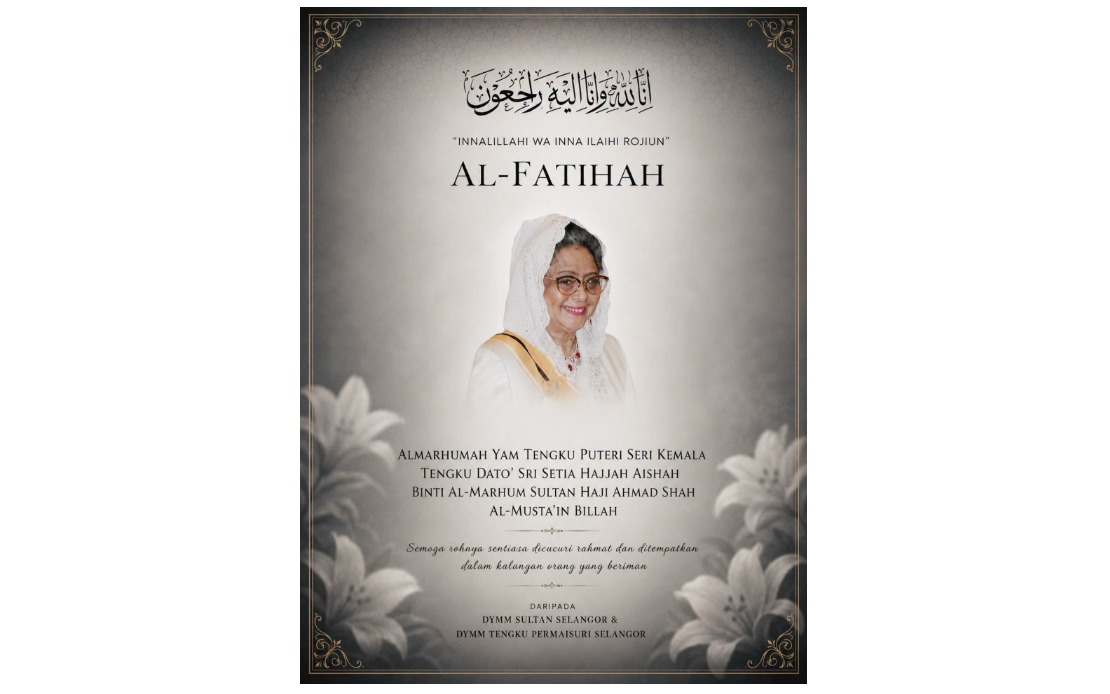
The royal household of Selangor has formally expressed its sympathies to the Sultan of Pahang, Al-Sultan Abdullah Ri'ayatuddin Al-Mustafa Billah Shah, following the passing of his elder sister, Tengku Puteri Seri Kemala Tengku Datuk Seri Aishah Almarhum Sultan Ahmad Shah. The statement came through the Selangor Royal Office, with Sultan Sharafuddin Idris Shah and Tengku Permaisuri Norashikin issuing a formal message of mourning and grief directed at their counterparts in the eastern state.
Tengku Datuk Seri Aishah passed away at a hospital in Kuala Lumpur at 9.15 pm on August 26, marking the end of a life deeply connected to Malaysia's royal heritage and institutional history. The departed was sister to the current Sultan of Pahang and held significant standing within the sultanate's extended family networks that have shaped governance and royal protocol across the peninsula for decades. Her death represents another milestone in the generational transition that has characterised Malaysia's constitutional monarchy in recent years.
The statement released by the Selangor Royal Office carried the formal language typical of inter-state royal communications, with Sultan Sharafuddin and Tengku Permaisuri Norashikin expressing their profound sadness at the loss. The message invoked Islamic tradition, praying that Allah's mercy would be extended to the departed soul and that she would be numbered among the faithful. This formulaic yet genuine expression of sympathy reflects both the religious foundations of Malaysia's royal institutions and the strong bonds of kinship and protocol that unite the country's various sultanates.
The timing and manner of the condolence demonstrate the intricate web of relationships that binds Malaysia's royal houses together. Selangor and Pahang, though geographically separated and distinct in their administrative structures, maintain historical connections rooted in the Federated Malay States period and earlier sultanate arrangements. The formal acknowledgement by Selangor's leading royal figures underscores the expectation that major states will publicly mark the significant personal losses experienced by sister sultanates, reinforcing the notion of a unified royal institution even as each state maintains its own sovereign court.
Following her death, preparations commenced for Tengku Datuk Seri Aishah's final journey back to her native state. Her remains were transported to the Pahang Royal Mausoleum in Pekan, the traditional burial ground for members of the Pahang royal family. The interment was to be conducted according to established royal customs and with full ceremonial honours befitting her status and lineage, demonstrating the respect accorded to senior members of the sultanate even in death.
The burial at the Pekan mausoleum carries particular significance within Pahang's institutional memory and royal traditions. This cemetery has long served as the repository for the state's most prominent royal figures, and Tengku Datuk Seri Aishah's placement there affirms her place within the sultanate's historical continuum. The decision to accord her full honours reflects both her personal standing and the importance the Pahang royal house places on maintaining proper ceremonial protocols that acknowledge the contributions of its senior members.
Interstate royal condolences such as these typically reflect not merely personal sorrow but also institutional respect and the maintenance of diplomatic protocols that have governed relations between Malaysia's sultanates for generations. The formal nature of the Selangor announcement, released through official channels rather than informal means, signals the significance accorded to Tengku Datuk Seri Aishah's passing within the broader architecture of Malaysian governance. These exchanges also serve to reinforce public consciousness of the interconnectedness of Malaysia's royal establishments and their shared commitment to Islamic principles and constitutional monarchy.
The death also underscores the demographic realities facing Malaysia's extended royal families, many of whom are experiencing the natural progression toward older age groups. As the generation that directly experienced the nation's independence era and the consolidation of constitutional monarchy gradually passes, their successors face the responsibility of maintaining traditions while navigating contemporary challenges. Tengku Datuk Seri Aishah's passing thus represents not only a family loss for the Pahang sultanate but also a broader moment of transition within Malaysia's institutional landscape.
For readers across the Southeast Asian region, such events offer insights into how Malaysia's constitutional monarchy functions beyond the formal structures of the Federal government. The inter-state courtesies and ceremonial protocols demonstrated through condolence messages reveal the subtle mechanisms through which Malaysia's thirteen sultanates maintain cohesion and mutual recognition. These practices, rooted in Islamic tradition and feudal history but adapted to modern statehood, represent a distinctive feature of Malaysian governance that distinguishes it from neighbouring monarchies.
The incident also reflects how the Malaysian media continues to provide coverage of royal family matters as part of its reporting on national institutions. While the immediate news concerned the death and formal expressions of sympathy, the broader significance lies in how such events periodically remind the public of the role Malaysia's royal houses play in national life and cultural continuity. The careful documentation of condolences, burial arrangements, and ceremonial observances maintains public awareness of institutional traditions that form part of Malaysia's constitutional and cultural fabric.

