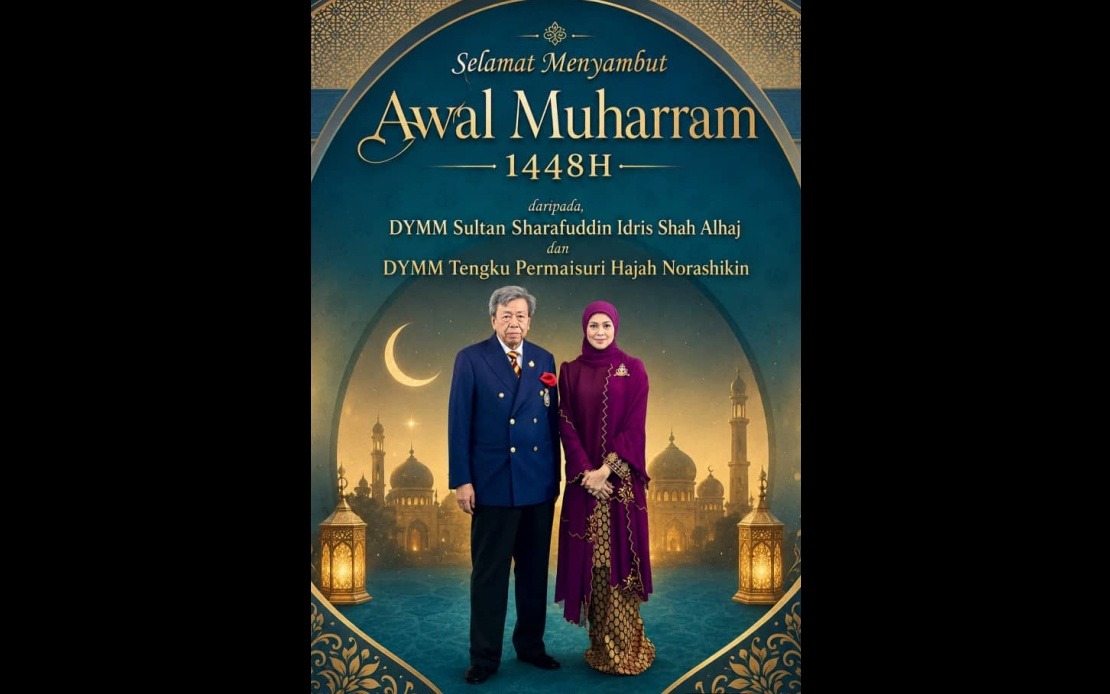
Sultan Sharafuddin Idris Shah of Selangor has renewed his appeal for Muslims to place unity at the forefront of their response to contemporary challenges, marking the occasion of Maal Hijrah 1448H celebrations in Shah Alam. The Islamic New Year observance provided the platform for the monarch to articulate his vision of cohesion within the Muslim community, framing the annual commemoration not as a mere historical recollection but as a catalyst for meaningful transformation and collective purpose.
In his address, Sultan Sharafuddin drew upon the philosophical significance of Hijrah, explaining that the concept transcends its literal interpretation as a physical journey from Mecca to Medina. Instead, the ruler characterised the event as emblematic of constructive change and the consolidation of the ummah—the global community of Muslims. This reframing positions Hijrah as a metaphor for spiritual and social renewal, inviting the faithful to examine their own commitment to community welfare and mutual support during times of difficulty.
The Sultan reflected on the enduring wisdom imparted by his late father, Sultan Salahuddin Abdul Aziz Shah, whose teachings emphasised restraint and principled conduct in addressing disagreements. The relevance of this paternal guidance resonates particularly in contemporary Malaysia, where political fragmentation, sectarian tensions, and social media amplification of disputes have strained communal bonds. By invoking his father's legacy, Sultan Sharafuddin positioned his message within a continuity of principled leadership and demonstrated that the call for unity extends across generations within the royal institution.
A central element of the Sultan's message concerns the methodology by which differences should be aired and resolved. He advocated for the application of wisdom and decorum when raising concerns, fundamentally rejecting the adversarial public discourse that has become increasingly prevalent. According to his perspective, constructive criticism and correction must be administered with courtesy and thoughtfulness, recognising that the manner of communication proves as important as its substance. This approach reflects classical Islamic jurisprudence on enjoining good and forbidding evil while maintaining societal harmony.
The Sultan stressed that problematic matters ought to be addressed through confidential discussions underpinned by mutual respect and collaborative problem-solving. This framework stands in stark contrast to the contemporary trend of airing grievances through public statements, social media campaigns, and media coverage that amplifies divisions. By advocating for private resolution, the ruler implicitly critiqued the performative nature of much modern political and social discourse, where public posturing often eclipses genuine effort to address underlying issues.
A particularly salient aspect of the Sultan's intervention concerned the strategic vulnerability created by internal discord. He warned that public quarrelling exposes weaknesses within both the Muslim community and the nation itself, creating opportunities for external actors or political rivals to exploit divisions for their own gain. This observation carries significant implications for Malaysia's multiethnic and multireligious context, where communal fractures can be weaponised to undermine social cohesion and democratic stability. The Sultan's message thus extends beyond moral suasion to encompass pragmatic national interest, suggesting that unity constitutes not merely a spiritual imperative but a strategic necessity.
The monarch elaborated that when internal conflicts persist without resolution, the entire community suffers regardless of which faction emerges nominally victorious. This zero-sum analysis challenges the competitive political culture that dominates Malaysian discourse, where winning arguments or policy disputes often takes precedence over preserving relationships and collective welfare. The Sultan's assertion that no genuine victor emerges from prolonged internal strife offers a corrective to this mindset, reorienting discussions toward mutual benefit rather than factional triumph.
Beyond addressing conflict, Sultan Sharafuddin articulated an affirmative vision of the Hijrah spirit centred on strengthening solidarity, nurturing tolerance, and subordinating personal or sectional interests to broader religious, national, and communal objectives. This formulation attempts to recalibrate priorities in a society increasingly characterised by identity politics and special interest advocacy. The Sultan's emphasis on transcending narrow concerns reflects classical Islamic ethics regarding communal obligation and suggests that spiritual renewal during Maal Hijrah should translate into concrete behavioural change.
The Sultan's benediction for the new Islamic year invoked divine blessing and prosperity for all inhabitants, alongside renewed commitment to unity and harmony among Muslims and the broader Malaysian society. This inclusive framing acknowledges that communal stability benefits not only the Muslim majority but the entire nation, recognising Malaysia's constitutional commitment to pluralism and interfaith coexistence. The formulation thus positions Muslim unity not as sectarian assertion but as foundational to national wellbeing.
The timing and content of Sultan Sharafuddin's message carry particular resonance in contemporary Malaysia, where political realignments, generational shifts, and economic pressures have tested social cohesion. By coupling moral exhortation with pragmatic warnings about the costs of division, the ruler articulated a message designed to reach both the idealistic and the calculatively self-interested. For Malaysian policymakers and community leaders, the Sultan's call for private resolution of disputes and prioritisation of collective interest over individual advancement offers a corrective to polarisation that increasingly characterises the nation's political and social landscape.