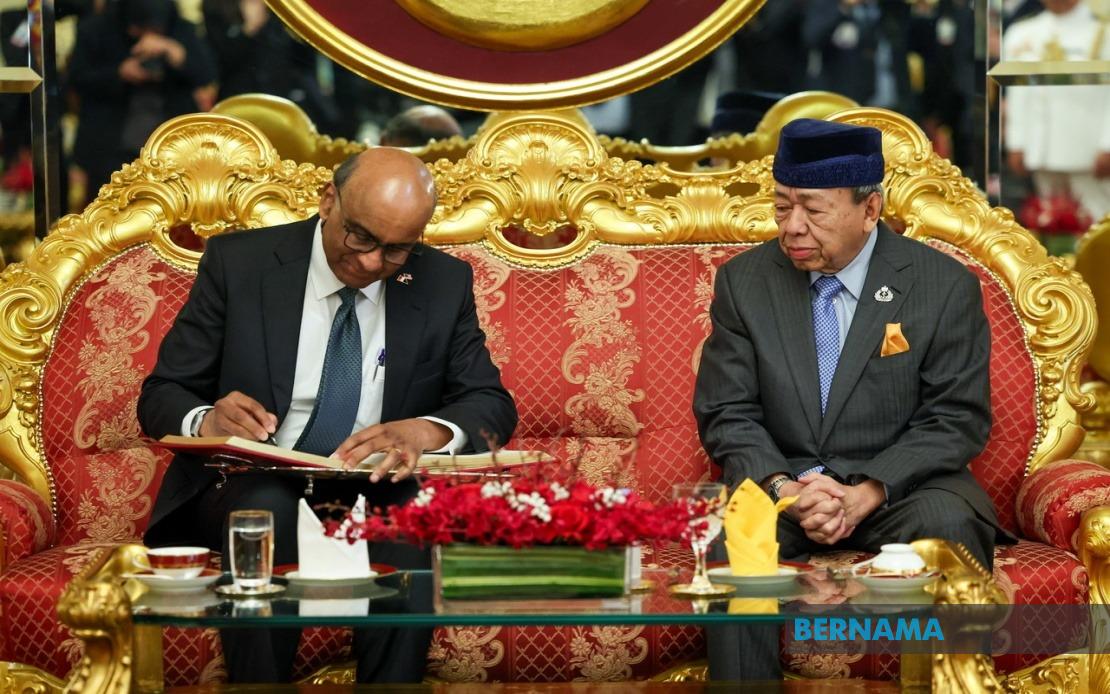
The Sultan of Selangor, Sultan Sharafuddin Idris Shah, hosted Singapore President Tharman Shanmugaratnam in an official audience at Istana Alam Shah on July 14, underscoring the bilateral relationship between Malaysia's most economically developed state and its prosperous southern neighbour. The 90-minute meeting, which commenced at 11 am and concluded at 12.40 pm, brought together senior figures from both sides in a formal setting that reflects the ceremonial importance placed on cross-border diplomatic engagement.
President Tharman arrived at the palace where he was formally received by Tengku Amir Shah, the Raja Muda of Selangor, the heir apparent to the sultanate. The presence of Tengku Amir Shah at the reception underscores Selangor's institutional commitment to the visit and signals dynastic continuity in state-level diplomacy. This protocol is particularly significant given Selangor's status as the economic engine of Malaysia, with its port facilities, manufacturing capacity, and financial services sector playing outsized roles in national prosperity and bilateral trade flows.
Minister of Entrepreneur Development and Cooperatives Steven Sim attended the audience in his capacity as minister-in-attendance, a role that designates him as the federal government's liaison officer and protocol representative during the visit. This ministerial presence bridges state and national-level engagement, ensuring that discussions held at Istana Alam Shah align with broader Malaysian government priorities and objectives. The inclusion of a portfolio minister responsible for business development and cooperative frameworks also hints at potential discussions regarding entrepreneurial partnerships and economic cooperation between the two jurisdictions.
President Tharman is undertaking a formal three-day state visit spanning July 13 to 15 at the invitation of His Majesty Sultan Ibrahim, King of Malaysia. This carefully scheduled engagement represents a reciprocal diplomatic gesture, as the Foreign Ministry has confirmed that it mirrors Sultan Ibrahim's state visit to Singapore during May 6 and 7, 2024. Such reciprocal visits serve multiple purposes in the context of Malaysia-Singapore relations: they reinforce institutional links between top leadership, provide opportunities for candid bilateral discussions on matters of mutual interest, and demonstrate publicly the stability and warmth of diplomatic ties.
The Selangor audience represents one component of a broader state visit itinerary that likely includes engagements at the federal level in Kuala Lumpur or Putrajaya. By beginning or including a stop in Selangor, the schedule acknowledges the state's economic and political weight within Malaysia's federation. Selangor generates substantial portions of Malaysia's gross domestic product and hosts major port operations, technology hubs, and manufacturing clusters that directly interact with Singapore's economy through supply chains, financial networks, and labour mobility.
Malaysia and Singapore share a relationship of strategic importance tinged with historical complexities and contemporary competition. Singapore functions as Malaysia's second-largest trading partner globally, a position that reflects decades of economic integration despite periodic tensions over water agreements, maritime boundaries, and labour issues. Within ASEAN specifically, Singapore ranks as Malaysia's most significant trading partner among member states of the regional grouping, a distinction that underscores the depth of commercial interconnection and the mutual economic stakes both nations possess in continued stability and growth.
The bilateral trade relationship carries particular significance for Malaysian manufacturers and service providers who depend on access to Singapore's developed financial markets, its position as a regional hub for multinational corporations, and its sophisticated logistics infrastructure. For Singapore, Malaysia offers natural resources, a large consumer market, and manufacturing capacity that complement its role as a financial and technology services centre. This complementary relationship, while not without friction points, has proven resilient across multiple political transitions in both countries.
State visits at this level serve purposes beyond the ceremonial. They provide frameworks within which working-level officials from both governments can establish agendas for bilateral cooperation, discuss irritants requiring resolution, and lay groundwork for agreements or initiatives that may be formalised at higher levels. The 90-minute duration of the Istana Alam Shah audience suggests substantive discussions beyond simple courtesy calls, providing adequate time for meaningful exchange on matters affecting both jurisdictions.
For Selangor specifically, engagement with Singapore's leadership offers opportunities to explore cooperation on urban development, port operations, technology transfer, and financial services. Selangor's Port Klang is one of Southeast Asia's busiest shipping hubs and directly interfaces with Singapore's port operations and the Strait of Malacca's strategic waterway. Any state visit discussion involving Selangor's leadership therefore carries implications for regional maritime commerce and logistics networks that extend far beyond bilateral concerns.
The visit also reflects Malaysia's broader diplomatic posture within ASEAN and the wider Indo-Pacific region. Maintaining robust relations with Singapore, despite occasional disagreements, remains a cornerstone of Malaysian foreign policy. State visits serve as periodic recalibrations of these relationships, affirming mutual commitment while creating space for discreet discussion of sensitive matters that might prove difficult to address through normal diplomatic channels.
President Tharman's selection of Selangor as part of his Malaysian itinerary suggests awareness of the state's economic importance and perhaps signals interest in exploring state-level cooperation mechanisms that complement national-level engagement. This multi-level diplomatic approach reflects contemporary practice in ASEAN, where subnational entities increasingly engage in economic and cultural cooperation while respecting the primacy of national governments in formal diplomatic matters.

