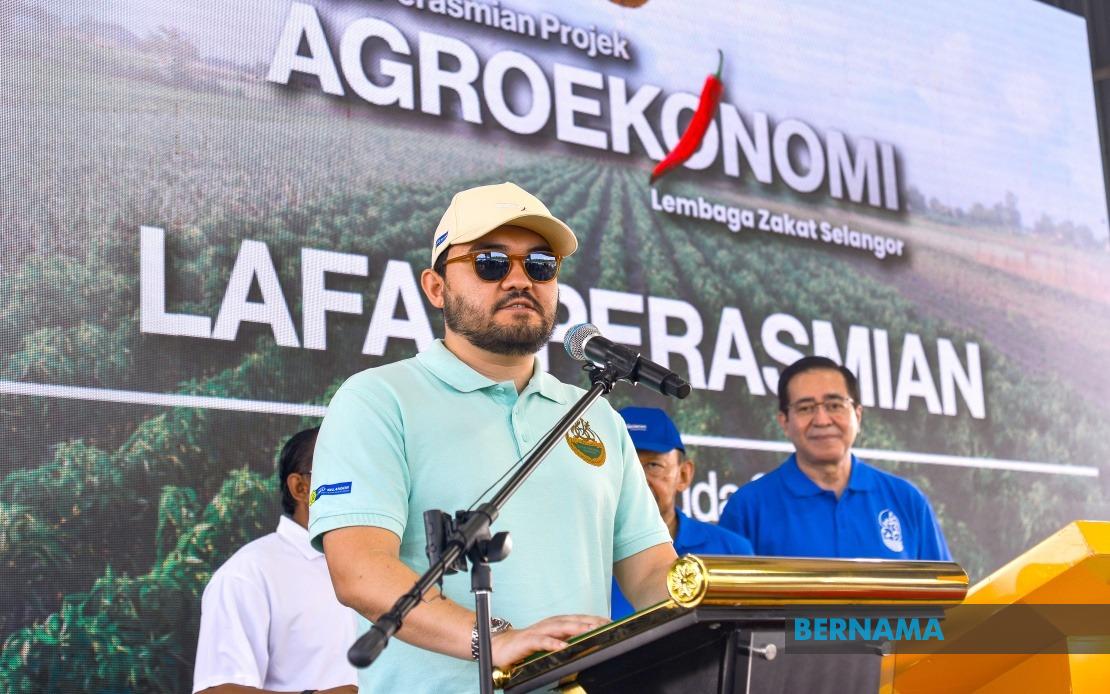
The Selangor Zakat Board has taken a significant step beyond traditional welfare assistance by introducing an agricultural initiative designed to generate lasting economic opportunities for the asnaf community. Launched on July 1 by the Raja Muda of Selangor, Tengku Amir Shah Sultan Sharafuddin Idris Shah, the Agroeconomic Project represents a shift towards self-sufficiency and income-generating activities as the primary avenue for supporting vulnerable populations in the state.
The project, developed through an investment of RM26 million, unfolds across 110 acres of land at Laman Agro Ehsan in Bukit Beruntung, with 76 acres allocated specifically for agricultural development. The initiative centres on intensive chilli cultivation using modern fertigation technology, a technique that optimises water and nutrient delivery to crops. This focus on high-value horticultural production reflects a strategic choice to maximise returns within a limited land footprint, making it economically viable for individual smallholders.
Fortynine asnaf recipients have been carefully selected to participate in a comprehensive three-year development programme. Rather than providing one-off cash assistance, the scheme equips participants with technical expertise, ongoing mentorship, and hands-on experience in managing commercial agricultural operations. Each participant receives a half-acre cultivation plot containing approximately 2,000 chilli plant bags, collectively representing 96,000 plants across all plots during each production cycle. This structured approach ensures participants acquire practical farming knowledge while building confidence in their ability to operate independently.
According to programme administrators, participants can anticipate generating monthly incomes of up to RM4,000 once their farming operations mature and achieve consistent production levels. This figure, substantially above basic living allowances, reflects the potential for agricultural enterprise to provide dignity and financial stability to recipients. The income trajectory underscores how targeted investment in productive capacity, rather than mere distribution of funds, can create meaningful economic transformation within vulnerable segments of society.
The selection process employed collaborative mechanisms, partnering with the Kuala Langat Area Farmers' Organisation to identify candidates possessing the motivation, capability, and circumstances necessary for successful participation. This screening approach moves beyond purely need-based criteria to emphasise entrepreneurial potential and readiness to engage in structured agricultural work. Such selectivity, while limiting programme accessibility, enhances the likelihood of success and sustainability for those chosen.
Beyond agricultural training and cultivation rights, the initiative provides comprehensive support structures addressing participants' broader welfare needs. Housing accommodation at the Prima Beruntung residential area is made available, with rental costs entirely subsidised by Zakat Selangor throughout the programme duration. This holistic approach recognises that barriers to economic participation often extend beyond skills deficits to encompass housing insecurity and related challenges. By addressing multiple dimensions of vulnerability simultaneously, the project creates a more enabling environment for participants to concentrate on productive agricultural work.
The financial architecture of the initiative demonstrates collaborative funding mechanisms characteristic of modern social enterprise in Malaysia. Beyond the primary RM26 million investment, strategic partners have contributed RM2.07 million in wakalah-based financing arrangements. The Pilgrims Fund Board, RHB Islamic Bank Berhad, and Cagamas Berhad have jointly funded aspects of the project, reflecting broader recognition within the financial and institutional sectors of the social development imperative. This multi-stakeholder approach distributes risk while mobilising diverse sources of capital and expertise.
Participant testimonials reveal the transformative impact of transitioning from welfare dependency to productive engagement. Norfhadilah Mohd Shafiin, a 45-year-old mother of five, describes the programme as having opened new pathways to strengthen family financial resilience. Her emphasis on knowledge acquisition and confidence-building reflects how economic empowerment programmes function beyond mere income generation to restore agency and self-determination. Similarly, participant Raimi Rusydi Rodi, a father of two, underscores the value of learning transferable agricultural skills within a supportive peer environment, highlighting how communal programme structures facilitate mutual learning and solidarity among participants.
The initiative carries broader significance for social policy in Selangor and potentially across Malaysia's Islamic financial ecosystem. By treating asnaf populations as capable agricultural entrepreneurs rather than passive benefit recipients, the project challenges conventional welfare paradigms. This reorientation towards productive capacity-building aligns with Islamic principles emphasising self-reliance and dignity while responding to contemporary labour market realities where traditional employment may be inaccessible to marginalised groups.
The agricultural focus offers additional advantages within Malaysia's economic and environmental contexts. Domestically produced horticultural products remain in high demand, and domestic chilli cultivation has consistently struggled to meet consumption requirements, necessitating significant imports. Supporting smallholder chilli farmers addresses supply-side constraints while providing market-validated income opportunities. Furthermore, local agricultural development supports rural economic diversification and food security objectives embedded within national development strategies.
The three-year programme structure reflects realistic timeframes for agricultural enterprises to achieve viability and profitability. Initial years typically involve intensive capital investment, crop establishment, market development, and operational refinement before consistent returns materialise. By providing sustained support across this critical period rather than expecting immediate self-sufficiency, the project acknowledges agricultural realities and positions participants for genuine long-term sustainability rather than short-term income spikes followed by programme exit.
Potential scaling of this model warrants consideration given demonstrated effectiveness and participant testimonials. Similar initiatives across other Malaysian states, adapted to local agricultural comparative advantages and asnaf demographics, could extend comparable opportunities to larger vulnerable populations. The involvement of Islamic financial institutions suggests financing mechanisms exist to support expanded implementation, though programme quality and participant selection rigour would require careful preservation during any expansion.

