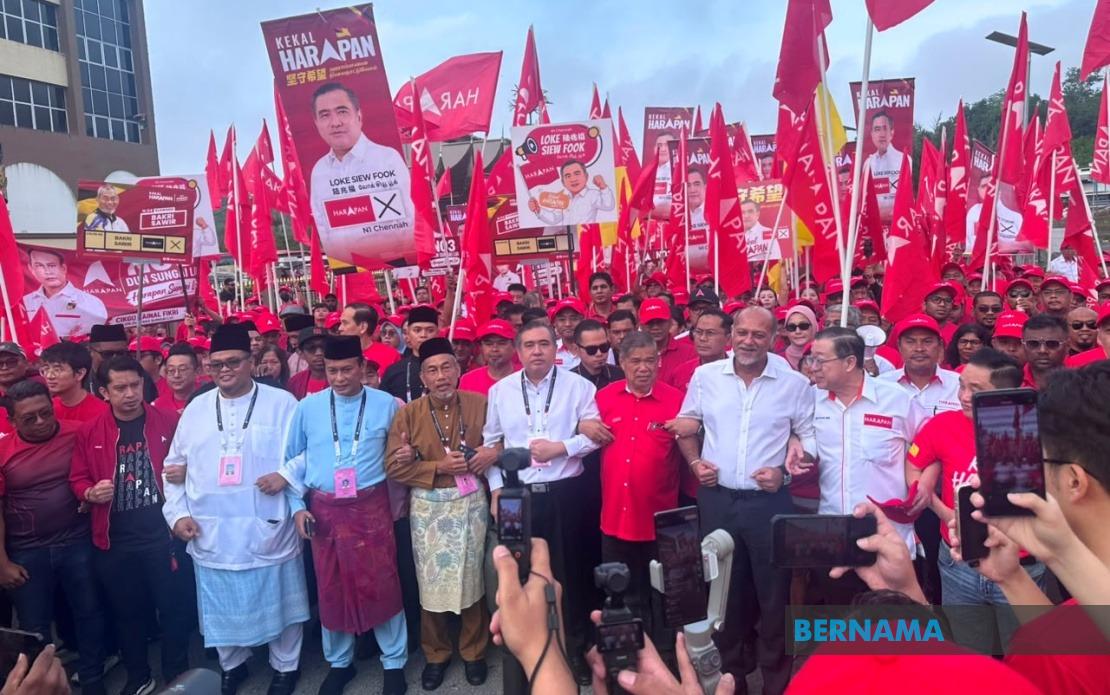
The Pakatan Harapan coalition deployed its senior leadership across multiple nomination centres throughout Negeri Sembilan on July 18, a coordinated show of support underscoring party unity as candidates formally entered the race for the 16th state election. The high-profile presence of ministers, state assemblymen, and party officials at various filing locations reflected the coalition's determination to project momentum in a state where it currently holds 17 of 36 legislative seats.
In Jelebu, DAP secretary-general Anthony Loke, who also serves as Minister of Transport, submitted his nomination papers for the Chennah state seat at the Dewan Besar Kuala Klawang. The appearance of multiple party chiefs alongside Loke—including DAP chairman Gobind Singh Deo, DAP adviser Lim Guan Eng, and Amanah president Datuk Seri Mohamad Sabu—demonstrated the cross-party nature of PH's coordination efforts and suggested a deliberate strategy to present a unified front to voters.
Parallel filings at the Jempol District and Land Office featured Deputy Communications Minister Teo Nie Ching, who serves as Wanita DAP chief, accompanying PH's Bahau state seat candidate Teo Kok Seong through the nomination process. The presence of Communications Minister Datuk Seri Fahmi Fadzil at the same venue added additional weight, as he was there to escort four separate PH candidates contesting the Serting, Palong, Jeram Padang and Bahau seats. This multi-candidate coordination highlighted how party machinery was mobilised to ensure smooth filing operations while maximising media visibility.
The composition of candidates under Fahmi's sponsorship revealed PH's mixed approach to candidate selection. While Teo retained his Bahau seat as the incumbent from the previous general election, the three other candidates—Yaacob Mahmood, Muhammad Zahin Zinal Abidin, and Manivanan Gowin—represented fresh faces, suggesting the coalition's effort to blend continuity with renewal as it sought to expand or consolidate its electoral footprint. Such rotation strategies often aim to energise local party bases while maintaining experienced representation in contested areas.
At the Port Dickson District Administration Complex, Negeri Sembilan Menteri Besar Datuk Seri Aminuddin Harun submitted his papers for the Linggi state seat, flanked by an impressive delegation including DAP deputy secretary-general Hannah Yeoh, PKR secretary-general Datuk Dr Fuziah Salleh, and the Prime Minister's political secretary Datuk Farhan Fauzi. Aminuddin's position as Menteri Besar and PH state chairman made his nomination filing symbolically significant; the cross-party attendance underscored efforts to project a cohesive leadership structure heading into the campaign. Incumbent assemblymen Yew Boon Lye (Chuah), Choo Ken Hwa (Lukut), and Dr G Rajassekaran (Sri Tanjung) also filed at this centre, consolidating experienced representatives who could leverage existing constituency networks.
At the Wisma Majlis Bandaraya Seremban venue, Entrepreneur and Cooperatives Development Minister Steven Sim coordinated the filing of six PH candidates, drawing support from Selangor State Legislative Assembly Speaker Lau Weng San, Bukit Gelugor MP Ramkarpal Singh, and PKR vice-president Datuk Seri R. Ramanan. This broader cross-state representation, with officials from Selangor participating in Negeri Sembilan proceedings, reflected how larger coalition machinery operated across state boundaries to reinforce messaging and ensure operational consistency.
The nomination day activity occurred within the context of Negeri Sembilan's specific electoral dynamics. Following the dissolution of the State Legislative Assembly on June 5 after receiving consent from Yang Dipertuan Besar Tuanku Muhriz Tuanku Munawir, the 36-seat legislature became vacant. In the previous 15th state election held in 2023, PH's 17-seat tally represented a narrow plurality; Barisan Nasional held 14 seats while Perikatan Nasional secured five. These numbers suggested a competitive landscape where modest swings in particular constituencies could alter overall control, making intensive candidate support and visible leadership presence strategically valuable for morale and media narrative-building.
The Election Commission designated August 1 as polling day, with early voting scheduled for July 28, providing candidates and parties roughly two weeks for campaign activities. The compression of the nomination-to-polling timeline meant that the July 18 filing day functioned not merely as an administrative checkpoint but as the de facto campaign launch, with media coverage of leadership attendance potentially reaching voters during this critical early phase when campaign narratives were still being formed.
For Malaysian observers accustomed to state-level politics, the spectacle of multiple ministers attending nomination centres reflected how electoral cycles in smaller states can attract national-level political attention. The participation of the Prime Minister's political secretary and various federal ministers suggested that Negeri Sembilan's result carried implications for broader coalition dynamics at the federal level, particularly regarding PH's ability to maintain its majority status in state legislatures as a counter to government narratives about its diminishing electoral relevance.
The strategic deployment of leadership across geographically dispersed nomination centres also served a resource-allocation purpose. By ensuring senior figures appeared alongside candidates in different constituencies, PH maximised the optics of party strength without requiring all senior leaders to attend every filing location, allowing them to cover maximum ground efficiently while generating multiple photo opportunities and media hooks across different centres and constituencies.
Looking forward, the composition and profile of fielded candidates, combined with the intensity of leadership involvement on nomination day, would signal which constituencies PH considered most competitive or symbolically significant. The mixture of incumbents and newcomers, along with the ministerial firepower deployed across different venues, suggested a party attempting simultaneously to consolidate existing gains, present fresh faces to voters, and project institutional confidence through visible leadership solidarity during the formal campaign commencement.

