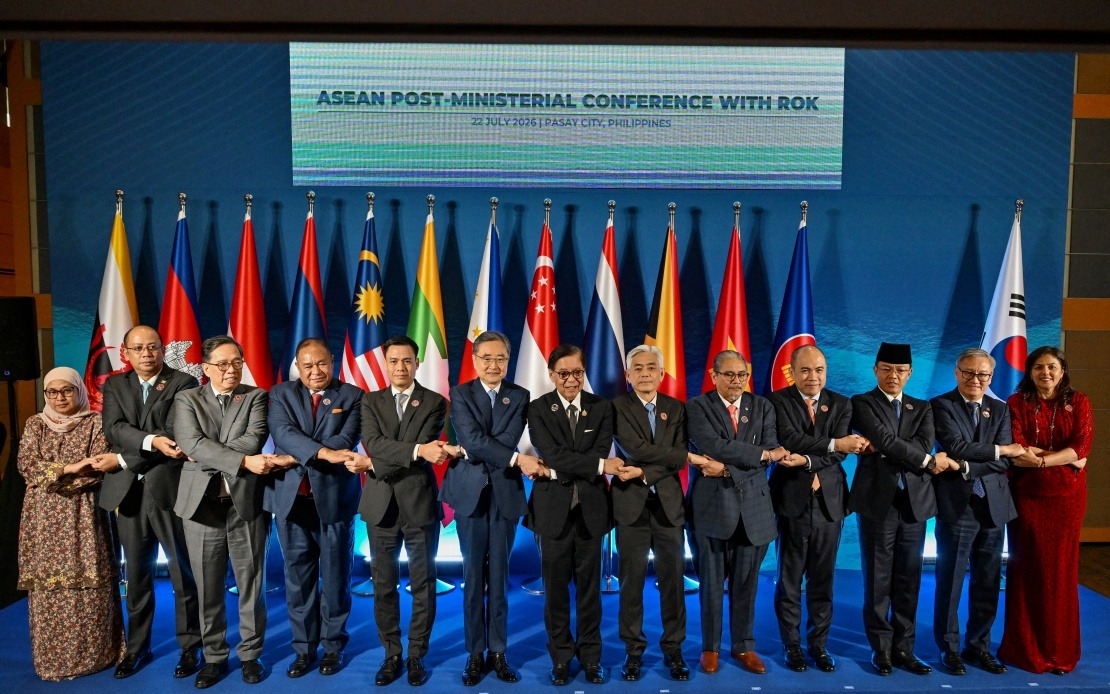
South Korea and the Association of Southeast Asian Nations have signalled renewed determination to strengthen their bilateral relationship, rolling out a series of ambitious collaborative initiatives during foreign ministers' talks in Manila this week. The meeting, held on the margins of broader ASEAN-related diplomatic gatherings, witnessed both sides endorsing a vision that positions the partnership as increasingly vital to navigating the region's complex economic and security landscape. The development marks a deliberate effort by Seoul to deepen its footprint across Southeast Asia at a time when supply chains are being reconfigured globally and technological advancement is accelerating at unprecedented pace.
Foreign Minister Cho Hyun, who co-chaired the session alongside Thailand's foreign minister, emphasised that South Korea and ASEAN have transcended the status of mere trading partners to become what he termed "indispensable partners." This characterisation reflects Seoul's strategic calculus that engagement with the ten-member bloc is critical to its long-term prosperity and regional influence. The rhetoric underscores how significantly the relationship has evolved since their initial diplomatic overtures, with both parties now viewing cooperation as mutually reinforcing rather than transactional.
The Comprehensive Strategic Partnership vision, which forms the scaffolding for these initiatives, was formally introduced by former President Lee Jae Myung at last year's summit. The framework rests on three substantive pillars: people-centred cooperation encompassing cultural and educational exchanges; growth and innovation focused on technological advancement and economic development; and peace and stability addressing regional security concerns. This tripartite structure demonstrates how Seoul conceptualises the relationship as spanning multiple dimensions rather than being confined to trade or diplomacy alone.
Among the most significant announcements was the introduction of a Korea-ASEAN AI Partnership Initiative, a programme designed to leverage Seoul's sophisticated capabilities in artificial intelligence across the region. The initiative encompasses three complementary streams: establishing robust AI ecosystems within ASEAN economies, fostering research collaboration and developing local talent in the field, and establishing regulatory frameworks that permit safe and responsible deployment of AI technologies. For ASEAN nations grappling with the challenge of technological leapfrogging, access to South Korea's full-stack AI expertise—spanning semiconductor design, software development and applications—represents a valuable opportunity to accelerate digital transformation without the lengthy trial-and-error phase that earlier industrialisers experienced.
Paralleling the AI push, Seoul introduced a suite of initiatives targeting cultural and creative industries, domains where Southeast Asian nations possess considerable inherent strengths but often lack the institutional scaffolding or technological infrastructure to scale regionally or globally. South Korean companies have achieved remarkable success in exporting cultural products—from entertainment to gaming—and sharing this know-how with ASEAN could unlock significant economic value whilst simultaneously fostering people-to-people connections that strengthen political ties. The cultural dimension of the partnership also carries symbolic weight, allowing both sides to position their relationship as transcending narrow strategic calculation.
The agreement to establish a joint maritime safety academy reflects heightened attention to ensuring stability in some of the world's busiest sea lanes, an issue that resonates acutely across Southeast Asia given territorial sensitivities and the region's dependence on maritime commerce. Seoul's commitment to cooperating on online scam crime detection and prevention, meanwhile, addresses a contemporary security challenge that cuts across borders and increasingly affects ordinary citizens in both South Korea and ASEAN countries. These initiatives demonstrate how the partnership addresses security challenges that extend beyond traditional military concerns.
Economically, the most consequential development involves efforts to upgrade their free trade agreement, which was initially concluded nearly two decades ago. The FTA, signed initially in 2006 covering goods before being expanded to services in 2007 and investment in 2009, is now being recalibrated to encompass digital economy transactions, critical mineral supply chains, and other emerging economic sectors. This upgrade reflects recognition that the original agreement was negotiated in a different technological era and no longer captures the full scope of contemporary commercial relationships. For Malaysia and other ASEAN members, enhanced terms on digital services and critical minerals—sectors of particular relevance to regional economies—could yield tangible benefits.
The scale of South Korea's economic engagement with ASEAN justifies the diplomatic investment evident in these initiatives. Seoul exported approximately US$122.5 billion in goods to ASEAN member states in 2025, positioning the bloc as its third-largest trading partner globally. This economic interdependence creates powerful incentives for both sides to navigate disagreements constructively and invest in institutional mechanisms that reduce friction. The talks initiated last month to upgrade the FTA demonstrate that Seoul regards the relationship as sufficiently important to warrant substantial negotiating resources.
A subtle but significant aspect of the Manila meeting involved discussions regarding the Korean Peninsula, with South Korea reiterating its pursuit of peaceful coexistence and shared growth with North Korea. Seoul explicitly sought ASEAN's continued diplomatic backing for its inter-Korean initiatives, and ASEAN member states obliged by reaffirming their view that peace and stability on the peninsula constitute prerequisites for broader regional stability. This framing—treating Korean peninsula security as integral to Southeast Asian interests rather than a parochial Korean concern—illustrates how Seoul has successfully embedded its strategic priorities within a broader regional security narrative.
The bilateral talks that Cho conducted with counterparts from the Philippines and Thailand, held concurrently with the multilateral session, permitted deeper discussion of country-specific concerns and opportunities. Such parallel diplomacy allows Seoul to calibrate its approach to different ASEAN members based on their particular economic structures, security challenges and diplomatic priorities. The Philippines, with its strategic location and security concerns regarding disputed maritime territories, and Thailand, as a long-standing Southeast Asian anchor, both merit particular diplomatic attention from Seoul's perspective.
Looking forward, the success of these new initiatives will depend substantially on implementation capacity and sustained political commitment from both sides. ASEAN member states have expressed formal welcome to the vision and pledged cooperation, yet translating such expressions into tangible collaborative outcomes requires institutional coordination, adequate funding and alignment of incentives across ten diverse economies with varying levels of technological development and institutional capacity. South Korea's willingness to provide technical expertise and capacity-building support will likely prove decisive in determining whether these initiatives move beyond ceremonial announcements to generate real-world benefits.
The partnership announcements also reflect broader strategic positioning as major powers recalibrate their relationships with Southeast Asia. ASEAN's centrality to the region's emerging geopolitical architecture makes partnerships with it attractive to multiple external actors, and South Korea's emphasis on technology sharing, cultural exchange and economic cooperation represents one approach to deepening regional engagement. Whether these initiatives ultimately reshape the relationship or remain largely symbolic will become clearer over the coming months as implementation details emerge and tangible outcomes become measurable.

