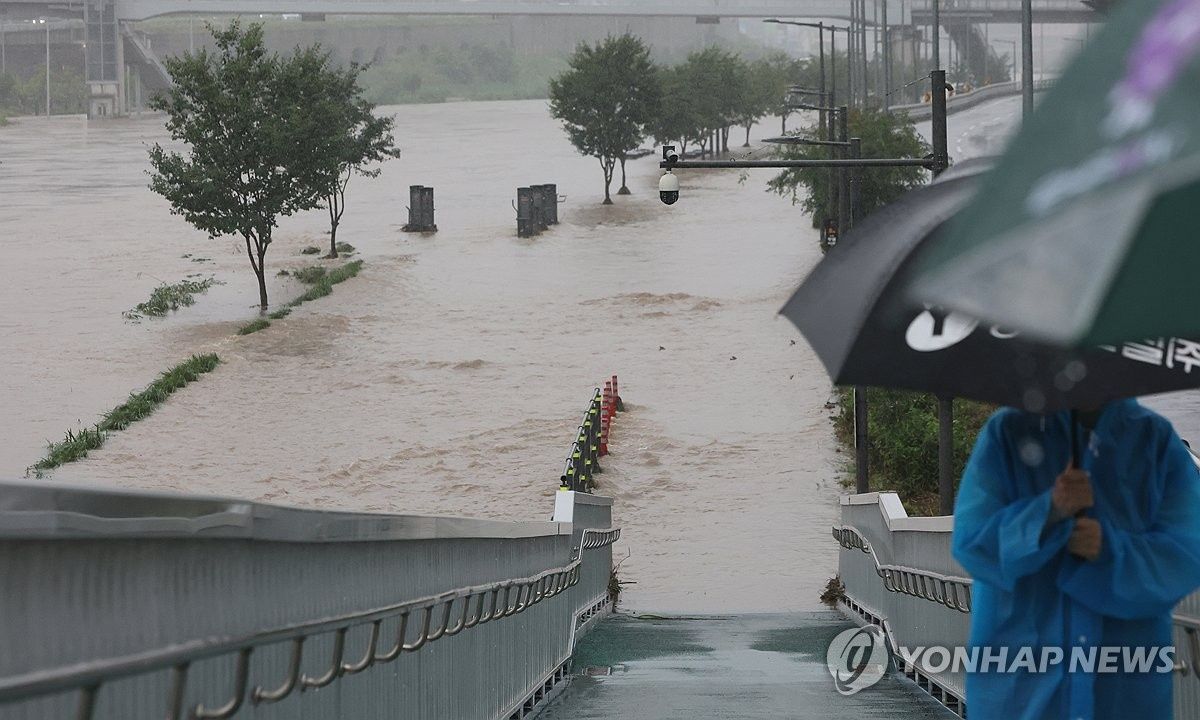
South Korea's capital region and eastern provinces have been gripped by severe weather overnight, with relentless downpours inundating residential areas, submerging roadways, and leaving hundreds of properties damaged. The Seoul metropolitan area and Gangwon Province bore the brunt of the deluge between midnight and 10 a.m., during which time the Central Disaster and Safety Countermeasure Headquarters confirmed approximately 540 documented instances of property damage across affected zones. Officials emphasized that despite the scale of destruction, no deaths or serious injuries had been recorded as of Saturday morning, a fortunate outcome given the intensity and speed of the precipitation event.
Rainfall measurements across the region underscored the exceptional nature of the weather system. Paju recorded 192.5 millimetres, Dongducheon 189.5 millimetres, Pocheon 179 millimetres, Gimpo 166.5 millimetres, and Cheorwon 159.5 millimetres—all figures considerably exceeding typical seasonal rainfall patterns and achieving near within a compressed ten-hour window. The uniformity of heavy precipitation across multiple municipalities indicated a weather front of considerable geographic extent, affecting both urban centres and rural districts with equal force.
The scale of property-related incidents manifested in two principal categories: direct flood damage and secondary environmental hazards. Authorities documented 148 instances of residential and vehicular flooding affecting homes, apartments, and roadways throughout the affected regions. An additional 392 cases involved fallen trees, dislodged debris, and structural compromises caused by waterlogging—consequences that often persist long after rainfall subsides and frequently necessitate costly remediation efforts. The disparity between flood and debris-related incidents reflects how saturated soil conditions amplified wind-driven damage alongside water accumulation.
Responding to the immediate threat, disaster management authorities implemented precautionary evacuations affecting 95 individuals drawn from 44 households distributed across six municipalities. These temporary relocations, while inconvenient, functioned as preventive measures to avert potential casualties in flood-prone or landslide-susceptible zones. The decision to evacuate substantially fewer residents than the property damage toll suggests that early warning systems and evacuation protocols, refined through decades of seasonal weather challenges, operated effectively to minimize human exposure to danger.
Environmental and recreational infrastructure sustained considerable disruption. Access to ten national parks, including the popular Mount Bukhan facility, was entirely restricted to visitors pending stabilization of trail conditions and completion of damage assessments. Roughly 275 designated hiking paths across the region remained closed, eliminating weekend recreational opportunities for residents and tourists alike. Coastal operations also faced suspension, with seven ferry routes servicing the west coast halted due to unsafe maritime conditions—a reminder that heavy rainfall impacts extend beyond terrestrial ecosystems into transportation networks dependent on stable water conditions.
Weather forecasts indicated that the crisis phase remained incomplete. Meteorological agencies projected that intense rainfall would persist through Sunday, with certain areas potentially experiencing rates approaching 300 millimetres per hour—precipitation intensity capable of overwhelming drainage infrastructure and triggering secondary hazards such as rapid-onset flooding and debris flows. This extended duration meant that cumulative rainfall totals could substantially exceed initial measurements, amplifying the risk calculus for landslide occurrence in mountainous terrain.
Government leadership responded with mobilization directives aimed at accelerating recovery operations. Prime Minister Han Seong-sook convened an emergency response meeting and explicitly ordered authorities to deploy equipment and personnel expeditiously to affected communities, signalling high-level political attention to the disaster response. In her remarks, Han acknowledged both the relief that fatalities had been avoided and the genuine hardship facing flood-affected residents, positioning the government's intervention as a measured but urgent response to legitimate civilian suffering.
Anticipating continuation of the weather system's progression, officials issued specific warnings for two additional provinces—Chungcheong (central region) and Gangwon (northeast)—where heavy rain was forecast to develop overnight and intensify Sunday morning. Prime Minister Han explicitly instructed disaster management personnel to prepare for potential landslides in these zones, reflecting accumulated knowledge about which geographic areas and soil conditions generate highest avalanche risks during extreme precipitation events. This forward-looking alertness represented the practical application of lessons learned from previous weather-related disasters.
For Malaysian observers, the Seoul incident illustrates both the vulnerabilities that advanced economies face during climate extremes and the institutional mechanisms through which developed nations attempt to minimize casualties. South Korea's relatively effective emergency response—reflected in zero fatalities despite substantial environmental disruption—contrasts instructively with disaster outcomes in regions where early warning systems, evacuation capacity, or disaster management coordination remains underdeveloped. The intensity of rainfall documented during this event (approaching 200 millimetres in ten hours) exceeds typical Malaysian monsoon precipitation rates, highlighting how climate variability increasingly produces weather events that challenge even sophisticated infrastructure systems.

