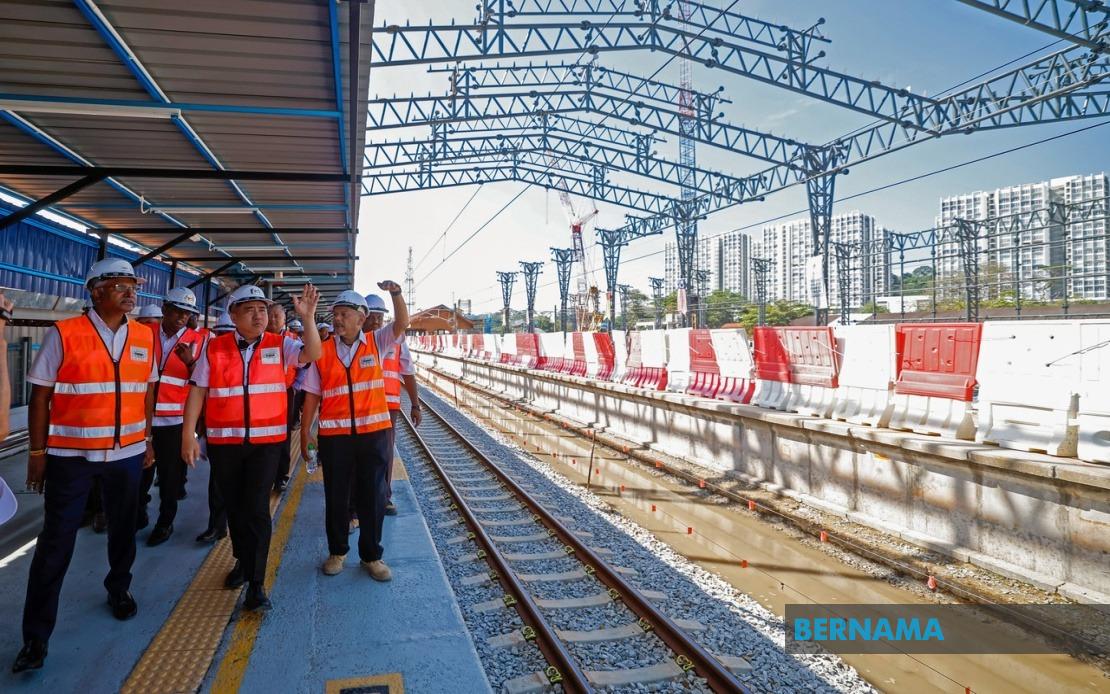
The construction of Seremban Sentral, an ambitious new integrated railway station that will serve as a modern transport interchange in the heart of Negeri Sembilan's capital, has progressed to the 35 per cent milestone and remains on schedule for completion by March 2027, Transport Minister Anthony Loke announced this week during an inspection of the site.
The RM100 million project represents a significant investment in regional infrastructure, combining the relocation and modernisation of the heritage Seremban KTMB Station—which has stood for over a century—with an entirely new contemporary facility. Loke, who represents Seremban in Parliament, characterised the undertaking as one of the ministry's most strategically important initiatives, positioning the station as a transformative landmark that will reshape urban mobility and development patterns in the state.
The most labour-intensive and technically complex phase of construction has now concluded, according to Loke. Foundation work, including deep piling operations and the relocation of underground utilities such as water mains, electrical cables, and telecommunications infrastructure, consumed the majority of the initial project timeline. These preliminary activities were necessarily protracted because precision in locating existing utilities and executing piling to exact specifications cannot be rushed without compromising structural integrity. With these foundational hurdles cleared, project momentum is expected to accelerate substantially through the remaining phases.
The acceleration will focus on the installation of the station's roof structure, extensive glazing systems, and interior finishings that will define the passenger experience. The architectural design incorporates a green building philosophy complemented by Minangkabau-inspired design elements, reflecting Negeri Sembilan's cultural identity while meeting contemporary sustainability standards. Commercial spaces will be integrated throughout, creating opportunities for retail and F&B operators and generating revenue streams to support long-term station operations.
The facility has been engineered with remarkable scalability. Initially designed to accommodate 30,000 passengers daily across six platforms, of which three will be operational at launch, the infrastructure permits future expansion to accommodate 120,000 daily passengers as demand grows. This forward-looking capacity planning reflects transport officials' confidence in regional population growth and their determination to avoid the costly retrofitting that plagues facilities designed without such expansion parameters. Loke suggested the station's capacity could serve the region's transport needs for three to five decades, providing a planning horizon that justifies the substantial capital outlay.
Dual entrance and exit points at the front along Jalan Tunku Antah and at the rear have been deliberately incorporated to manage traffic circulation and reduce congestion. The design thoughtfully distributes passenger flows and vehicle drop-offs, mitigating the bottlenecks that commonly plague transport hubs where all access routes converge at a single point. When combined with planned frequency increases for Komuter commuter services and express trains once double-tracking of the line is completed, the station is intended to catalyse a modal shift toward rail transport and support higher population densities around the station.
A parallel conservation undertaking has just concluded, restoring the original Seremban KTMB Station to contemporary safety and operational standards. This work involved upgrading electrical systems and wiring infrastructure to modern specifications while preserving the heritage structure's character and integrity. Simultaneously, authorities have engineered a new dedicated stormwater drainage system that will channel rainwater directly into Sungai Temiang, bypassing the station area entirely. This intervention specifically addresses chronic flooding that has previously disrupted station operations and passenger safety during heavy monsoon rainfall, a persistent vulnerability that new infrastructure has finally resolved.
The Seremban Sentral project forms the anchor component of a larger transit-oriented development precinct. Behind the station, the Seremban Sentral TOD mega-project is planned, which will layer residential, commercial, and mixed-use development around the transport hub. This integrated approach—combining transport infrastructure with surrounding urban development—represents best practice in urban planning, enabling the station to function as a catalytic anchor rather than as an isolated facility. For Malaysian cities, such integrated approaches remain relatively uncommon, making Seremban a potential model for future urban renewal initiatives.
Parallel progress on the Klang Valley Double Track Phase 2 upgrade has reached 55.8 per cent completion. To expedite construction on one segment, one track has been temporarily closed, necessitating a temporary reduction in afternoon Komuter service frequencies. While such service reductions are never popular with commuters, they represent a deliberate trade-off to compress the overall project timeline. The double-tracking project, when fully completed, will enable significantly higher service frequencies and reliability on commuter routes serving the greater Klang Valley, which remains Malaysia's densest population and employment corridor.
For Malaysian transport and urban development, the Seremban initiative offers several broader implications. First, it demonstrates sustained commitment to modernising critical heritage infrastructure rather than demolition, a principle that urban preservationists have long championed. Second, it exemplifies the scalable, future-proof design methodology that Malaysian planners should apply more systematically across the transport network. Third, the integration of stormwater management into the transport infrastructure design shows how climate adaptation and resilience can be embedded into major projects from inception rather than addressed as afterthoughts. Finally, the project's focus on integrated mobility hubs rather than standalone rail stations reflects evolving understanding of how transport, urban development, and livability intersect in contemporary Southeast Asian cities.
The March 2027 timeline, while still over two years distant, represents achievable momentum given current progress rates and the completion of preliminary work. For Seremban residents and commuters, the station will eventually offer a seamlessly integrated entry point to regional rail networks. For Negeri Sembilan's economic development aspirations, it represents catalyst infrastructure enabling higher-density, transit-oriented urban growth. As Malaysia continues upgrading its transport infrastructure, the Seremban project serves as both practical achievement and policy statement: heritage preservation and contemporary functionality need not conflict, and transport infrastructure can simultaneously serve operational needs and urban transformation objectives.

