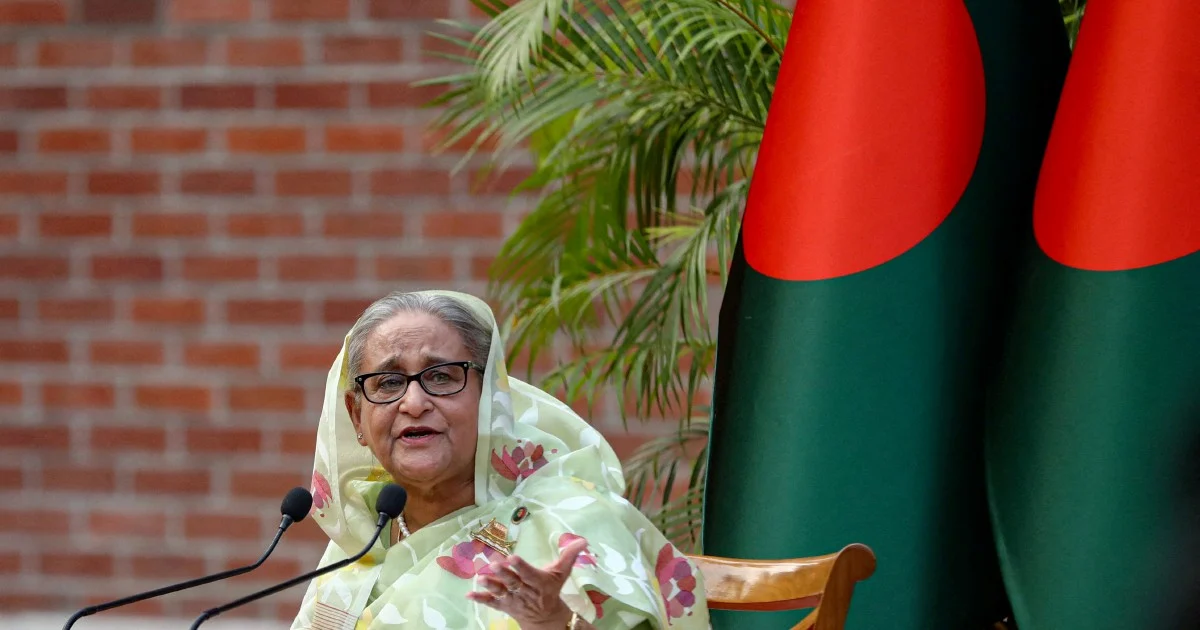
The political crisis enveloping Bangladesh has taken a sharper turn as the nation's interim government issues stark warnings against the return of ousted Prime Minister Sheikh Hasina, who was forced to flee to India in August following unprecedented public unrest. The threat of imprisonment marks an escalation in the standoff between Hasina and Bangladesh's new leadership, which has consolidated power following her dramatic exit from Dhaka amid mass protests that ultimately toppled her administration.
A senior minister from the interim government made the incarceration threat public on Monday, directly challenging Hasina's recent assertions to international media that she intended to return voluntarily in December and submit herself to judicial proceedings. The announcement effectively signals that Bangladesh's post-Hasina leadership will pursue aggressive legal action against the former premier, signalling a hardening of positions that could prolong the nation's political turbulence well into the coming months. The warning appears designed to forestall any attempt by Hasina to stage a dramatic homecoming and potentially galvanise her supporters, who remain scattered across Bangladesh.
Sheikh Hasina's August departure represented one of South Asia's most consequential political upheavals in recent years. Her administration, which had governed Bangladesh continuously since 2009 with a brief interruption, unravelled with startling speed as student-led demonstrations morphed into broader anti-government mobilisation. The protests, initially triggered by concerns over a quota system affecting government jobs, evolved into a full-blown rejection of her leadership, ultimately compelling security forces to stand down and allowing her to escape to the Indian capital. Her sudden absence created a power vacuum that was swiftly filled by an interim administration headed by Dr Muhammad Yunus, the Nobel laureate and microfinance pioneer.
The interim government has since embarked on an ambitious agenda aimed at fundamentally restructuring Bangladesh's political and institutional landscape. Beyond managing the immediate aftermath of Hasina's departure, authorities have initiated mass arrests targeting her supporters and have launched investigations into alleged corruption and human rights violations during her tenure. The scale and intensity of these prosecutorial efforts have no parallel in Bangladesh's recent democratic history, suggesting the current leadership intends to prevent any swift reversal of power dynamics. For Malaysian observers and broader regional audiences, the spectacle offers a cautionary tale about the fragility of even seemingly entrenched political systems when confronted with sustained popular mobilisation.
Hashina's situation bears particular relevance across Southeast Asia, where several nations grapple with questions of executive accountability and institutional stability. Her predicament highlights the existential risks facing elected leaders when they lose the confidence of both the streets and the security establishment simultaneously. In Bangladesh's context, where the military has historically wielded significant influence over civilian politics, the current transition reveals how quickly institutional actors can withdraw support from political figures facing mass opposition. The interim government's explicit threats of imprisonment also underscore a broader pattern in post-crisis transitions whereby incoming administrations use legal mechanisms to prevent the return of displaced predecessors.
The contrast between Hasina's public statements and the government's unambiguous warnings creates a volatile negotiating position. By announcing her intention to return and surrender, Hasina may have calculated that voluntary submission would shield her from the harshest judicial treatment. However, the interim government's response suggests such calculations may prove naive. The threat of imprisonment regardless of the manner of return essentially forecloses the option of dignified homecoming, leaving Hasina with limited alternatives. She risks either remaining in exile indefinitely, a scenario that would effectively end her political career, or risking return only to face prolonged detention without certainty of fair proceedings.
India's role in this evolving drama merits close attention from regional governments. New Delhi has granted Hasina asylum without formally extraditing her to Bangladesh, positioning itself as a regional power willing to shelter displaced political figures. This posture reflects India's broader interests in maintaining influence over Bangladeshi affairs and its historical ties to Hasina's family, who have enjoyed India's support across multiple political eras. However, India's tolerance of Hasina's presence may face pressure if Bangladesh's interim government intensifies diplomatic pressure or if the situation threatens to destabilise the bilateral relationship. For Southeast Asia, India's handling of this situation could set precedents regarding how major regional powers treat ousted leaders seeking asylum.
The December timeframe mentioned by Hasina in her Reuters interview now appears unrealistic given the government's unambiguous warnings. Any return within that window would expose her immediately to arrest and detention, effectively negating whatever strategic advantage she imagined her voluntary submission might confer. The interim administration appears intent on ensuring that Hasina's return, if it occurs at all, happens only after extensive legal proceedings have been completed and the government has consolidated its political position beyond challenge. This strategy potentially stretches Bangladesh's political uncertainty across months or years, creating a prolonged period of institutional transition.
For Malaysia and other ASEAN nations, the Bangladeshi situation carries sobering implications about democratic resilience and institutional checks. While Bangladesh enjoyed roughly fifteen years of formal democratic rule under Hasina and her predecessors, the system ultimately proved insufficient to insulate against either mass mobilisation or institutional abandonment. The episode underscores how rapidly political fortunes can shift when coalitions fracture and security establishments reassess their allegiances. For Malaysian policymakers and observers, the unfolding Bangladesh crisis offers instructive lessons about the complexity of managing political transitions and the limited protection that formal democratic procedures afford leaders facing simultaneous challenges from street movements and institutional power holders.

