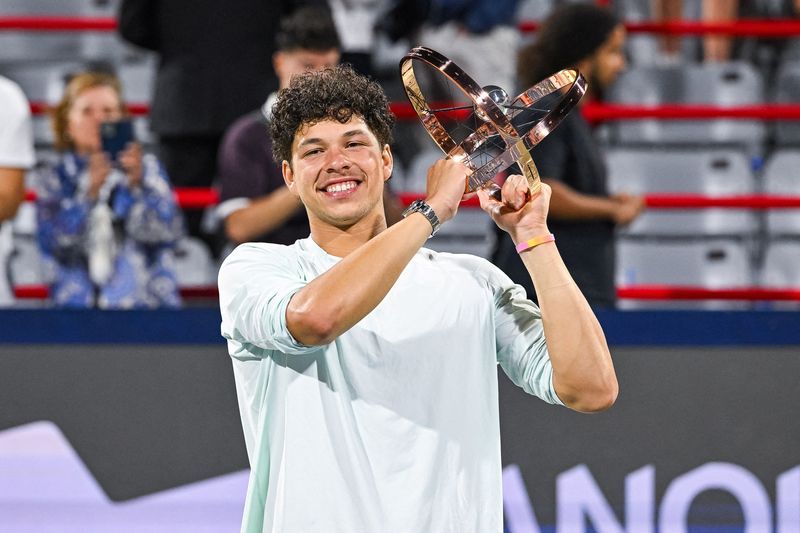
Ben Shelton enters the US Open with renewed determination after a turbulent campaign that saw him claim four titles despite wavering performances at tennis's biggest stages. The world number nine is banking on his triumphant defence of the Canadian Open crown to propel him deeper into a Grand Slam tournament, where inconsistency has plagued his pursuit of an elite breakthrough.
The 23-year-old's season has resembled a pendulum swinging between promise and letdown. At the Australian Open, he reached the quarter-finals, yet struggled to gain traction elsewhere—exiting in the second round at Roland Garros and falling in the opening match at Wimbledon. Such disparities at major tournaments underscore a player still developing the composure required to sustain momentum over two weeks of elite competition, though his recent Montreal success suggests the foundation is solidifying beneath the noise.
Shelton's Canadian Open victory arrived without surrendering a single set, a demonstration of dominance that extended beyond mere scorelines. His performance sparked recognition of technical refinements he has cultivated, particularly in his serve-breaking discipline and tactical range. Speaking after his final victory over Brandon Nakashima, Shelton articulated confidence in his evolving approach, emphasising how his return of serve had sharpened and his defensive-to-offensive transitions had become more decisive—elements that distinguish champions from contenders.
The American's ascent occurs against a generational vacuum in US men's tennis. Since Andy Roddick captured the US Open in 2003 by defeating Juan Carlos Ferrero, two decades have passed without an American male champion at Flushing Meadows. That drought amplifies expectations surrounding Shelton, who has emerged as the nation's most credible challenger to end a streak that now spans longer than most professional careers. The cultural weight of carrying such hopes extends beyond individual tennis—it touches on national pride in a sport where American dominance has historically defined eras.
Former champion Roddick weighed in on Shelton's realistic chances before Jannik Sinner's withdrawal from this year's tournament. In an August podcast appearance, Roddick assessed that if the world number one Italian and Spain's Carlos Alcaraz—typically the tour's most formidable pairing—were operating below their peak levels, Shelton possessed the weapons to contend for the title. The conditional framing reflects how tennis hierarchies function: Shelton's talent remains genuine, yet his positioning depends largely on how his competitors perform rather than purely on his own ceiling.
Shelton arrived in New York carrying lessons from his semi-final run last year, when he demonstrated he could navigate the demanding path through a Grand Slam draw. That experience offers tangible evidence that his body, mind, and technique can withstand the cumulative fatigue of successive five-set contests against world-class opposition. Few players reach that stage without possessing legitimate credentials, and Shelton's return visit represents a legitimate opportunity to advance further.
The hard court season has become his laboratory, with Shelton observing incremental improvements at each tournament he contests. This trajectory matters psychologically—athletes draw confidence from visible progression rather than stagnation or decline. By his own assessment, the trend line points upward precisely when maximum exposure awaits, a fortunate timing that few players engineer deliberately but that can prove decisive if sustained.
Shelton's philosophical approach to the professional calendar reflects maturity beyond his years. He characterises the tennis year as simultaneously blessing and curse—blessing because endless opportunities to compete mean that single disappointing tournaments need not define careers, curse because the relentless schedule offers little time for extended reflection or recovery. Within this framework, he has recognised that individual matches possess outsized importance; one breakthrough performance against a seeded rival can fundamentally alter momentum and perceptions.
For Malaysian and Southeast Asian tennis observers, Shelton's trajectory carries broader significance. His emergence as a realistic Grand Slam contender represents the kind of breakthrough that typically arrives before nations generate sustained production lines of talent. Should he succeed at the US Open, it would inject revitalising energy into American tennis at a moment when sustained competitiveness has become questioned. Conversely, his failure to capitalise would reinforce narratives about generational decline in the sport's traditional heartland.
The intersection of Shelton's personal capability, the historical drought for American men at the US Open, and the temporary absence of Sinner creates a convergence point that rarely aligns in professional sport. Whether Shelton can transform exceptional individual performances into extended tournament success remains the fundamental question.

