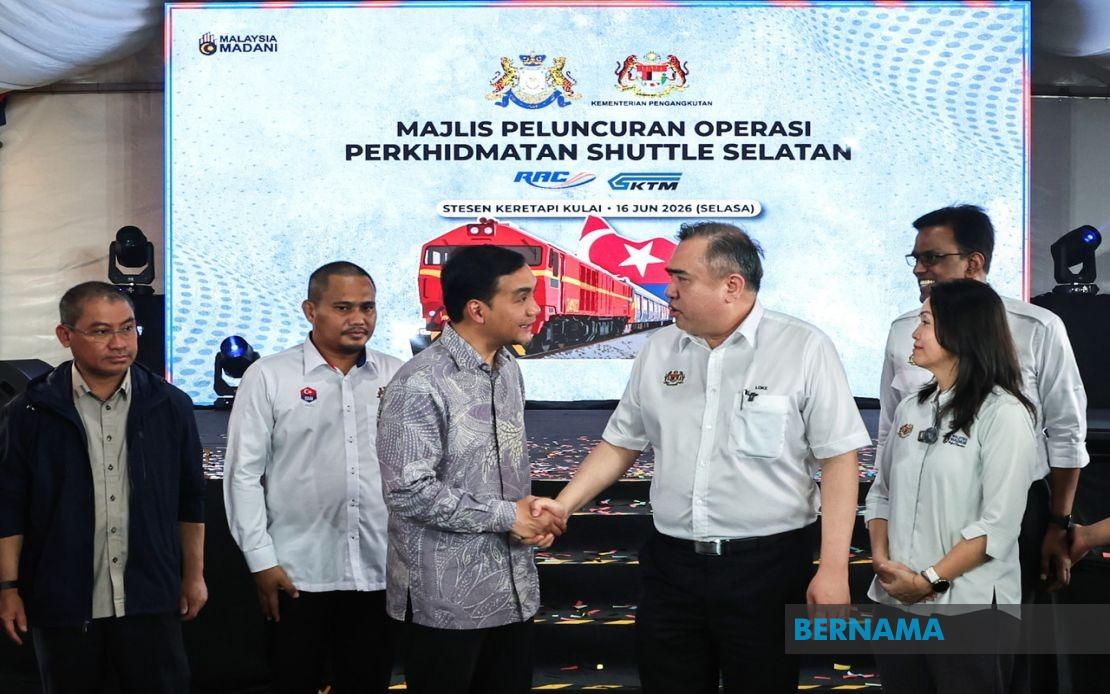
The Johor government has rolled out a significant addition to the state's public transport infrastructure with the launch of Shuttle Selatan, a dedicated rail service designed to improve connectivity between three major population centres. Unveiled at Kulai KTM station on June 16, the shuttle brings together the residential, commercial and industrial zones of Kulai, JB Sentral and Pasir Gudang, with Transport Minister Anthony Loke highlighting its potential to benefit more than two million people across these areas.
The initial network comprises two main corridors that will form the backbone of the service. The first operates between Kulai and JB Sentral, serving commuters in both directions, while the second connects Kempas Baru with Pasir Gudang. Journey times are competitive with private transport, taking approximately 40 minutes from Kulai to JB Sentral and between 40 to 45 minutes on the Kempas Baru to Pasir Gudang stretch. These travel durations position the shuttle as a viable alternative for daily commuters seeking to avoid road congestion in this rapidly developing part of Peninsular Malaysia.
Expansion is already envisioned as part of a longer-term strategy to deepen rail penetration across Johor's southern corridor. The government plans to eventually extend the network from Paloh through Kulai by way of Kluang, Renggam and Layang-Layang stations, substantially widening the catchment area. In parallel, three additional stations—Taman Daya, Bandar Baru Sri Alam and Pasir Putih—are under consideration to ensure that a greater proportion of the regional population gains direct access to rail-based commuting. Such phased growth reflects a pragmatic approach to infrastructure development, allowing the initial service to establish itself before scaling up.
To overcome the persistent challenge of first and last-mile connectivity, which often deters public transport uptake in Malaysia, the authorities have assembled a comprehensive support ecosystem. Feeder bus services will extend coverage beyond the rail stations themselves, while coordination with Bas.My routes ensures seamless transfers. A dedicated shuttle at Kempas Baru and park-and-ride facilities at AEON Bandar Dato' Onn provide flexible access points for drivers who wish to switch to rail for the main journey leg. These complementary measures reflect lessons learned from earlier transport initiatives and acknowledge that rail alone cannot serve dispersed populations without integrated bus networks.
A crucial incentive driving early adoption is the Commuter MADANI Shuttle Selatan Card, a subsidised travel pass that embodies the government's intent to shift behaviour toward public transport. The Railway Assets Corporation (RAC) has allocated more than RM150,000 to distribute 3,000 cards at no charge to eligible Johor residents. Each card, valued at RM50, grants unlimited rides for a defined period, effectively reducing the cost barrier that discourages many from switching away from personal vehicles. This targeted subsidy targets a real pain point: for many working-class and middle-income commuters, even modest transport costs accumulate significantly over a month or year.
Johor's economic trajectory provides the strategic context for this infrastructure investment. As one of Malaysia's fastest-growing states, Johor is experiencing rapid expansion across multiple sectors—manufacturing, logistics, port operations, tertiary education and international trade. This growth generates substantial commuter flows between residential zones and employment hubs, placing strain on existing road networks. Shuttle Selatan addresses this by offering an efficient, reliable alternative that can absorb demand without the environmental and congestion costs of private motoring. For the state government and federal transport authorities, the service is thus framed not merely as a convenience but as essential infrastructure supporting economic competitiveness.
The launch reflects a collaborative approach involving three institutional players: the Ministry of Transport, the state-owned railway operator Keretapi Tanah Melayu Berhad (KTMB), and the Railway Assets Corporation (RAC). This tripartite arrangement combines policy direction, operational expertise and asset management, though it also introduces coordination challenges. Success will depend on these agencies maintaining alignment as the network matures and usage patterns become clearer. For Malaysian readers accustomed to transport services that sometimes suffer from siloed management, the explicit mention of cooperation may signal a more integrated approach to public transport delivery.
The presence of senior political figures at the launch—Johor Menteri Besar Datuk Onn Hafiz Ghazi and the state's Public Works, Transport, Infrastructure and Communications Committee chairman Mohamad Fazli Mohamad Salleh—underscores the priority assigned to this initiative. Public transport expansion has become a signature theme across Malaysian state administrations, reflecting both voter demand for congestion relief and climate-related policy goals. Johor, as a major economic engine for the country, occupies particular importance in the national transport agenda.
Operational sustainability remains a key consideration for observers of Malaysian transport schemes. The subsidised fares and free trial cards are designed to build ridership momentum, but the long-term financial health of the service will depend on whether passenger volumes stabilise at profitable levels once promotional incentives expire. The two million potential beneficiaries represent a large addressable market, but converting awareness into regular usage requires consistent service quality, reliability and responsive customer service—areas where Malaysian public transport sometimes faces scrutiny.
For commuters in the Kulai-Johor Bahru-Pasir Gudang corridor, Shuttle Selatan potentially offers freedom from daily traffic battles and reduced transport expenditures. For employers in these zones, improved public transit accessibility enhances their capacity to recruit from a wider geographic area. For Johor's state government, the service advances its development agenda while addressing urban mobility challenges that could otherwise constrain future growth. The launch thus carries significance beyond transport logistics, touching on questions of economic dynamism, quality of life and Malaysia's broader shift toward sustainable urban development.