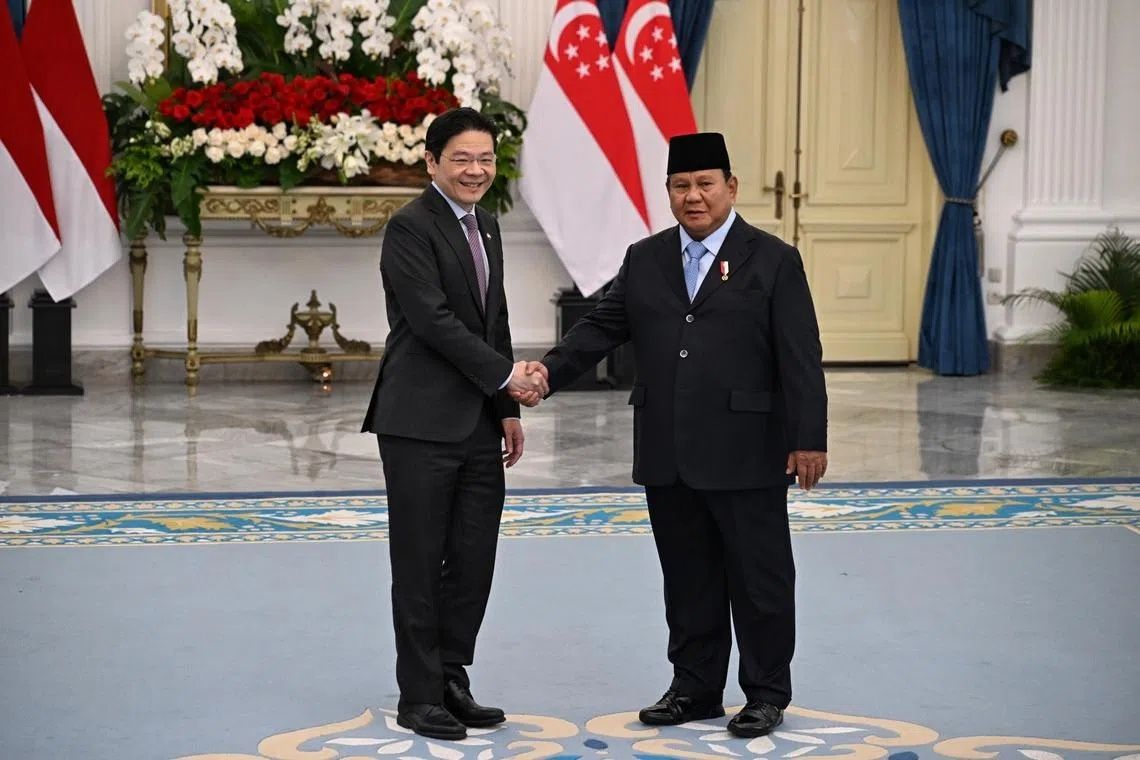
Singapore and Indonesia have reinforced their bilateral commitment to maintaining the Strait of Malacca as a secure and open shipping corridor for all nations, marking a pivotal moment in their evolving strategic relationship amid mounting regional tensions. The pledge emerged from high-level talks on July 6 between Prime Minister Lawrence Wong and President Prabowo Subianto during their annual Leaders' Retreat, where maritime security took centre stage as both countries grapple with geopolitical uncertainties threatening one of the world's most critical trade arteries.
The Strait of Malacca occupies exceptional importance in global commerce, funnelling roughly one-third of international maritime trade and substantial energy shipments between the Indian Ocean and South China Sea. For Malaysia, Singapore and Indonesia alike, whose territorial waters border or flank this narrow passage, maintaining its security and accessibility remains fundamental to economic prosperity and regional stability. The three nations have historically coordinated patrols and safety measures through established frameworks, yet the recent emphasis by Singapore and Indonesia signals a conscious upgrading of their collaborative stance at a time when piracy, accidents and geopolitical flashpoints threaten disruption.
President Prabowo articulated Indonesia's position with particular clarity, stressing that both nations shared fundamental interests in preserving the waterway's status as a passage "free for all parties." He underscored the necessity of protecting the strait from conventional threats including piracy and robbery, whilst simultaneously addressing environmental concerns such as pollution and maritime accidents—challenges that demand sustained coordination and investment in coastal surveillance and emergency response capabilities. His statement that Indonesia would continue coordinating with Malaysia and Thailand to uphold the strait's openness in accordance with the United Nations Convention on the Law of the Sea reflects the broader multilateral framework within which Southeast Asian littoral states operate.
Prime Minister Wong connected Singapore's maritime security concerns to wider global disruptions, drawing explicit parallels with recent turmoil in the Middle East. The choking of traffic through the Strait of Hormuz following regional tensions has demonstrated how geopolitical instability can cascade through critical chokepoints, creating supply chain disruptions and energy price shocks felt across Asia and beyond. By contrast, the Strait of Malacca has historically remained relatively insulated from such crises, a status that both leaders recognise requires active protection and diplomatic vigilance. Wong's characterisation of Singapore and Indonesia as "strategically aligned" on navigational freedoms suggests a coordinated messaging strategy designed to reassure regional and global traders that the passage remains a reliable conduit for commerce.
The bilateral discussions revealed that both governments view maritime security as inseparable from broader economic development objectives. Rather than treating security and prosperity as competing concerns, Singapore and Indonesia have framed their commitment to the strait's openness as foundational to the prosperity both nations seek. This integrated approach reflects contemporary strategic thinking in Southeast Asia, where economic interdependence and shared infrastructure vulnerabilities have forged new imperatives for regional cooperation beyond traditional military or diplomatic channels. The two nations are preparing to commemorate 60 years of diplomatic relations in 2027, creating additional impetus to deepen ties across multiple dimensions.
Beyond maritime security, the Leaders' Retreat catalysed significant progress in renewable energy cooperation, positioning this sector as potentially transformative for bilateral relations. The involvement of Indonesia's sovereign investment fund Danantara alongside Singapore firms including Keppel Electric, Sembcorp Industries and Singapore Energy Interconnections signals serious institutional commitment to cross-border electricity trade initiatives. Prime Minister Wong framed such arrangements as a "win-win" endeavour whilst emphasizing their significance as building blocks for a broader ASEAN Power Grid capable of enhancing regional energy security and reducing dependence on volatile international fossil fuel markets. For Malaysia and other regional neighbours, successful Singapore-Indonesia electricity cooperation could establish operational blueprints for similar initiatives elsewhere in Southeast Asia.
The discussions extended into digital infrastructure and cybersecurity cooperation, reflecting recognition that emerging economic competition and technological disruption demand coordinated responses. President Prabowo reported that exchanges on the digital ecosystem had produced "fairly concrete outcomes," though specifics remained undisclosed. Such cooperation acknowledges that digital vulnerabilities and supply chain fragility represent contemporary security challenges as consequential as traditional military or maritime concerns. Both leaders committed to strengthening supply chain resilience and economic connectivity, areas where Southeast Asian economies have demonstrated both vulnerability and potential for mutually beneficial integration.
Singapore's investment trajectory in Indonesia underscores the economic substance underlying these diplomatic statements. Prime Minister Wong highlighted developments in industrial zones including the Batam, Bintan and Karimun regions, and notably the Kendal Industrial Park in central Java, which has achieved full capacity ahead of its tenth anniversary in 2026. Planned expansion of Kendal by an additional 1,000 hectares represents genuine commitment to Indonesia's industrial development, with implications for job creation and downstream business development throughout the region. For Malaysian policymakers, Singapore's deepening economic footprint in Indonesia carries strategic implications regarding regional economic architecture and competitive positioning.
The emphasis on Indonesia's economic prospects within Singapore's strategic calculus reflects broader calculations about regional power dynamics and economic geography. Prime Minister Wong repeatedly stressed Singapore's confidence in Indonesia's developmental trajectory whilst characterising investment flows as extending far beyond capital provision to encompass business creation, industrial ecosystem development and infrastructure advancement. This framing acknowledges that Indonesia's success directly influences Singapore's own prosperity given geographic proximity and deep economic integration. The political economy of Singapore-Indonesia relations thus operates at multiple levels simultaneously, blending security cooperation, trade and investment flows, and infrastructure development into an integrated strategic package.
The bilateral partnership's evolution away from traditional manufacturing and investment frameworks towards renewable energy, digital infrastructure and supply chain resilience reflects structural transformations reshaping Southeast Asian economies. Both nations recognise that competitive advantage increasingly derives from technological sophistication, sustainable energy systems and digital connectivity rather than conventional manufacturing cost advantages. By coordinating on these emerging sectors, Singapore and Indonesia are positioning themselves advantageously within evolving regional and global value chains. For Malaysia, observing and potentially emulating aspects of this cooperation framework offers pathways to deeper trilateral engagement on the Strait of Malacca and complementary economic development priorities.
Looking forward, the Singapore-Indonesia partnership serves as a model for how regional states can simultaneously advance security cooperation and economic integration without treating these objectives as separate policy domains. The commitment to keeping the Strait of Malacca open and secure represents not merely a defensive posture against external disruption but an affirmative vision of Southeast Asian maritime commerce functioning as a stable, prosperous global commons. Whether this partnership can withstand future geopolitical pressures and deliver tangible outcomes across energy, digital and supply chain sectors will substantially influence regional stability and economic prospects throughout the coming decade.

