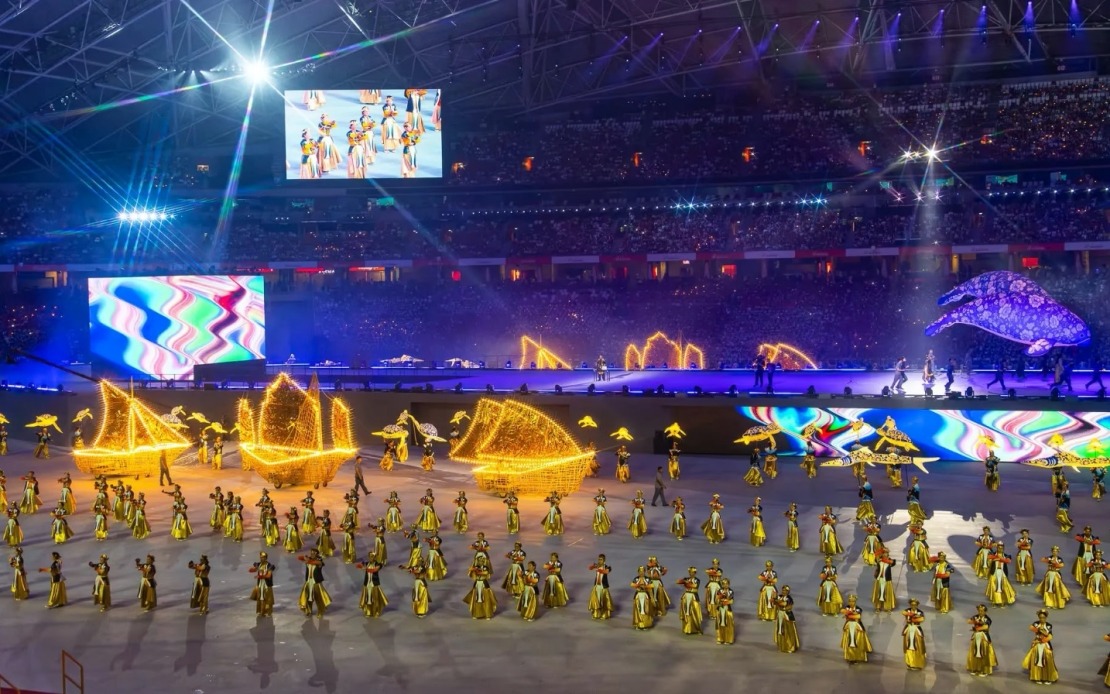
Singapore marked another milestone in its national calendar on Sunday as it celebrated its 61st National Day with a significant ceremonial return. The centrepiece National Day Parade (NDP) came back to the National Stadium, a venue that had been absent from hosting this prominent civic occasion for the past ten years. Held under the unifying banner "Majulah Singapura, Go Beyond!", the 2024 edition brought together President Tharman Shanmugaratnam, Prime Minister Lawrence Wong, Cabinet ministers and Members of Parliament alongside approximately 42,000 members of the public who transformed the stadium's stands into a sea of red and white.
The parade represented more than simply a ceremonial revival; it signalled a deliberate choice by Singapore's leadership to reinvigorate a traditional centrepoint for civic gathering after a decade of alternative arrangements. The decision to return to the National Stadium reflects confidence in large-scale public assembly and a symbolic reaffirmation of the nation's institutional anchors. For Malaysian observers, such state ceremonies offer interesting parallels to our own National Day celebrations, though Singapore's approach showcases distinct logistical innovation and thematic sophistication in how it frames national identity for its multicultural, densely urban population.
What distinguished this year's celebration was an imaginative expansion of the traditional parade format. For the first time across Singapore's six decades of independence, organisers conducted the Presidential Gun Salute and State Flag Flypast beyond the stadium's confines, extending festivities to Kallang Basin. This geographical extension meant that four 25-pounder Howitzer guns, mounted on Mobility 3rd Generation (M3G) rafts, traversed the waterway itself. The manoeuvre deliberately broadened the celebration's reach, allowing thousands of additional spectators stationed throughout the wider Kallang precinct to experience the ceremonial elements more intimately than traditional stadium-bound proceedings would permit.
The gun salute itself drew on significant military resources and personnel. A total of 151 participants from the 23rd Battalion of the Singapore Artillery and the 35th Battalion of Singapore Combat Engineers orchestrated the traditional 21-gun complement, demonstrating the civic-military coordination required for such ceremonial displays. This blend of heritage ritual with contemporary logistical innovation—honouring longstanding traditions whilst adapting them to modern venues and dispersed audiences—characterises how Singapore manages its state ceremonies.
The parade commenced around 6 pm with its parade and ceremony segment, organised around the theme "Go Beyond Self". This thematic orientation proved revealing about Singapore's contemporary national messaging. Rather than emphasising collective unity in abstract terms, the phrase "Go Beyond Self" suggests an individualistic, aspirational framing that encourages personal excellence whilst presumably contributing to broader national development. The segment assembled 32 contingents representing more than 2,000 direct participants, creating a substantial human spectacle. Six Guard of Honour contingents drew from the full spectrum of Singapore's state apparatus: the Singapore Army, Republic of Singapore Navy (RSN), Republic of Singapore Air Force (RSAF), the newer Digital and Intelligence Service (DIS), Singapore Police Force (SPF), and Singapore Civil Defence Force (SCDF). This composition of 72 personnel underscored the comprehensive institutional representation contemporary Singapore considers essential to national identity display.
Beyond the ceremonial parade component, 10 contingents from uniformed youth organisations participated alongside 16 supporting contingents, creating a multi-generational and multi-institutional panorama. The Singapore Armed Forces (SAF) Colours Party anchored these segments, providing the symbolic focus toward which all contingents oriented their participation. This careful orchestration of different state sectors and youth organisations reflects deliberate state-building through symbolic inclusion.
The evening's entertainment dimension featured distinctly in the National Day Parade show segment, which centred on the overarching "Majulah Singapura, Go Beyond!" theme. The production deployed 36 artists and more than 2,600 performers, substantially outnumbering the ceremonial parade participants and indicating the primacy of spectacular entertainment in modern state celebrations. The show segment sought to present what organisers characterised as "Singaporeans' authentic stories, innovative technology and a moving soundtrack", packaging national identity through contemporary cultural production rather than exclusively through military pageantry.
A particularly significant innovation featured in the show segment's casting and performance choices. The organisers deliberately incorporated seven dancers from diverse backgrounds, specifically including an autistic dancer and a dancer with Down syndrome. This inclusion carried explicit ideological weight, with official framing suggesting that such representation demonstrated how "every Singaporean can contribute to shaping a shared future, regardless of background or ability". For regional observers, this approach to inclusive representation within state ceremonies reflects evolving global standards around disability inclusion and diversity in public institutions. Malaysia's own national ceremonies might consider whether such explicit casting choices could enhance how we frame national belonging and contribution.
The broader significance of Singapore's National Day proceedings extends beyond the city-state itself. As a highly developed, densely urbanised, multicultural society with substantial security apparatus and technological infrastructure, Singapore's approach to state ceremonialism provides a notable model for how modern city-states manage civic identity. The deliberate blending of traditional military ritual with contemporary performance spectacle, the geographic expansion of ceremonial space through innovation, and the incorporation of previously marginalised groups into state representation all suggest considered choices about what contemporary national identity communication requires.
For Southeast Asia more broadly, Singapore's National Day evolution demonstrates how even firmly established civic institutions undergo periodic reinvention. The decade-long hiatus from the National Stadium before this 2024 return was not presented as a departure from tradition but rather as a temporary alternative arrangement. The 2024 homecoming therefore carried weight as reaffirmation rather than innovation, even as the execution introduced novel elements. This balance between continuity and change characterises successful institutional management across the region.
The 42,000-strong public attendance figure itself warrants consideration. In an era of declining civic participation across developed democracies and developed authoritarian systems alike, the maintenance of mass public engagement with state ceremonialism represents a notable achievement of institutional relevance. Whether this reflects genuine popular enthusiasm for National Day, effective mobilisation by state institutions, or some combination remains analytically complex. Nevertheless, the physical turnout demonstrates that Singapore's National Day retains capacity to draw substantial public participation, a benchmark that institutions across Southeast Asia continue to monitor as measures of civic health and institutional legitimacy.

