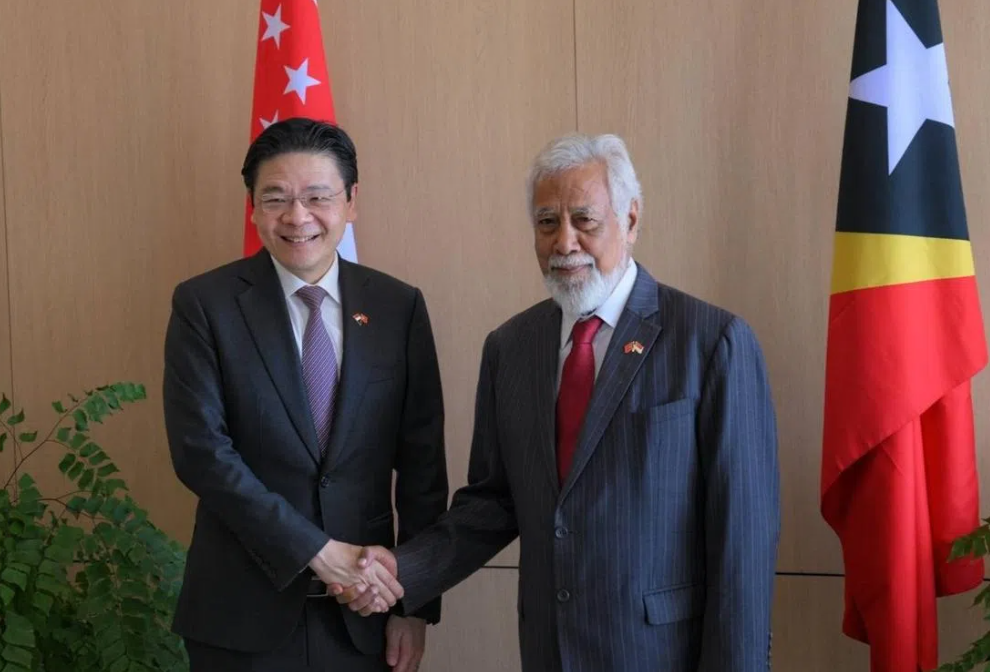
Prime Minister Lawrence Wong's inaugural visit to Timor-Leste has marked a significant escalation in Singapore's engagement with the region's newest nation, as both countries formalized their commitment to closer partnership through a comprehensive bilateral framework signed on July 3. The accord, witnessed by Wong and Timor-Leste's counterpart Xanana Gusmao at the Government Palace in Dili, establishes the institutional scaffolding for sustained cooperation across multiple sectors. The pact creates a formal mechanism through which foreign ministry officials will conduct regular consultations on bilateral matters alongside broader regional and strategic developments, providing structured channels for government-to-government coordination that reflects both nations' recognition of mutual benefit in deepened ties.
The agreement's significance extends beyond ceremonial gestures, representing instead a calculated strategic move by Singapore to entrench itself within Timor-Leste's development trajectory. Both leaders articulated a shared philosophy that national stature derives not from geographic footprint but from strategic positioning and institutional capability. Wong emphasized this point explicitly, noting that despite their modest size, both Singapore and Timor-Leste possess agency to determine their futures through disciplined effort and robust partnerships. This framing resonates particularly for Timor-Leste, which as Southeast Asia's youngest independent state remains engaged in consolidating institutions and building international standing. Gusmao reciprocated by acknowledging Singapore's instrumental role in supporting his nation's journey toward and through Asean membership, recognizing decades of practical assistance extending well beyond diplomatic ceremony.
Economically, Singapore's positioning as one of Timor-Leste's largest foreign investors provides the foundation for the partnership's expansion. Singaporean enterprises currently operate across diverse sectors, from wholesale and retail trade through renewable energy development, reflecting accumulated confidence in the nation's investment climate and growth potential. Wong framed these investments as harbingers of broader economic dynamism, arguing that coordinated bilateral efforts can catalyze new business opportunities while supporting Timor-Leste's diversification away from petroleum-dependent revenue streams. The emphasis on sustainable growth acknowledges both nations' long-term interests in fostering stable, inclusive development rather than extractive or transitional engagement.
A particularly consequential dimension of the partnership involves labour mobility. Beginning in 2027, Singapore will selectively open specific occupations and sectors to Timorese workers, initially targeting roles in construction and marine shipyard operations where Singapore firms have expressed early interest. This represents a calculated expansion of Singapore's non-traditional labour sourcing strategy, recognizing Timor-Leste as a potential supplier of skilled and semi-skilled workers for Singapore's construction and maritime industries. For Timorese nationals, this opening creates tangible employment pathways and income opportunities within a developed economy. For Singapore employers, particularly in labour-intensive sectors, the arrangement provides access to a broader, more geographically diversified workforce at a time when conventional labour sourcing faces constraints. The phased implementation, beginning in the second half of 2027, allows both governments and private sectors time to establish recruitment, training, and integration frameworks.
Healthcare cooperation represents another substantive pillar of the expanding relationship. The National University Hospital and Timor-Leste's Ministry of Health intend to formalize a five-year collaboration framework focusing on health workforce development, training systems modernization, public health capacity, and health systems strengthening. Rather than imposing external blueprints, the partnership responds to Timorese health ministry priorities, with NUH prepared to provide specialized support in emergency care, paediatrics, obstetrics and gynaecology, ophthalmology, and foundational supportive care infrastructure. This approach reflects sophisticated development partnership practice, where external expertise becomes a resource deployed according to recipient priorities rather than donor preferences. For Timor-Leste, which inherited limited institutional health capacity following independence, such collaborations address genuine capability gaps. For Singapore's healthcare system and institutions, engagement provides experience within a developing healthcare context while contributing to regional health security.
Education and institutional development constitute a third cooperation domain. Wong highlighted Singapore's commitment to supporting Timor-Leste's teacher training institute and educational leadership development. This focus on educators and school administrators addresses a fundamental bottleneck in education systems across developing economies: without capable leaders and teachers, infrastructural investment yields limited returns. By supporting capacity building among educators responsible for shaping subsequent generations, Singapore's partnership addresses structural rather than symptomatic constraints. The multi-year engagement reflects recognition that educational institution strengthening operates on longer timeframes than transactional development assistance.
Timor-Leste's recent accession to the Association of Southeast Asian Nations on October 26, 2025, provides crucial context for understanding the partnership's trajectory and Singapore's strategic calculations. Wong's visit explicitly positions Singapore as invested in facilitating Timor-Leste's successful Asean integration and preparing the nation for its scheduled 2029 chairmanship. This forward-looking posture distinguishes Singapore's engagement from conventional bilateral diplomacy, framing current investments as foundational to regional institutional health. The expansion of Singapore's existing Stars package, originally launched in December 2022 to provide Asean readiness training, now includes enhanced programming tailored to chairmanship responsibilities. Singapore will conduct specialized workshops in Dili addressing the administrative, diplomatic, and substantive dimensions of the Asean chair role. Additionally, Timorese officials will receive attachments to Singapore's own chairmanship teams when Singapore assumes the chair in 2027, enabling hands-on learning from actual conduct of the rotating leadership position.
The reciprocal recognition accorded both leaders underscores the partnership's symbolic weight alongside its practical dimensions. Wong received the Order of Timor-Leste with Grand Collar from President Jose Ramos-Horta, acknowledging Singapore's sustained contributions to national development and Asean integration. In his acceptance remarks, Wong attributed the honour not to himself but to generations of Singaporean professionals—trainers, knowledge workers, and specialists—who have contributed their expertise within Timor-Leste through capacity building initiatives. This framing situates the partnership within a longer continuum of Singapore's development assistance engagement rather than current leadership initiatives, implying institutional commitment extending beyond individual political tenures.
The partnership's significance for Malaysia and broader Southeast Asia warrants consideration. Singapore's deliberate cultivation of a comprehensive relationship with Timor-Leste reflects competitive positioning within the region as Asean's newest member state charts its institutional development trajectory. Malaysia, Indonesia, and other regional powers similarly seek influence within this developing nation. Singapore's comparative advantages—institutional sophistication, financial capacity, professional expertise—find expression through targeted cooperation addressing genuine development priorities rather than zero-sum geopolitical competition. For Southeast Asian readers, the model demonstrates how smaller, developed economies can leverage institutional capacity and expertise to exercise disproportionate influence through partnering on priority issues. The arrangement also illustrates Asean's institutional evolution, whereby the organization encompasses increasingly diverse membership across development levels, requiring support mechanisms to enable effective participation.
Looking forward, the institutionalization of bilateral cooperation creates enduring frameworks likely to persist beyond current political leadership. Regular consultation mechanisms establish expectations of ongoing engagement, while time-specific commitments—the five-year health collaboration, the 2027 labour mobility implementation, the 2029 chairmanship preparation—create concrete milestones against which partnership progress can be measured. For Timor-Leste, this partnership represents strategic engagement with an economically advanced, professionally capable neighbour that has invested substantially in the nation's successful integration into regional architecture. For Singapore, the partnership advances multiple objectives: securing economic opportunities, diversifying labour sourcing, strengthening regional stability through supporting institutional development in a strategically located nation, and exercising soft power through expertise and partnership.
The visit's outcome reflects both nations' recognition that contemporary Southeast Asian development requires sustained, multi-dimensional partnerships transcending traditional development assistance frameworks. By combining investment facilitation, labour mobility arrangements, institutional capacity building, and strategic coordination, Singapore and Timor-Leste have constructed partnership architecture acknowledging mutual interests in regional stability, economic growth, and institutional strengthening. As Timor-Leste consolidates its Asean membership and prepares for chairmanship, partnerships of this calibre become increasingly consequential for enabling effective participation in regional institutions and demonstrating to external actors that integration has strengthened rather than diminished the nation's institutional capacity.

