A Singapore High Court has dramatically reduced the custodial sentence imposed on former television actor Edmund Chen, cutting his jail term from five days to merely one day in connection with a 2025 traffic accident that left a motorcyclist with serious injuries. Justice Hri Kumar Nair delivered the decision on Monday, July 20, finding that while the district judge had correctly identified grounds for imprisonment, the five-day term represented an unjustifiably harsh punishment for the circumstances of the case.
The incident that sparked the legal proceedings occurred on March 4, 2025, along the Ayer Rajah Expressway as it approaches the Central Expressway. Chen, whose legal name is Tan Kai Yuan, was operating a private vehicle when he attempted to change lanes across the chevron road markings to access the CTE/Seletar Expressway junction. The 64-year-old actor had not positioned his vehicle in the correct lane ahead of the road split and moved to make this correction by slowing his car to near-standstill before filtering across the third lane. A 21-year-old motorcyclist travelling behind Chen's vehicle collided with the car despite attempting to swerve around it. The impact resulted in multiple wrist fractures requiring surgical intervention at Singapore General Hospital, with the young victim requiring local anaesthesia for treatment and subsequently spending two days hospitalised followed by 99 days of medical leave.
Chen's legal representation underwent significant changes during the appeal process. Initially represented by lawyers from Invictus Law, he later engaged Senior Counsel Abraham Vergis from Providence Law Asia to mount the appellate challenge. Vergis constructed his defence around three primary arguments: that the seriousness of the victim's injuries fell within the lower end of the grievous hurt spectrum, that Chen's conduct, while careless, was not so egregious as to demand incarceration, and that available non-custodial measures would adequately serve the interests of justice. The dashcam footage from Chen's vehicle proved instrumental in this strategy, revealing that Chen had activated his indicator lights before the manoeuvre and that the motorcyclist's view was partially obstructed by a passing vehicle navigating the road curve.
Justice Nair's ruling acknowledged the tension between judicial assessment and appellate intervention. While declining to conclude that the district judge erred in determining that the threshold for custodial punishment had been crossed, the judge found the five-day sentence itself disproportionate to the established facts. This calibrated approach reflects an increasingly nuanced jurisprudential stance toward traffic offences in Singapore, where courts attempt to balance deterrence and proportionality without defaulting to incarceration for all breaches of the custodial threshold. The original sentencing by the district judge on January 29 had surprised some observers, as the prosecution itself had argued for a financial penalty ranging between S$3,000 and S$5,000.
Vergis emphasised during arguments that the nature and location of the victim's injuries—localised fractures in the extremities treated under local anaesthesia without resulting in permanent disability—suggested the harm caused was comparatively less severe than many other grievous hurt cases prosecuted in the courts. He contrasted this with the broader implications of incarceration for a man in his seventh decade with significant family responsibilities and prior good standing. The defence also highlighted that Chen had immediately ceased his vehicle to provide assistance to the injured motorcyclist and had cooperated fully with law enforcement investigations, demonstrating accountability and responsible conduct in the aftermath.
The prosecution's position, maintained by Deputy Public Prosecutor Ben Tan, rested on the fact that Chen had persisted with his dangerous manoeuvre despite receiving audible warnings. The horns sounded by drivers of two passing vehicles demonstrated that Chen's conduct was objectively dangerous and observable to other experienced road users. The prosecutor argued that the five-year driving disqualification already imposed, combined with a maximum fine of S$5,000, would be insufficient to deter similar dangerous lane-changing behaviour on Singapore's expressways. This reflects broader concerns about lane discipline on high-speed corridors, where improper manoeuvres cause a disproportionate share of accidents.
Chен pleaded guilty to a single charge of causing grievous hurt by driving without due consideration for other road users. Beyond the jail term reduction, the High Court maintained the five-year driving disqualification order, effectively barring Chen from operating any motor vehicle for six decades. This represents a stringent penalty in practical terms for someone who may have decades of remaining life, and Vergis had argued that the psychological weight of this ban, combined with the trauma Chen has experienced, rendered additional imprisonment unnecessary. The defence counsel suggested that Chen, given the gravity of the experience, was unlikely to resume driving regardless of legal penalties.
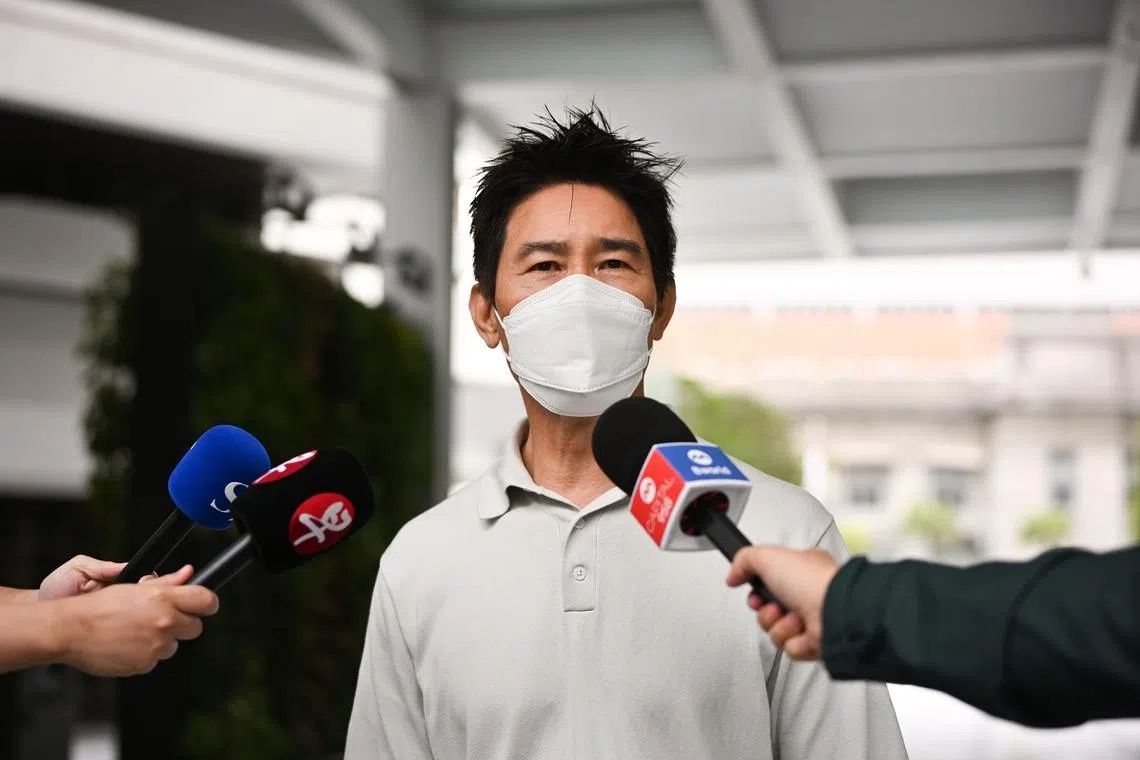
Chen's appearance before the court carried particular emotional resonance. Before the hearing commenced, he informed reporters that he had prepared five days' worth of medication for his anticipated custodial term and that neither he nor his family had slept the preceding night, illustrating the psychological toll of facing imprisonment despite his age and background. These human dimensions influenced the judicial assessment, though Justice Nair was careful to base his ruling on legal principles rather than sympathy alone. The distinction between recognising personal hardship and allowing it to override principled sentencing frameworks remains central to appellate jurisprudence in Singapore.
Chen's media profile and previous prominence in Singapore's entertainment industry formed a backdrop to proceedings, though courts maintain formal neutrality regarding an offender's social standing. Known for starring in popular television dramas including Star Maiden and Patrol during the 1990s, Chen had stepped back from regular acting when his daughter Chen Yixin was born in 2000. He maintained selective involvement in the industry, accepting occasional roles such as appearing in the 2017 series Life Less Ordinary. His wife is veteran actress Xiang Yun, recognised for acclaimed performances in classic local dramas including The Awakening, Double Happiness and The Little Nyonya. The couple's long-standing prominence in Singapore's cultural landscape likely remained peripheral to judicial deliberations, yet such context often features in media coverage of high-profile defendants.
The High Court's decision carries implications for how Singapore's judiciary approaches dangerous driving cases resulting in serious injury. By reducing the sentence while maintaining the custodial threshold acknowledgement, Justice Nair signalled that courts must carefully calibrate imprisonment terms to the precise circumstances rather than applying formulaic approaches. The ruling also underscores the increasing importance of appellate review in ensuring proportionality, particularly when lower courts impose sentences that occupy the extreme end of permissible ranges. For Malaysia and other Southeast Asian jurisdictions observing Singapore's jurisprudence, the decision may inform contemporary debates about balancing public safety concerns with individual circumstances in traffic-related offences.
The case demonstrates how Singapore's legal system manages cases involving prominent figures without extending special consideration, whilst simultaneously ensuring that punishment remains proportionate and lawful. The reduction from five days to one day, while modest in absolute terms, represents a meaningful vindication of Chen's appellate challenge and reflects judicial recognition that even when custodial thresholds are crossed, imprisonment length must maintain rational connection to offence gravity and offender culpability. As Chen concludes his dramatically abbreviated custodial term and faces a lengthy driving prohibition, the case adds to the evolving body of appellate precedent governing traffic offences in Singapore.

