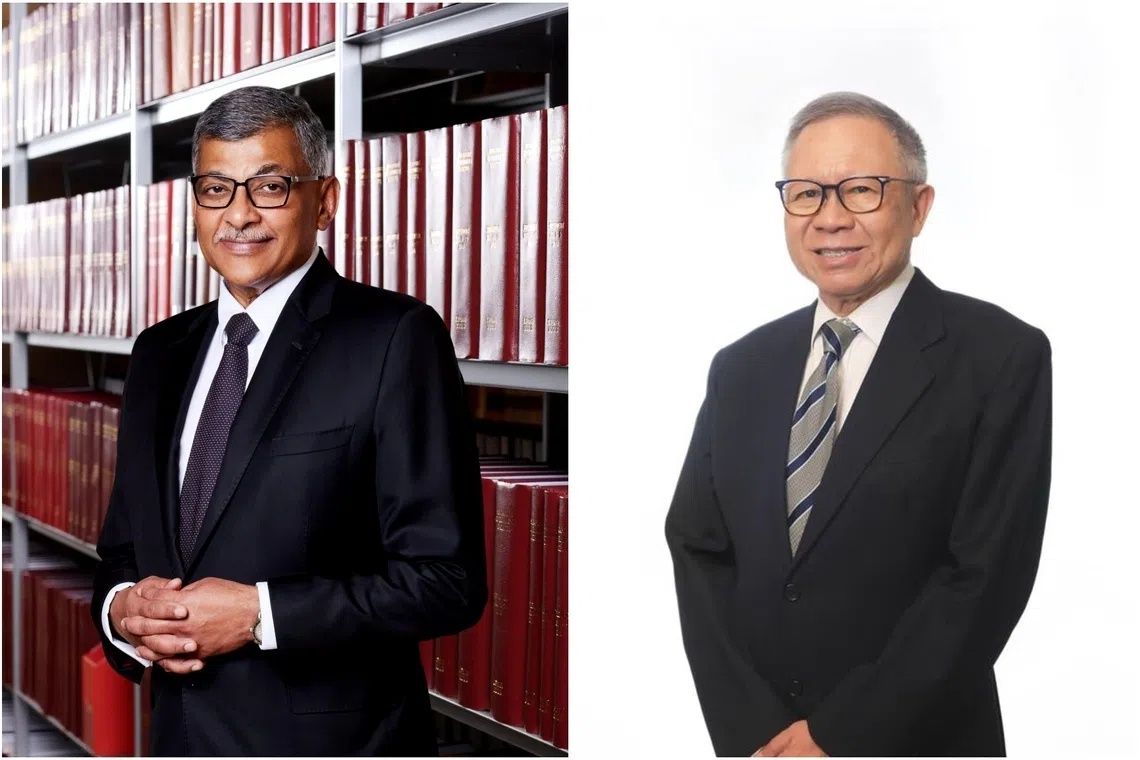
Singapore has conferred its highest civilian honour on Chief Justice Sundaresh Menon and Eddie Teo, former chairman of the Council of Presidential Advisers, recognising their extraordinary contributions to the nation across more than a century of combined service. Both recipients, Menon at 62 and Teo at 79, will receive the Order of Temasek (With Distinction) at this year's National Day Awards ceremony. The accolade places them among 7,491 individuals nationwide recognised for their public and civic endeavours, marking a significant moment in Singapore's institutional recognition of lifetime achievement.
Menon's elevation to the honour comes as he prepares to step down from his position as head of the judiciary on 26 February 2027, concluding a 14-year tenure that has fundamentally reshaped Singapore's justice system. Since taking office in November 2012, he has orchestrated one of the most comprehensive modernisations of judicial administration in the region, moving the courts from traditional paper-based processes into a digitally integrated ecosystem. His vision extended beyond administrative efficiency, encompassing the structural transformation that saw the establishment of the Appellate Division of the High Court and the creation of the Singapore International Commercial Court, institutions that have bolstered Singapore's standing as a regional legal hub.
The Chief Justice's impact on the justice system reflects a deliberate shift toward therapeutic interventions within the courts that serve vulnerable populations. His introduction of therapeutic justice principles in the Family Justice Courts and Youth Courts has fundamentally altered how Singapore approaches disputes involving children and family matters, moving away from purely adversarial paradigms. The establishment of the Singapore Judicial College represents an equally transformative achievement, creating the first comprehensive institutional framework for ongoing judicial education and ensuring that the bench maintains world-class competency standards across an evolving legal landscape.
In response to the award, Menon emphasised that the honour extends beyond his individual achievement, reflecting the collective effort of judges, court officers, legal professionals and staff across the judiciary who have worked to sustain public confidence in Singapore's administration of justice. His remarks underscore a crucial philosophical point: that the rule of law, which has been foundational to Singapore's governance since independence, depends on the collaborative commitment of multiple institutions and individuals working in concert. The timing of the award carries particular symbolic weight, coinciding with the bicentennial commemoration of Singapore's legal and judicial traditions, anchoring this recognition within the nation's broader institutional history.
Teo's recognition acknowledges nearly six decades of service spanning defence, the Prime Minister's office, the Public Service Commission and ultimately the Council of Presidential Advisers. Beginning his career in 1970 within the Ministry of Defence's Security and Intelligence Division, Teo rose to lead that agency at just 31 years old, remaining its director throughout the pivotal 1979–1994 period when Singapore's security architecture faced significant regional challenges. His subsequent progression through permanent secretary roles in defence and the Prime Minister's office positioned him as a custodian of institutional knowledge during critical periods of Singapore's development.
Teo's tenure as chairman of the Public Service Commission from 2008 to 2018 demonstrated his commitment to modernising the civil service itself. Rather than perpetuating a homogeneous recruitment model, he deliberately broadened the composition of the commission by appointing members from diverse professional backgrounds spanning academia, law and social work. This approach reflects a progressive philosophy about how Singapore's bureaucracy should evolve, recognising that effective governance requires perspectives beyond traditional administrative training. His particular pride in having served under Singapore's founding generation—learning directly from Lee Kuan Yew, Goh Keng Swee and former president S. R. Nathan—illustrates the transmission of institutional values across decades.
Teo's final chapter in public service, leading the Council of Presidential Advisers until June 2026, acquainted him with governance challenges of unprecedented scale. During the Covid-19 pandemic, the council oversaw discussions leading to the withdrawal of approximately S$40 billion from Singapore's reserves, the largest such drawdown in the nation's history. This sum, deployed under the collective judgment of the President, the council and the Government, allowed Singapore to stabilise its economy, protect businesses and sustain employment without incurring heavy public debt. The episode exemplifies how institutional checks and balanced decision-making processes function during extreme circumstances, a legacy Teo helped shape through his leadership.
Beyond Menon and Teo, Singapore recognised additional distinguished contributions at this year's awards. Alan Chan, chairman of the Land Transport Authority since 2016, received the Distinguished Service Order for his transformation of Singapore's public transport infrastructure. Under his stewardship, rail system reliability metrics improved dramatically, with mean kilometres between failures rising from 393,000 in 2017 to two million in 2026—a sevenfold improvement reflecting systematic investment in maintenance and modernisation. Chan's oversight of major infrastructure projects including the Thomson-East Coast Line and the Singapore Rail Test Centre, alongside acceleration of electric vehicle adoption, has positioned Singapore's land transport for the energy transition era.
Edmund Cheng, former chairman of the Civil Aviation Authority of Singapore, was similarly honoured for contributions spanning the aviation sector, rehabilitation of former offenders and support for the arts. The breadth of recognitions across transport, aviation, arts and labour relations reflects Singapore's deliberate acknowledgment that nation-building requires excellence and commitment across multiple domains of public life. For Malaysian and Southeast Asian observers, these honours underscore Singapore's structured approach to recognising institutional stewardship and the calibre of leadership that has sustained the city-state's economic and political stability.
These awards carry significance beyond Singapore's borders, offering regional insights into how nations can systematically recognise and retain talent within public service. In a region where private sector opportunities frequently lure capable individuals away from government service, Teo's explicit reflection on the value of public sector careers carries weight. His statement that 56 years of government service, while perhaps not generating private-sector wealth, provides meaning and purpose addresses a recruitment challenge that resonates across Southeast Asia. The honours thus function not merely as retrospective recognition but as forward-looking statements about the value societies place on committed institutional service.

