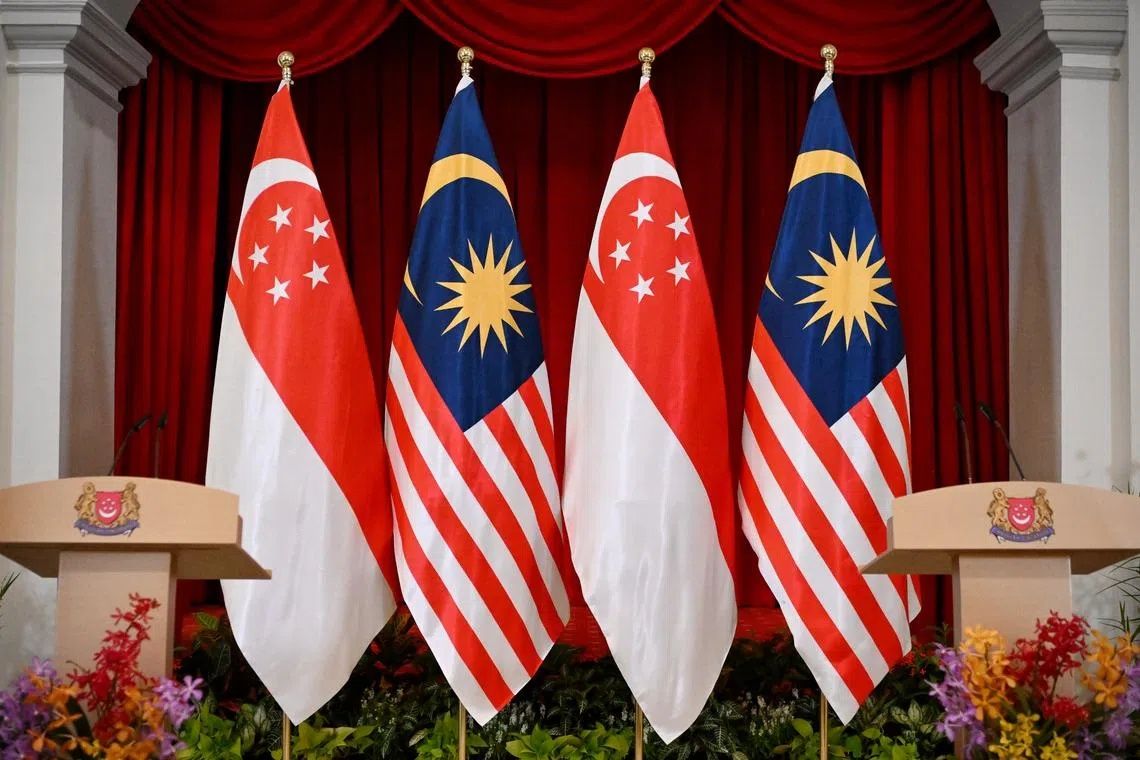
During a four-day state visit to Malaysia at the invitation of Sultan Ibrahim Sultan Iskandar, Singapore's President Tharman Shanmugaratnam has articulated a vision of the island republic's relationship with its northern neighbour as fundamentally rooted in shared values rather than transactional gain. In an interview with Malaysian news agency Bernama published on Sunday, July 12, the President underscored that while disagreements between Singapore and Malaysia will inevitably surface, these friction points should not undermine the broader architecture of cooperation that has been painstakingly constructed over decades.
The foundation of this partnership, according to President Tharman, rests on a deliberate institutional approach to managing difference. Rather than sweeping contentious issues under the carpet or allowing them to fester, both governments have adopted a strategy of confronting disputes directly while simultaneously reaffirming commitment to the overarching relationship. This methodology has fostered measurable trust and generated reserves of goodwill that serve as a buffer during periods of tension. The President's visit continues a diplomatic tradition established when Sultan Ibrahim conducted his inaugural overseas state visit to Singapore in May 2024, shortly after ascending to the throne in January that year.
President Tharman acknowledged frankly that the two neighbours have navigated numerous sensitive and intricate bilateral challenges throughout their modern history. Such friction is entirely natural given their geographic proximity, intertwined past, and the complexities that inevitably arise when two distinct political systems occupy adjacent territory. Yet successive administrations on both sides have demonstrated strategic discipline by resisting the temptation to become entrapped by these disputes. Instead, both governments have pursued resolution pathways grounded in calm deliberation, mutual respect, and adherence to established international legal frameworks. Though the President refrained from cataloguing specific grievances, his acknowledgment implicitly recognizes issues ranging from water agreements to maritime boundaries and resource-sharing arrangements.
The interpersonal dimension of this relationship deserves particular weight in understanding its durability. The accumulation of trust and familiarity among political leaders, government officials, and citizens on both sides has created psychological and institutional space for managing tensions through dialogue rather than confrontation. This human infrastructure of understanding proves especially valuable in an era of regional fragmentation and global uncertainty. President Tharman explicitly advanced the proposition that regional stability does not require the elimination of disputes—an unrealistic aspiration—but rather demands the disciplined management of disagreement through responsible conduct and mutual restraint.
The Singapore-Malaysia example carries implications extending far beyond the bilateral relationship itself. Both nations function as exemplars for the broader Association of Southeast Asian Nations and the wider Asia-Pacific region, demonstrating that dialogue, restraint, respect for sovereignty, and adherence to a rules-based international order constitute viable pathways for managing complex relationships. In an era when geopolitical friction in other parts of Asia threatens to destabilize the region, the Singapore-Malaysia model offers a counternarrative of neighbours choosing cooperation over confrontation.
President Tharman issued an explicit call for deepening and widening engagement across multiple societal levels. He observed that regular interaction among leaders, politicians, bureaucrats, business communities, and ordinary people on both sides had occurred organically among earlier generations but now requires deliberate cultivation and facilitation through structured mechanisms. Bilateral exchange programmes, youth leadership forums, community-based initiatives, and educational partnerships represent concrete vehicles for maintaining the vital connective tissue binding the two societies together. This proactive approach acknowledges that good relations cannot be taken for granted but demand continuous investment and renewal.
Looking forward, President Tharman articulated an expansive agenda for bilateral cooperation extending across multiple domains. The accumulated mutual trust built over six decades provides the foundation upon which Singapore and Malaysia can pursue deeper integration across economic, energy, and human capital dimensions. In an international context characterized by fracturing multilateral trade arrangements and intensifying competition among major powers, both countries possess compelling incentives to strengthen regional integration. Joint market development, enhanced energy resilience through renewable energy partnerships, optimized supply chain coordination, and climate change collaboration through carbon credit mechanisms represent concrete opportunities for advancing shared prosperity.
The President highlighted existing flagship projects as proof of concept for win-win cooperation. The Johor-Singapore Special Economic Zone and the Rapid Transit System Link demonstrate how neighbouring countries can harness complementary strengths to generate mutual benefits. These initiatives exemplify a development model increasingly relevant as traditional patterns of bilateral engagement evolve. Singapore's capital and financial expertise combine productively with Malaysia's land resources and demographic advantages, generating outcomes superior to what either nation could achieve in isolation.
Regional architecture provides another critical arena for deepened collaboration. President Tharman emphasized that Singapore and Malaysia share fundamental interests in preserving Asean's coherence, reliability, and trustworthiness as a collective actor on the global stage. Malaysia's 2025 Asean chairmanship achieved significant milestones, including Timor-Leste's admission as the organization's eleventh member. As Singapore prepares to assume the chairmanship in 2027, bilateral coordination between the two nations will prove essential for maintaining Asean's momentum in promoting regional peace, stability, and economic growth. The transition between chairmanships offers opportunities for reinforcing the organization's foundational principles and advancing its strategic objectives in an increasingly complex geopolitical environment.
President Tharman invoked a Malay aphorism—"jiran sepakat membawa berkat," or "neighbours in agreement bring blessings"—to encapsulate the philosophical underpinning of Singapore-Malaysia cooperation. This cultural reference carries significance beyond rhetorical flourish, signalling that both nations share linguistic and conceptual frameworks that transcend formal diplomacy. The partnership has yielded tangible mutual benefits and contributed to development trajectories in both countries over sixty years. The President's closing reflection—"we are each better for working together, respecting, and having affection for each other. Let our hearts shake hands"—distils a vision of international relations rooted in genuine regard rather than narrow calculation, a philosophy increasingly rare in contemporary geopolitics yet vital for regional stability and shared prosperity in Southeast Asia.

