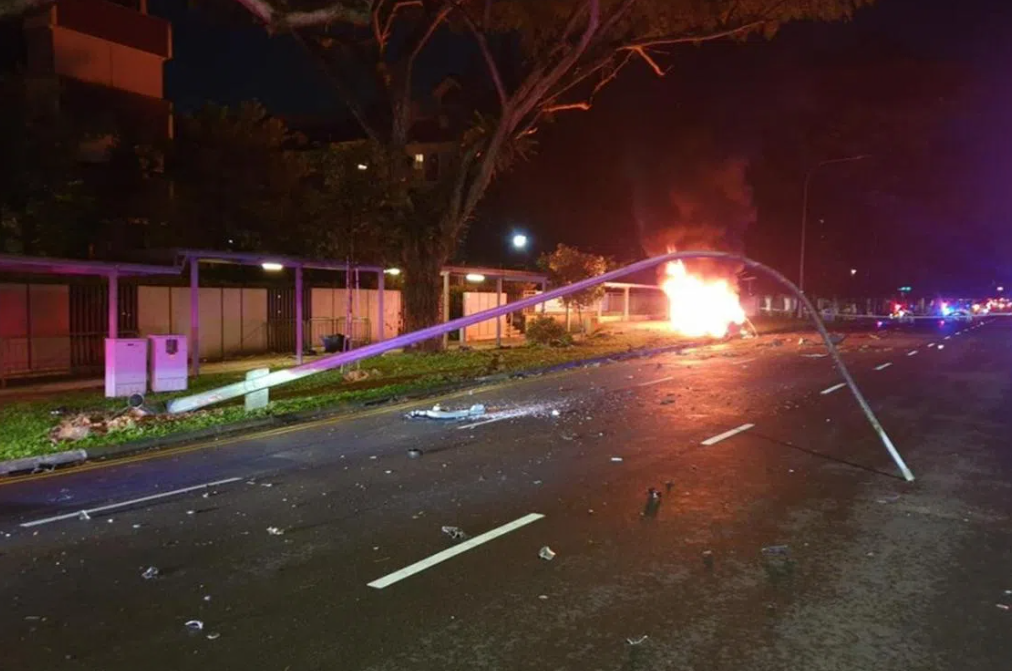
A 29-year-old man in Singapore has been formally charged following a dramatic early-morning incident on March 6, 2024, when he allegedly drove recklessly through central Singapore while impaired by alcohol, ultimately colliding with a school bus and leaving his vehicle engulfed in flames. Aaron Tan Yao Cong faces five separate charges including drink driving, dangerous driving causing hurt, and driving against the flow of traffic. The case underscores persistent dangers posed by impaired drivers on busy urban roads and the vulnerability of young passengers relying on public transport for their daily commute.
According to court documents filed this week, Tan's blood alcohol content was measured at approximately 148 milligrams per 100 millilitres of blood—nearly double Singapore's legal driving limit of 80 milligrams per 100 millilitres. The reading was particularly concerning given that Tan initially refused to undergo a breathalyser test at the point of arrest, a refusal itself forming one of the charges against him. The concentration suggests substantial alcohol consumption prior to him getting behind the wheel at approximately 5.50am, a time when roads are typically less congested but visibility and reaction times remain critical factors.
The sequence of events that morning reveals escalating dangerous behaviour. Tan first violated a straight-only traffic direction along Cavenagh Road near the junction with Bukit Timah Road, instead negotiating a left bend that propelled his vehicle directly into oncoming traffic lanes. After briefly stopping, he accelerated sharply and embarked on a high-speed journey that saw him weaving erratically between vehicles along Bukit Timah Road and Upper Bukit Timah Road, reaching an average velocity of 114 kilometres per hour during the 6.16am run—well above prudent speeds for urban conditions during morning rush-hour preparation.
The situation deteriorated further when Tan approached the junction of Sixth Avenue. Police documents indicate he failed to observe a red traffic light signal and struck a private bus that was executing a lawful U-turn manoeuvre. The collision with the bus was followed immediately by impact with a lamp post, the force of which ignited a fire that rapidly consumed his vehicle. The rapid escalation from traffic violations to physical collision demonstrates how impaired driving compounds risks exponentially; each decision made while under the influence increases the statistical probability of catastrophic outcomes.
Mercifully, all occupants of both vehicles managed to evacuate before flames consumed the car entirely. Tan himself and three passengers traveling with him escaped the burning vehicle, as did the bus driver and two child passengers aged nine and ten. However, the two children aboard the bus required hospitalisation for injuries sustained during the collision, highlighting how bystanders—particularly vulnerable young people—bear the consequences of individual drivers' choices to operate vehicles while impaired. The bus driver and other passengers were also conveyed to hospital for assessment and treatment.
Tan's criminal history deepens concern about systemic failures in deterrence and rehabilitation. Court records reveal he was previously convicted of drink driving and driving without due care and attention in 2019, merely five years before this latest incident. Despite having faced the justice system for substantially similar offences, he appears not to have modified his behaviour or taken seriously the warnings inherent in criminal conviction. This pattern suggests that existing penalty structures may be insufficient to prevent recidivist offending in drink-driving cases, a problem not unique to Singapore but common across Southeast Asia where vehicular fatalities linked to alcohol impairment remain stubbornly high.
The specific charges laid against Tan carry substantial potential penalties reflecting the seriousness with which Singapore's judiciary treats drink-driving offences, particularly those involving injury to others. A conviction for drink driving as a repeat offender carries imprisonment up to two years and fines reaching $20,000 Singapore dollars. The dangerous driving causing hurt charge permits sentences of up to two years imprisonment, fines up to $10,000, or both, with repeat offenders facing enhanced penalties including fines up to $20,000. Each additional charge carries its own sentencing range, creating potential for cumulative sentences if Tan is convicted on multiple counts.
Tan appeared in court on Thursday, June 18, facing the full array of charges without indicating his intention regarding plea. His case has been adjourned to July 16, providing time for prosecutorial preparation and defence review of evidence. The charge sheet demonstrates comprehensive documentation of his movements that morning, beginning with the traffic sign violation at 5.50am and extending through the high-speed driving phase captured on traffic monitoring systems, to the collision and fire at approximately 6.25am. Such detailed record-keeping, enabled by modern surveillance infrastructure, means that evading responsibility through denial becomes increasingly difficult.
The incident resonates particularly with Malaysian road safety advocates, as similar patterns of impaired driving persist across the region despite increasing awareness campaigns and legislative measures. Repeat offenders in particular represent a policy challenge; many jurisdictions struggle to balance rehabilitation approaches with public protection imperatives. Singapore's approach of escalating penalties for repeat offenders reflects a deterrence philosophy, yet cases like Tan's suggest that conviction alone may not sufficiently alter behaviour without accompanying intervention programmes addressing underlying factors driving individuals to operate vehicles while substantially intoxicated.
The involvement of school-age children in this incident adds a dimension of public concern that extends beyond the immediate participants. Parents and educators across Southeast Asia have legitimate anxieties regarding road safety, particularly given morning and afternoon commuting routines when children are most reliant on buses and public vehicles. While school bus services generally operate to high safety standards, their vulnerability to collisions caused by impaired drivers operating private vehicles remains an inescapable risk factor in densely populated urban environments. This case illustrates vividly that defensive driving and institutional safety protocols cannot fully protect against the unpredictability of substantially impaired drivers.
The July 16 court date will determine Tan's path forward, whether through guilty pleas accelerating sentencing or through contested proceedings requiring full trial. Regardless of outcome, the case exemplifies the continuing prevalence of alcohol-impaired driving in Singapore and the capacity of such behaviour to generate serious injury, particularly to vulnerable passengers unable to influence driver behaviour. For Malaysian road users and policymakers, the case provides a sobering reminder that legal consequences, however severe, have proven inadequate as standalone deterrents against repeat drink-driving offences, suggesting that complementary interventions including mandatory rehabilitation, licence suspension periods, and vehicle confiscation may warrant consideration as part of regional approaches to this persistent public safety challenge.