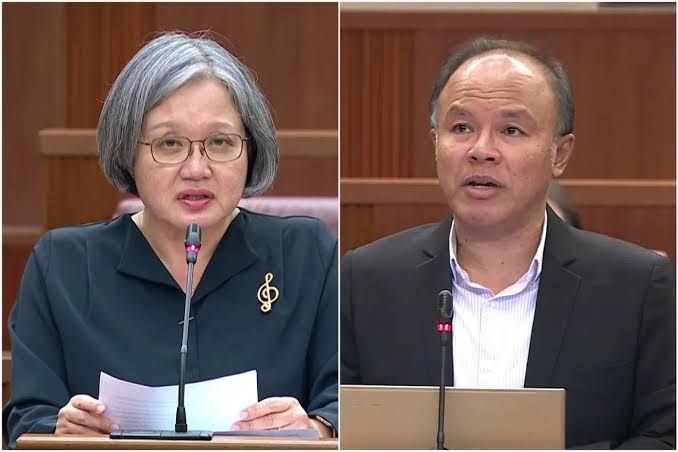
Singapore's Parliament has formally closed the door on disciplinary action against Workers' Party leaders Sylvia Lim and Faisal Manap for their role in misleading a parliamentary committee, with Leader of the House Indranee Rajah announcing on July 7 that no further penalties can be imposed due to expired legal timelines. The decision effectively marks the conclusion of a protracted institutional saga that has preoccupied Singapore's legislature for years, though it underscores the intricate procedural constraints that can ultimately frustrate accountability mechanisms even when misconduct has been established.
The disciplinary process originated from a deception involving former Sengkang GRC MP Raeesah Khan, who fabricated an anecdote about police conduct during a 2021 parliamentary speech. When Parliament's Committee of Privileges commenced its investigation, it discovered that Khan had not acted alone. The committee found that Workers' Party chief Pritam Singh had instructed Khan to conceal the falsehood, whilst Lim and Faisal, both then serving as Aljunied GRC MPs, were present during discussions about the matter yet provided misleading testimony to investigators. The committee's determinations established a clear hierarchy of culpability, with Singh deemed most culpable for orchestrating the cover-up and Lim and Faisal assigned secondary roles.
Parliament's response differentiated sharply between Singh and his two colleagues. Recognizing Singh's conduct as the most egregious, authorities referred his case to the public prosecutor for independent criminal investigation, affording him full legal representation before the courts. Lim and Faisal, whose conduct the committee characterised as "subsidiary" and noting they had been "somewhat helpful to the committee, albeit in a limited way," were initially spared immediate disciplinary action. Parliament deliberately postponed addressing their conduct pending resolution of Singh's criminal proceedings, a choice framed as extending fairness to both individuals by resolving the most serious allegations first and establishing definitive factual findings.
Singh's legal journey validated Parliament's investigation. He was convicted by the District Court in February 2025 for lying to Parliament, subsequently appealing the decision. The High Court upheld his conviction in December 2025, confirming the committee's core findings that both Lim and Faisal had indeed provided false statements. Yet this judicial vindication arrived at a problematic procedural juncture. By the time Singh's appeals concluded, Singapore's 14th Parliament had been dissolved following general elections, and the 15th Parliament had commenced in September 2025. This transition fundamentally altered the legal landscape for imposing penalties on Lim and Faisal.
The Parliament (Privileges, Immunities and Powers) Act contains a crucial temporal constraint that proved decisive. Section 22 of the legislation permits Parliament to punish misconduct committed either during the current parliamentary session or during the preceding Parliament's second session. Lim and Faisal's dishonesty had occurred during the first session of the 14th Parliament, making it temporally inaccessible to the 15th Parliament's disciplinary powers. Indranee acknowledged that had timelines differed, she would have "proposed a different course of action," suggesting frustration with procedural outcomes that diverged from substantive merits. The statutory time bar effectively insulated Lim and Faisal from formal parliamentary sanctions despite confirmed dishonest conduct.
Indranee's explanation revealed Parliament's deliberate strategic choice in 2021 when the committee first made its findings. Rather than immediately initiating disciplinary proceedings against all three implicated leaders, Parliament "decided to give Ms Lim and Mr Faisal the benefit of the doubt for the time being." This forbearance was intended to preserve fairness during Singh's criminal proceedings, but it inadvertently consumed the statutory window within which penalties could be imposed. The decision illustrates a tension between procedural fairness—allowing time for comprehensive legal resolution—and institutional accountability mechanisms that operate within fixed temporal parameters. Parliamentary dissolution created an unanticipated consequence that procedural caution had not fully anticipated.
Although Parliament cannot now impose formal sanctions, Indranee noted that alternative mechanisms remain available. Parliament could pass a motion expressing disapproval of Lim and Faisal's conduct, a symbolic gesture acknowledging wrongdoing without punitive consequences. However, Indranee contended that such action would be superfluous given that Parliament had already signalled its emphatic disapproval of dishonesty to Parliament or its committees when it declared Singh unsuitable as Leader of the Opposition in January. That motion represented Parliament's institutional judgment that such conduct fundamentally disqualified an individual from senior opposition leadership, a finding that implicitly encompassed censure of complicit behaviour by Lim and Faisal.
The conclusion of this matter carries significance for Southeast Asian democratic institutions. Singapore's Parliament demonstrated commitment to investigating internal misconduct and confirming factual findings through court proceedings. Yet the episode also illustrates how procedural rules and institutional timelines can limit accountability outcomes despite establishing misconduct. The time bar provisions of the Privileges Act, designed to provide finality and prevent indefinite exposure to disciplinary action, ultimately prevented Parliament from formally sanctioning individuals whose dishonesty had been judicially confirmed. For Malaysia's Parliament and other regional legislatures monitoring these developments, the Singapore case exemplifies both the rigour and the limitations of parliamentary accountability systems.
Lim's response to the ministerial statement remained restrained. She declined to object to Parliament's closure of the matter, noting that she had previously addressed the issues during the January motion concerning Singh. She pointedly observed that references to her conduct in Singh's appeal judgment had derived from prosecution evidence, and that she had never been called as a witness in criminal proceedings, thus lacking opportunity to present her perspective before courts. This statement suggested her view that judicial findings, drawn from evidence she could not directly contest, should not have formed the basis for parliamentary disciplinary decisions. Her position highlighted the asymmetry in how different standards of evidence and procedural fairness applied to Singh, whose criminal conviction was exhaustively litigated, versus Lim and Faisal, who faced committee findings without parallel criminal proceedings.
The Workers' Party itself had already moved beyond the controversy internally. During party elections on June 28, cadres voted to retain Singh as party leader despite his conviction, signalling party members' assessment that his leadership remained valuable despite the misconduct finding. This party-level decision, distinct from Parliament's institutional response, reflected the divergence between parliamentary accountability and broader political judgment. Whilst Parliament has now definitively closed its institutional chapter on this matter, the reputational implications for the Workers' Party leadership, the broader questions about opposition accountability, and the procedural lessons regarding parliamentary disciplinary mechanisms will likely continue shaping discussion of governance and institutional integrity in Singapore.
The practical consequence of Parliament's decision is that Lim and Faisal will face no further formal consequences for their conduct. Yet the case has established enduring precedent regarding how Parliament investigates internal misconduct, the role of criminal courts in confirming or refuting parliamentary findings, and the ultimate constraints imposed by statutory time bars on institutional accountability. For Malaysian policymakers and legislators observing regional institutional practices, Singapore's experience offers cautionary lessons about ensuring that accountability mechanisms contain adequate flexibility to respond appropriately to delayed resolution of serious misconduct, and that procedural fairness in addressing the most culpable actors does not inadvertently expire the jurisdiction to address complicit parties.

