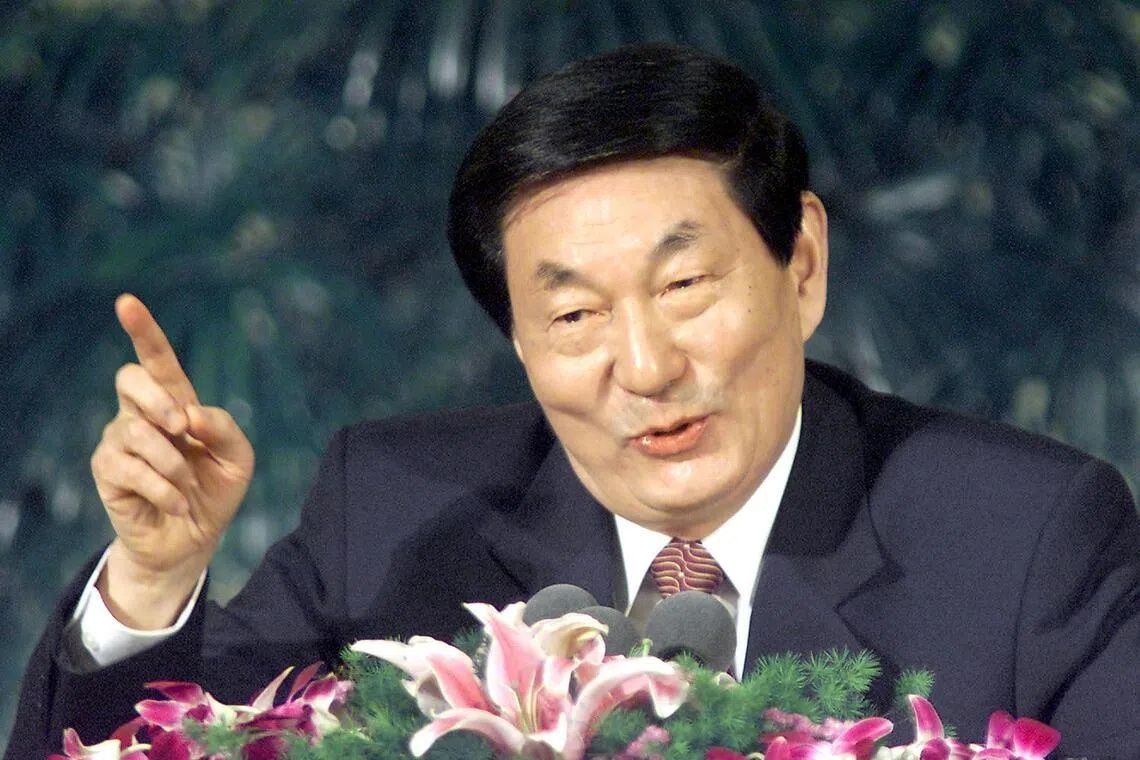
Singapore's Prime Minister Lawrence Wong has extended formal condolences to Chinese Premier Li Qiang following the passing of former Premier Zhu Rongji, marking the end of a significant chapter in modern Chinese leadership. Zhu, who died in Beijing on Wednesday, August 12, was approaching his 98th birthday, having left an indelible mark on both China's domestic trajectory and its international standing across the Asia-Pacific region.
In a letter dated August 13, PM Wong paid extensive tribute to Zhu's transformative tenure as China's chief executive, emphasizing the former premier's instrumental role in reshaping the country's economic architecture during a critical period of modernization. Wong specifically highlighted Zhu's stewardship during China's accession to the World Trade Organization in 2001, a watershed moment that fundamentally altered the nation's integration into the global trading system and its subsequent economic trajectory. This achievement, Wong suggested, reflected Zhu's capacity for long-term strategic planning and his willingness to embrace reforms that would position China as a major economic force.
The Singapore premier's tribute also underscored the personal diplomatic relationships that Zhu cultivated with Singapore's leadership across multiple decades. Wong noted that Zhu had maintained extensive contact with former prime ministers Lee Kuan Yew and Goh Chok Tong on numerous occasions, cultivating a foundation of mutual respect and understanding that transcended the typical formality of state-to-state relations. These personal connections, Wong implied, had been instrumental in fostering the broader framework of cooperation between the two nations.
A particularly significant moment in Zhu's engagement with Singapore came in 1999 when he became the first Chinese leader to deliver the prestigious Singapore Lecture, an annual forum organized by the ISEAS – Yusof Ishak Institute that provides a platform for prominent global figures to address topics of regional and international significance. The choice to extend this invitation to Zhu reflected Singapore's recognition of his importance, and his acceptance underscored China's growing openness to dialogue with regional partners. In that address, Zhu articulated a vision of China's economic development as inherently beneficial to broader Asia-Pacific prosperity, a message that resonated with Singapore's own outward-looking economic philosophy.
Wong highlighted Zhu's proposal during that lecture for establishing a free trade area between the Association of Southeast Asian Nations and China, an initiative that demonstrated the former premier's recognition of mutual economic interdependence across the region. This proposal proved remarkably prescient, as it foreshadowed the later development of more formalized economic arrangements between China and Southeast Asia. The concrete realization of Zhu's vision has become evident in subsequent decades, with China establishing itself as a crucial economic partner for Singapore and other regional nations, fundamentally reshaping trade patterns and investment flows across Southeast Asia.
Beyond his national-level leadership, Wong also acknowledged Zhu's earlier career in Shanghai, where he served as mayor before ascending to the premiership. During that period, Zhu actively promoted official exchanges and collaborative learning initiatives between Shanghai's administrative apparatus and Singapore's governance structures. These sub-national relationships, Wong noted, created crucial channels for the transfer of knowledge and best practices between the two societies, establishing working relationships that would prove invaluable as bilateral ties deepened over subsequent years.
Among Zhu's most enduring legacies in Singapore-China relations was his support for the China-Singapore Suzhou Industrial Park, a government-to-government collaboration that represented an innovative approach to bilateral economic cooperation. This project, launched during Zhu's tenure, symbolized both nations' commitment to moving beyond simple trade to establish integrated industrial and manufacturing ecosystems. The project's success demonstrated the feasibility of complex bilateral cooperation and provided a template for future joint ventures, making it a cornerstone of contemporary Singapore-China economic relations.
Wong's assessment suggests that the foundation Zhu established during his tenure as both Shanghai administrator and national premier has proven remarkably durable. The extensive exchanges and close ties between Singapore and China that characterize their relationship today have deep roots in initiatives that Zhu championed, from government-to-government projects to high-level personal interactions. The former premier's ability to articulate a vision of mutually beneficial regional development while simultaneously pursuing practical mechanisms for implementation distinguished his approach to foreign relations.
For Malaysian and broader Southeast Asian readers, Zhu's passing carries significance beyond bilateral Singapore-China affairs. His advocacy for enhanced economic cooperation between China and ASEAN foreshadowed patterns that would increasingly dominate regional economic relationships. The prosperity of several ASEAN nations, including Malaysia, has been substantially influenced by the frameworks and relationships that leaders like Zhu helped establish. His willingness to engage constructively with Southeast Asian counterparts set a diplomatic precedent that influenced subsequent Chinese leadership approaches to the region.
The timing of Wong's tribute also reflects Singapore's careful cultivation of its diplomatic relationship with China at a period when regional geopolitical considerations have become increasingly complex. By emphasizing historical continuities and shared accomplishments, Wong reinforced Singapore's role as a trusted interlocutor between China and the wider region. This positioning remains strategically important as regional nations navigate the evolving economic and political landscape of Southeast Asia.
Zhu's legacy extends beyond specific projects or policies to encompass a broader approach to economic governance and international relations. His emphasis on market-oriented reforms, integration into global institutions, and pragmatic cooperation with regional partners represented a particular strand of Chinese leadership thinking that left lasting imprints on the regional order. For Southeast Asian policymakers, his career demonstrated the potential benefits of embracing economic openness and institutional engagement, lessons that continue to inform contemporary policy debates across the region.

