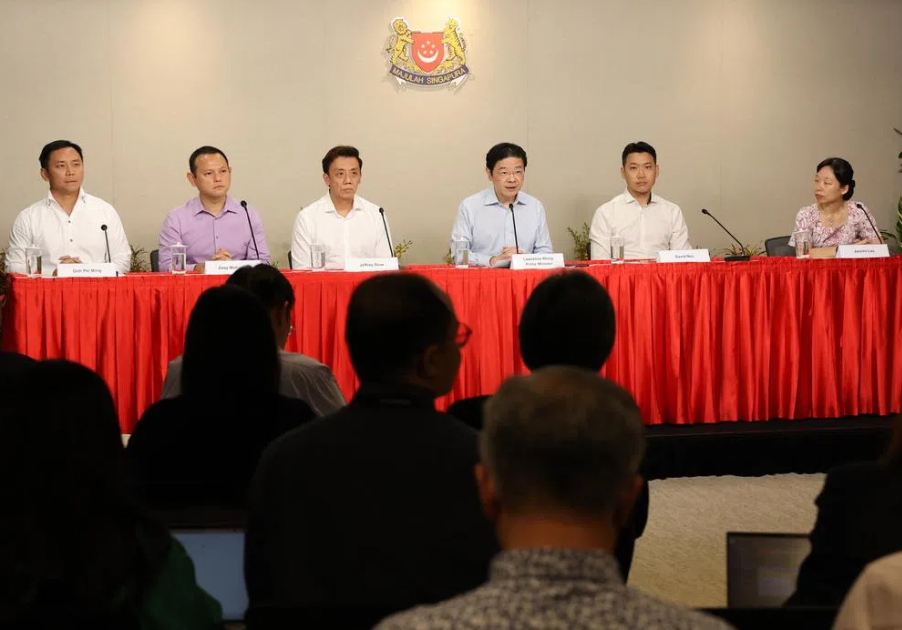
Singapore's Prime Minister Lawrence Wong has unveiled a significant restructuring of the Cabinet that signals the government's continuing commitment to nurturing a new generation of political leaders while maintaining the steady hand of experienced ministers. The reshuffle, announced on July 22, comes in the wake of recent political resignations and reflects the ruling party's deliberate strategy to build depth within its leadership ranks across multiple tiers of government.
The Cabinet shake-up elevates two newcomers from the 2025 general election to full ministerial status. Jeffrey Siow and David Neo, both relatively inexperienced by Singapore's standards, will now hold ministerial portfolios, having served successfully in acting capacities since the previous round of changes in May 2025. Siow will continue leading the Transport Ministry while Neo remains in charge of Culture, Community and Youth, both as full ministers rather than temporary appointees. Their promotions represent a deliberate gamble by Wong that these politicians have demonstrated sufficient capability and earned sufficient trust among both their Cabinet peers and the civil service to handle permanent ministerial responsibilities.
A third first-term politician, Sim Ann, has been appointed Second Minister for Foreign Affairs and Home Affairs, a significant elevation that places her in a senior position overseeing two critical government portfolios simultaneously. Jasmin Lau, another first-term MP, will take the helm of the Manpower Ministry as acting minister, succeeding Tan See Leng who transitions to become Minister for Trade and Industry with responsibility for energy and industry matters. These moves scatter responsibility across the younger cohort, preventing any single portfolio from resting entirely on an inexperienced pair of shoulders while still providing meaningful advancement opportunities.
The reshuffle also brings labour chief Ng Chee Meng back into the Cabinet as Minister in the Prime Minister's Office, a move that underscores Wong's intention to draw experienced figures from different sectors of governance and union leadership. Similarly, K. Shanmugam has been elevated to Senior Minister status, joining Lee Hsien Loong as one of the Cabinet's most seasoned members. Wong explicitly noted that as the government navigates a transition period, the counsel and mentoring capacity of these veterans becomes increasingly valuable for guiding younger office-holders through complex policy decisions and institutional knowledge.
Two backbench MPs and former senior civil servants—Foo Cexiang and Shawn Loh—have been appointed as ministers of state, both representing first-term parliamentarians who are transitioning into fuller executive responsibilities. This dual appointment of relatively junior MPs to ministerial rank reflects the government's need to accelerate the development of its next tier of leadership, particularly given the unexpected departures that have disrupted the normal pace of succession planning.
The timing of this reshuffle is directly linked to two significant political resignations in 2026. Acting Minister-in-Charge of Muslim Affairs Faishal Ibrahim stepped down on July 20 following what he described as a "lapse of judgment" in handling personal interactions, also relinquishing his position as Senior Minister of State for Home Affairs. Earlier, in June, Koh Poh Koon resigned from his role as senior minister of state, citing family reasons. Wong acknowledged that these unexpected departures necessitated an earlier and more substantial reorganisation than the government's customary annual review process would normally trigger.
Wong's explanation for the reshuffle's timing reveals something fundamental about Singapore's approach to political succession. While the government reviews its Cabinet composition annually as standard practice, the unexpected resignations forced an acceleration of leadership transitions. The Prime Minister stressed that building a strong pipeline of political talent requires investment not only in ministerial-level appointments but also in developing younger backbenchers and creating opportunities for them to gain experience and demonstrate readiness for advancement. This multi-layered approach to talent development contrasts with systems that focus development efforts only at the ministerial level.
On the question of why he has not appointed a second deputy prime minister to work alongside Gan Kim Yong, Wong indicated that the current structure of senior leadership is sufficient and appropriate for the government's needs. However, he acknowledged that this situation remains subject to review as the broader leadership transition continues. The Cabinet also features three coordinating ministers—Shanmugam overseeing national security, with Chan Chun Sing and Ong Ye Kung appointed in May 2025 to coordinate other government functions—creating a distributed model of senior oversight that Wong presented as robust and flexible.
Wong also addressed the persistence of his own tenure in the finance ministry, a portfolio he has held since 2021. He characterised the search for his successor as an ongoing process, noting that different individuals develop at different paces and that his responsibility involves assessing readiness and entrusting responsibilities when the time proves appropriate. This candid admission that he has not yet identified or ready a suitable successor for one of government's most demanding positions underscores the genuine challenge of leadership succession in a small, developed economy where the pool of qualified candidates is necessarily limited.
The structural approach Wong has adopted reflects a philosophy of continuous, measured renewal rather than generational turnover. By retaining experienced voices like Shanmugam and Lee Hsien Loong while simultaneously promoting Siow, Neo, and others, the government attempts to preserve institutional memory and decision-making quality while demonstrating commitment to generational advancement. For Singapore, whose political legitimacy rests partly on meritocratic governance and competent administration, this balance carries particular weight. The reshuffle signals to the public that leadership transitions occur based on demonstrated capability rather than seniority alone, while simultaneously reassuring stakeholders that inexperience will not result in drift or governance vacuums.
For Malaysian observers, Singapore's deliberate succession planning offers instructive comparisons. Singapore's approach treats leadership development as a systemic institutional function, with clear pathways for advancement and explicit acknowledgment of mentoring relationships between veteran and emerging leaders. The reshuffle demonstrates that even within a stable, single-dominant-party system, unexpected departures and resignations force adaptation and acceleration of planned transitions. Moreover, Wong's transparency about continuing to search for a finance minister successor, rather than simply anointing someone, suggests that Singapore's ruling establishment maintains higher thresholds for critical portfolios than pure seniority or factional loyalty might otherwise dictate.
The changes take effect progressively from July 27 onwards, with some appointments taking effect at later dates, allowing for orderly transitions and handovers between outgoing and incoming ministers. Wong framed the entire exercise as reflecting "the Singapore way of leadership renewal," a continuous process rather than a discrete event. This language suggests that the government views such reshuffles not as acknowledgments of problem or failure but as routine expressions of an institution's commitment to sustained excellence and generational continuity. Whether the promoted first-term politicians perform successfully in their enlarged roles will significantly influence not only the government's future leadership depth but also public confidence in its capacity to manage an orderly, competent transfer of power.

