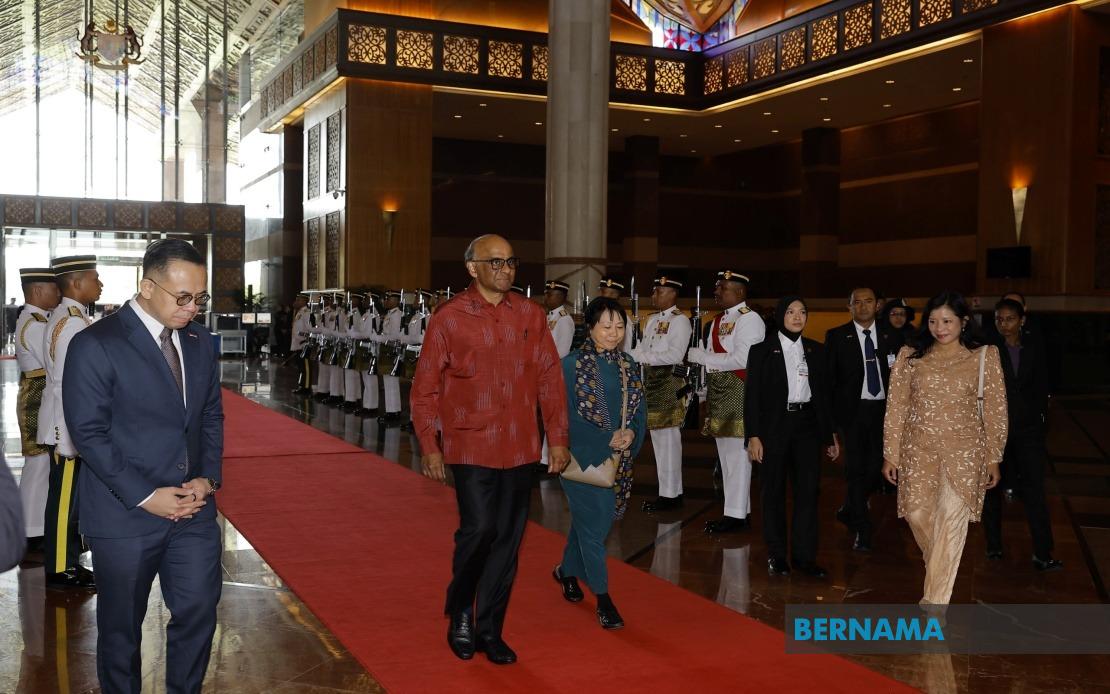
Singapore President Tharman Shanmugaratnam brought his three-day state visit to Malaysia to a close on July 15, departing from Kuala Lumpur International Airport in the afternoon. The President, accompanied by his wife Jane Ittogi and an official delegation, boarded a commercial flight back to Singapore at 2.20 pm from KLIA's Terminal 1, concluding a journey that underscored the enduring strength of relations between the two neighbouring city-state and nation.
The departure proceedings reflected the ceremonial significance accorded to the visit. Upon arrival at the Bunga Raya Complex within the airport terminal at 1.45 pm, Tharman was honoured with a formal Guard of Honour comprising officers and personnel from the First Battalion of the Royal Ranger Regiment. The military contingent, numbering 26 personnel and led by Captain Muhammad Hanafi Ja'afar, stood at attention as the President passed through the departure hall—a traditional mark of respect extended to heads of state in Malaysian protocol.
Minister of Entrepreneur and Cooperatives Development Steven Sim represented the Malaysian government at the farewell ceremony, extending formal courtesies on behalf of the nation. This presence underscored the ministerial-level commitment to maintaining warm ties with Singapore's leadership, a pattern consistent with how both nations approach diplomatic ceremonial obligations.
The visit itself commenced on Sunday following an invitation from His Majesty Sultan Ibrahim, King of Malaysia. For Tharman, who assumed the presidency of Singapore on September 14, 2023, this journey represented a significant milestone—his inaugural state visit to Malaysia in his new capacity as the nation's ninth President. The symbolism was not incidental; state visits by newly inaugurated heads of state typically serve to establish personal rapport and set the diplomatic tone for the incoming administration's regional engagement.
Beyond protocol, the visit carried deeper diplomatic significance as a reciprocal gesture. It directly responded to Sultan Ibrahim's own state visit to Singapore that took place on May 6 and 7, 2024. Such reciprocity demonstrates a commitment by both nations to maintaining balanced, mutually respectful relations—a crucial element in a relationship where geographical proximity and shared economic interests create both opportunities and potential friction points that require careful management.
During his time in Malaysia, Tharman engaged with the highest levels of the Malaysian government and monarchy. On Monday, he participated in a state welcoming ceremony before being received in audience by Sultan Ibrahim at Istana Negara, the official residence of the Malaysian King. This formal audience represented the centerpiece of the visit, providing both leaders with an opportunity to discuss bilateral matters, regional developments, and shared concerns affecting Southeast Asia's political and economic landscape.
Following the royal audience, Tharman received a courtesy call from Prime Minister Datuk Seri Anwar Ibrahim, a meeting that extended beyond the customary pleasantries of diplomatic protocol. The gathering included several senior Malaysian ministers: Foreign Minister Datuk Seri Mohamad Hasan, Investment, Trade and Industry Minister Datuk Seri Johari Abdul Ghani, and the aforementioned Steven Sim. The breadth of ministerial participation reflected Malaysia's approach of engaging Singapore on multiple fronts—diplomatic, commercial, and developmental—recognising that contemporary state relations increasingly require coordination across portfolios rather than isolating discussions within foreign ministries alone.
The visit also extended to Malaysia's constituent states, reflecting the federal structure of Malaysian governance and the recognition that bilateral relations exist at multiple levels. On the third day, Sultan Sharafuddin Idris Shah, the Sultan of Selangor, granted Tharman an audience at Istana Alam Shah. This subnational engagement acknowledged the significance of Selangor—Malaysia's most economically dynamic state and home to greater Kuala Lumpur—in the overall relationship. It also demonstrated how Malaysia incorporates its state rulers into the diplomatic process, a feature unique to Malaysia's constitutional monarchy system that distinguishes it from purely centralised governance models.
The timing and scale of the visit carry broader implications for Southeast Asian regionalism. As both Singapore and Malaysia navigate evolving dynamics in the region—including challenges related to maritime demarcation, water agreements, transport connectivity, and economic competition—the maintenance of high-level diplomatic engagement provides essential channels for addressing grievances and identifying areas of mutual benefit. Tharman's visit occurs within a context where regional stability increasingly depends on bilateral relationships functioning smoothly, as wider geopolitical tensions involving major powers create pressure on smaller nations to balance competing interests.
For Malaysian observers, the visit represented an opportunity for the government to demonstrate its commitment to regional integration and stable neighbourly relations at a time when domestic economic challenges and political considerations might otherwise dominate the policy agenda. Similarly, for Singapore, the visit allowed Tharman to establish personal relationships with Malaysia's leadership early in his presidency, a foundation that typically facilitates more candid dialogue on sensitive issues in subsequent years.
The three-day format, while brief, concentrated intensive engagement among the nations' most senior figures. Such condensed visits often prove more effective than prolonged stays, as they focus participants' attention on substantive matters rather than extending into periods of reduced intensity. The structured programme—featuring ceremonial components, private discussions, and state-level protocols—reflected the carefully choreographed nature of state visits between nations where the relationship carries both historical depth and contemporary complexity.
Looking forward, this visit establishes a foundation for Tharman's presidency to unfold against a backdrop of personal familiarity with Malaysia's leadership. The reciprocal nature of the visits, combined with the ministerial breadth of engagement, signals both nations' intention to sustain institutional relationships beyond any individual political cycles or shifting administrations. For Malaysia particularly, maintaining such cordial relations with Singapore remains strategically important given their economic interdependence, shared transport infrastructure, and overlapping security interests in maintaining regional peace and maritime security.

