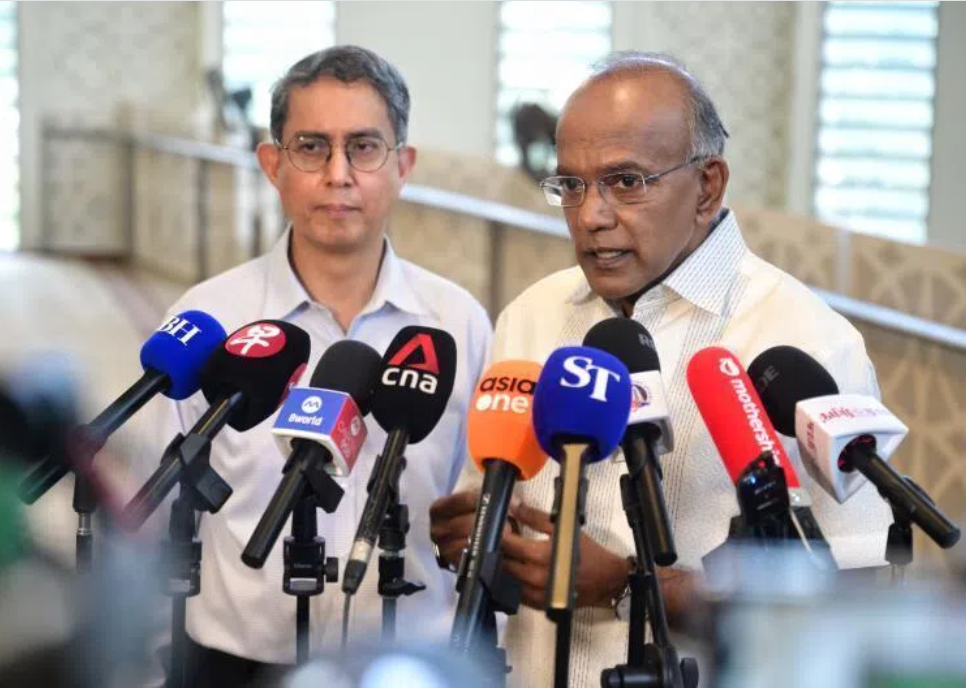
Singapore's Home Affairs Minister K Shanmugam has publicly defended the circumstances surrounding the resignation of former Minister-in-charge of Muslim Affairs Faishal Ibrahim, stating that the ex-minister's online communications with a member of the public were objectively inappropriate, though confirming Faishal was afforded a fair hearing before stepping down on July 20. The minister's detailed Facebook statement provides the government's official account of events that culminated in a sudden ministerial departure just weeks after a general election.
According to Shanmugam's account, the matter originated from a series of digital exchanges between Faishal and an unnamed woman from the public. The interactions, which predominantly occurred through online messaging with occasional face-to-face meetings at public events, prompted the woman to lodge a harassment complaint directly with Prime Minister Lawrence Wong by email, attaching messages and images from their communications. This escalation transformed what might have remained a private interpersonal matter into something requiring government scrutiny, particularly given Faishal's position as a senior public office holder.
The crux of Shanmugam's explanation centres on the nature and trajectory of these interactions. He characterized Faishal's responses as sending ambiguous signals that the woman reasonably interpreted as encouraging her to continue the exchanges. When Faishal eventually attempted to terminate the communications, the woman grew angry and escalated her concerns to the Prime Minister's Office. While Faishal counter-alleged that he too experienced harassment, the government referred the matter to police for investigation, recognizing the dispute's potential seriousness.
Shanmugam emphasized that the transition of the dispute from a personal matter into the public domain fundamentally altered its status. Once a formal complaint reached a government office, the situation required institutional assessment regarding whether any impropriety had occurred on the part of a minister. This reflects established governance standards rooted in principles articulated by founding Prime Minister Lee Kuan Yew and reiterated by Senior Minister Lee Hsien Loong, which distinguish between private conduct that can be addressed privately and public-domain controversies demanding formal action.
Crucially, Shanmugam noted that Faishal himself concluded that maintaining his positions as Member of Parliament and minister had become untenable. In his resignation correspondence to Prime Minister Wong, Faishal explicitly denied any physical relationship with the woman and stated he had not intended their interactions to develop toward intimacy. Importantly, he acknowledged that he should not have permitted the exchanges to continue and that he ought to have established clearer personal boundaries from their inception. This self-reflection appears to have been central to his decision to resign, which the Prime Minister accepted.
For Malaysian readers and Southeast Asian observers, the case underscores how rapidly digital communications can create complications for public figures across the region. The incident illustrates the vulnerability of senior officials to escalating personal disputes, particularly when communications are susceptible to differing interpretations. In the Malaysian context, where political accountability and ministerial conduct standards similarly matter, the Singapore precedent demonstrates how governments navigate the tension between respecting privacy and safeguarding public trust when elected representatives become embroiled in personal controversies.
Shanmugam's broader governance principle—that purely private matters can remain confidential if addressed through counselling, but public complaints automatically trigger institutional review—reflects a relatively clear institutional standard. This contrasts with jurisdictions where boundaries between public accountability and personal privacy remain murkier. For Malaysian policymakers and civil society observers, Singapore's explicit articulation of conduct standards may offer a useful reference point as Malaysia continues developing its own expectations regarding ministerial behaviour.
The case also highlights the role of digital communication in contemporary governance challenges. The prevalence of messaging platforms, social media, and email means that interpersonal disputes leave extensive digital trails that can rapidly become evidence in broader institutional proceedings. Faishal's situation demonstrates how online exchanges, particularly those involving government officials and members of the public, carry inherent risks regardless of initial intent.
Shanmugam paid tribute to Faishal's ministerial record, crediting him with conscientious work and substantial contributions to his constituencies and to national governance. Faishal's political trajectory—beginning with his 2006 election to Marine Parade GRC alongside the People's Action Party (PAP), moving to Nee Soon GRC for three consecutive terms, and returning to Marine Parade for the 2025 general election—demonstrated political stability and constituent support. His professional background as a National University of Singapore real estate professor before entering politics in 2012 provided technical expertise that served him across parliamentary secretary, senior parliamentary secretary, and ministerial appointments spanning transport, education, and social and family development portfolios.
Faishal's rapid ascent following the May 2025 Cabinet reshuffle, which elevated him to senior minister of state with acting ministerial responsibilities, positioned him as a rising figure in Singapore's political establishment. His sudden resignation thus represented a significant loss for the government and marked an unexpected denouement to what had appeared a consolidating political career. Shanmugam's eulogistic comments—describing Faishal as "a true gem" focused on making a difference and possessing a genuine heart for public service—suggest the episode proved genuinely difficult for the political leadership.
The timing of the resignation, occurring barely weeks after Faishal's team won uncontested election in Marine Parade, underscores how quickly personal conduct issues can disrupt electoral mandates and political momentum. For Southeast Asian observers, the case demonstrates that even in stable, well-governed systems with clear institutional protocols, the digital age creates novel vulnerabilities for public figures. The convergence of online communication ambiguity, public complaint mechanisms, and institutional accountability standards created a situation where boundary misjudgements—however minor in the eyes of some—became ministerial career-ending events.
Looking forward, the Faishal episode may prompt reflection across Singapore and the region regarding expectations for digital communication conduct among public officials. As government officials increasingly interact with constituents online, establishing clearer norms regarding appropriate professional boundaries in digital spaces may become increasingly important. The case serves as a cautionary example of how personal complications can rapidly acquire institutional significance once they enter formal complaint processes, regardless of the parties' original intentions.

