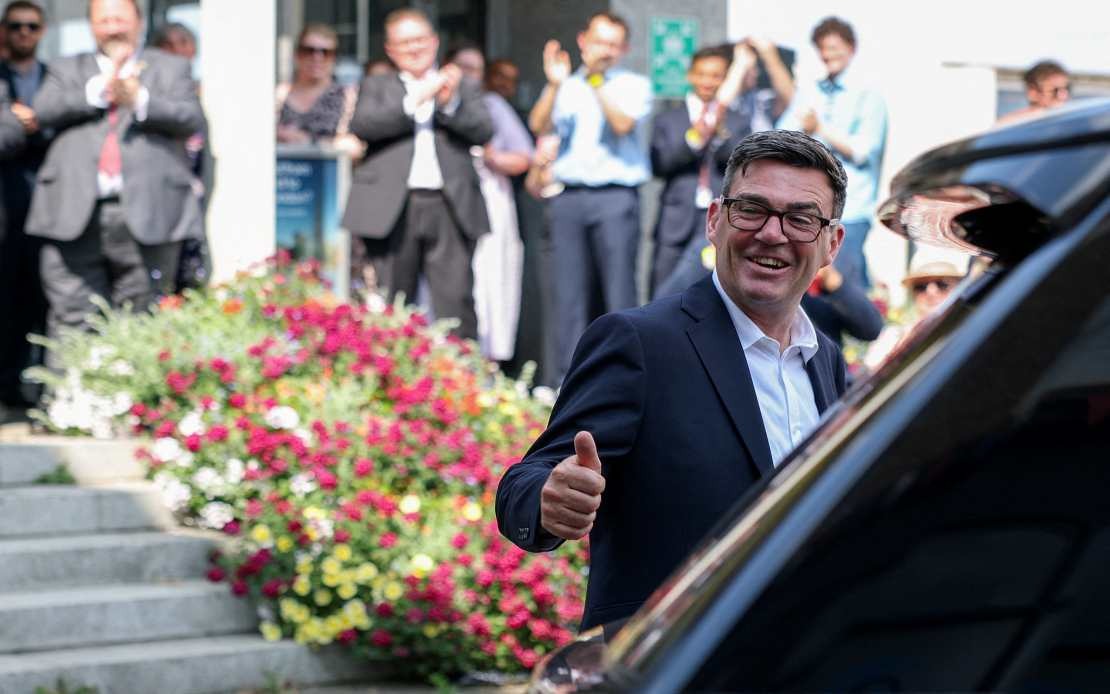
Singapore Prime Minister Lawrence Wong has formally welcomed Andy Burnham to his role as the newly appointed British Prime Minister, sending a congratulatory letter on Monday following Burnham's audience with King Charles III at Buckingham Palace. The move signals Singapore's commitment to maintaining diplomatic continuity with the United Kingdom under its new leadership, as Labour Party chief Burnham prepares to navigate Britain through a complex period of geopolitical realignment and economic uncertainty.
In his message, Wong expressed confidence in the resilience of Anglo-Singapore relations, pointing to a partnership forged over generations that extends beyond traditional diplomatic channels. The Singapore leader sought to position the two countries' relationship as one grounded in pragmatism and shared strategic interests, noting that both nations have consistently demonstrated an ability to achieve meaningful outcomes through coordinated action even during periods of global turbulence. This framing reflects Singapore's broader foreign policy approach of cultivating partnerships with major powers while maintaining careful balance across competing interests in the Indo-Pacific region.
The Strategic Partnership framework underpinning Singapore-UK ties encompasses cooperation spanning multiple domains. Wong specifically referenced innovation, science and technology, and defence as priority areas for deepened collaboration. These sectors reflect Singapore's economic development priorities and Britain's own strategic reorientation toward Indo-Pacific engagement, suggesting that the relationship extends well beyond ceremonial exchanges into substantive areas affecting both nations' long-term prosperity and security posture. The emphasis on defence cooperation carries particular significance given regional tensions and the United Kingdom's declared commitment to maintaining a persistent military presence east of Suez.
Singapore's government has also underscored the importance of Britain's continued regional engagement through multiple institutional channels. Wong highlighted the United Kingdom's status as an ASEAN Dialogue Partner and its participation in the Five Power Defence Arrangements, a Cold War-era security agreement involving Britain, Singapore, Malaysia, Australia, and New Zealand. These mechanisms have undergone renewed relevance amid shifting power dynamics in Southeast Asia, and Singapore's emphasis on British participation suggests recognition that Western military capability and political commitment remain important counterbalances to regional strategic competition.
The timing of Wong's congratulations carries additional diplomatic weight given Singapore's assumption of the ASEAN Chairmanship and the United Kingdom's elevation to the G20 Presidency in 2027. Wong explicitly framed these concurrent leadership roles as a distinctive opportunity for enhanced coordination on global challenges. This positioning allows Singapore to leverage its regional voice through ASEAN while potentially amplifying its influence within broader multilateral frameworks through coordinated action with a major Western economy. The convergence of these responsibilities suggests both nations anticipate substantive engagement on issues ranging from regional stability to economic cooperation and climate action.
Burnham's ascension to the British premiership represents a significant political shift in Westminster, bringing Labour back to government after a period of Conservative administration. His appointment follows King Charles III's formal invitation to form a government, the constitutional procedure through which new British prime ministers assume office. For regional observers, the transition underscores broader political realignment within Western democracies and raises questions about how Labour's approach to Indo-Pacific strategy may differ from its predecessor administration, particularly regarding military commitments and economic partnerships across Southeast Asia.
For Malaysia and the broader Southeast Asian region, the changing of the guard in London carries implications for how collective ASEAN interests are represented within major power networks. Britain's historical ties to Malaysia, rooted in the colonial period but evolved into modern security and economic relationships, mean that shifts in British policy receive careful attention across Southeast Asia. Wong's emphasis on the UK's regional engagement role suggests that Singapore—and by extension ASEAN—seeks reassurance that London will maintain substantive involvement in Asian affairs rather than allowing its attention to drift exclusively toward European or Atlantic concerns.
The Singapore-UK relationship also exemplifies how smaller regional powers navigate great power competition. By emphasising partnership with Britain while maintaining relationships with other major players, Singapore demonstrates a deliberate strategy of hedging through diversified alignments. This approach, increasingly relevant for Malaysian policymakers observing regional dynamics, rests on the assumption that multiple security partnerships and economic relationships provide greater stability than exclusive alignment with any single power bloc. Wong's outreach to Burnham fits within this broader strategic framework.
Looking ahead, the substance of Singapore-UK cooperation under Burnham's administration will likely reflect continuities established by previous British governments while potentially introducing new emphases aligned with Labour Party priorities. Areas such as green technology development, financial services innovation, and cybersecurity may feature prominently in bilateral discussions. Singapore's position as a regional hub for finance, technology, and trade makes it a natural partner for British companies and institutions seeking to expand Indo-Pacific operations, suggesting economic dimensions to the relationship will complement strategic and defence considerations.
The relationship between Singapore and the United Kingdom ultimately illustrates how regional powers in Southeast Asia maintain crucial partnerships with distant major powers whose strategic interests intersect with Asian stability and prosperity. Wong's warm reception of Burnham signals that Singapore expects the new British administration to maintain the commitments and engagement patterns established by recent predecessors, while also potentially opening channels for exploring new areas of cooperation aligned with contemporary challenges. As Britain adjusts to its evolving global role and ASEAN pursues its own institutional agenda, the Singapore-UK partnership will likely serve as a barometer for Western-Asian cooperation in the coming years, with implications extending across the broader Southeast Asian community.

