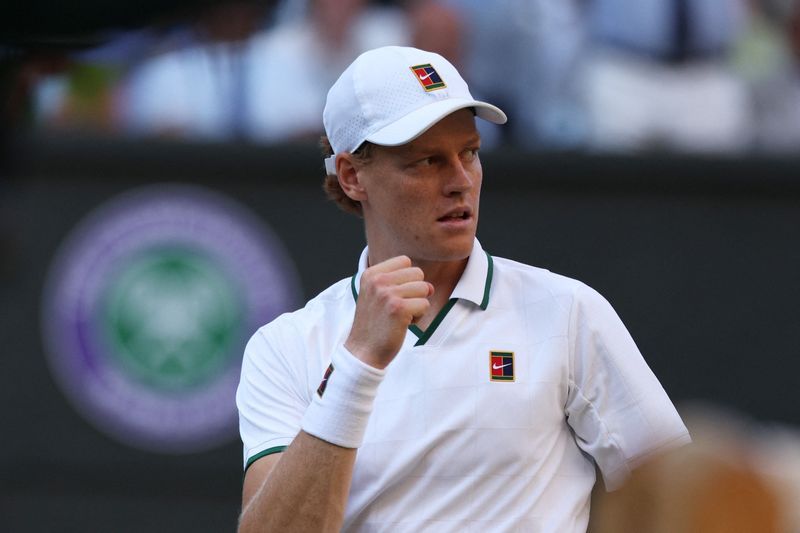
Jannik Sinner, the Italian number one seed, claimed his fifth Grand Slam title on Sunday by successfully defending his Wimbledon crown against a spirited Alexander Zverev in a dramatic final that tested both players to their limits. The 24-year-old Italian prevailed 6-7(7) 7-6(2) 6-3 6-4 in a nearly four-hour contest at the All England Club, adding his name to a select group of just ten men who have managed to retain the prestigious title in the professional era. Zverev, competing in his first Wimbledon final and fresh from winning the French Open, mounted a formidable challenge that came perilously close to producing a significant upset, but ultimately lacked the final reserves of firepower needed to topple the defending champion.
The opening set encapsulated the match's intensity and the minuscule margins that separated the two players throughout an encounter decided by fine tactical adjustments and moments of individual brilliance. Played in searing heat and a buffeting breeze on Centre Court, the first set consumed 65 minutes and featured heavy-hitting baseline exchanges where service games proved nearly impenetrable. Only a single break point emerged across the initial twelve games, with Sinner squandering his opportunity at 4-3 when he awkwardly misdirected a forehand, sending his shot beyond the sideline. Zverev's forehand, often a liability at crucial junctures throughout his career, demonstrated impressive consistency and accuracy, while his serve remained virtually untouchable, dropping merely eight points in the entire set.
The tiebreak proved decisive in determining set ownership. Zverev secured the first set point after chasing down a rare drop shot from Sinner, but the Italian passed him at the net to stay alive. The German promptly saved set point with an unreturnable serve, and when opportunity presented itself once more, he unleashed a flowing forehand winner that finally breached Sinner's formidable defence. This triumph ended Sinner's remarkable streak of capturing 14 consecutive sets against Zverev, signalling that the German challenger possessed the tactical weapons and mental fortitude to compete at the highest level against his elite opponent.
Frustration crept into Sinner's demeanour during the opening stages of the second set as Zverev's serving proved impervious to attack. The Italian attempted various strategies to manufacture breaks, but the German's delivery appeared virtually unbreakable. However, Sinner's resilience and composure reasserted themselves in the second set's tiebreak, where he elevated his intensity and aggression to level the match. The contest had transformed into an absorbing duel dominated by thunderous serves and devastating groundstrokes from both baselines, the quality of tennis on display rivalling any spectacle witnessed during the fortnight.
The turning point arrived during a crucial moment in the third set at 3-3, approximately two hours and 42 minutes into the encounter. Zverev earned his first break point opportunity of the match, creating a possibility to seize control of the contest. However, as Sinner executed a delicate drop shot and Zverev scrambled to retrieve it, the German's feet slipped from beneath him on the dusty baseline as he attempted to change direction. The resulting fall was awkward and visibly unsettled Zverev, notwithstanding his insistence to Sinner that he remained uninjured. The psychological impact of this tumble appeared significant, as Zverev's mobility became noticeably restricted thereafter. Sinner held his serve on the subsequent game and then capitalised on Zverev's reduced mobility to break through for the first time in the match, fundamentally shifting momentum in the Italian's favour.
Zverev's frustration manifested itself through increasingly desperate gestures, including hurling his racket across the turf in disgust as Sinner consolidated his advantage. The German regained some composure during the fourth set, but Sinner had entered a zone of superior execution and mental clarity, breaking Zverev's serve once more to establish a commanding position at 4-3. From this point forward, the writing appeared on the wall, with Sinner serving out the final set from a position of control. The conclusion featured two spectacular rallies that showcased the attacking prowess and court sense both players could muster, culminating in Sinner's victory after three hours and 46 minutes of absorbing competition.
Sinner's achievement represents a significant milestone in his rapidly ascending career trajectory. The Italian became the first player from his nation to win Wimbledon singles honours when he defeated Carlos Alcaraz in the previous year's final, and his successful defence demonstrates the consistency and physical durability required to sustain excellence on grass courts. His path to the final included overcoming a second-round collapse at the French Open and a close opening-round encounter against Miomir Kecmanovic mere weeks earlier. Yet Sinner rebuilt his form comprehensively, culminating in a masterclass performance during the semi-final and final where he relinquished not a single service game, underscoring his capacity to elevate his game when championship points are at stake.
The Italian's post-match reflections revealed a player acutely aware of the transient nature of sporting achievement and the privilege of competing at the sport's most hallowed venue. "There's no better place, honestly, to play tennis," Sinner remarked while cradling the iconic pineapple-topped Challenge Cup. His comments about waking on Sunday morning consumed by nervous anticipation reflected the magnitude of defending a Grand Slam title, a feat that fewer than fifty men have accomplished throughout professional tennis history. Sinner emphasised his appreciation for the contest's quality and intensity, recognising that Zverev's exceptional performance elevated the match beyond mere competition into a demonstration of elite-level tennis craft.
Zverev's fourth Grand Slam final defeat represented a bitter disappointment after an extraordinary resurgence that culminated in his maiden major title at the French Open, achieved on his 41st attempt at that tournament. Nevertheless, the German can take substantial satisfaction from his emergence as a genuine threat at the sport's most prestigious events. At 29 years old, Zverev proved capable of competing with the sport's elite on the pristine lawns of the All England Club, an achievement that had eluded him until this championship. His bid to become the first German man to win the Wimbledon title since Michael Stich in 1991 fell narrowly short, but his inaugural appearance in the final at the venue suggested that Wimbledon's grass surface may finally suit his powerful game.
From a regional perspective, Sinner's triumph reinforces the Italian contingent's remarkable resurgence in men's professional tennis. The sport has witnessed the emergence of Italian players capable of challenging tennis's traditional powerhouses on the sport's grandest stages, signalling a potential shift in the global tennis hierarchy. For Malaysian and Southeast Asian observers, Sinner's achievement serves as a reminder that sustained excellence and consistent hard work across multiple surfaces ultimately determine success in professional sport. His ability to elevate his performance during championship encounters and his willingness to acknowledge opponents' contributions to quality tennis exemplify the sportsmanship and professionalism that characterise the sport at its highest echelons.
The Wimbledon final showcased tennis of the highest calibre, with both players demonstrating the technical mastery, physical conditioning, and mental resilience required to compete at the sport's apex. Sinner's victory preserves his status as one of the sport's dominant forces and confirms his capacity to win major titles on different surfaces throughout the season. Meanwhile, Zverev's performance, despite ending in defeat, signals his potential to challenge for multiple major titles in the years ahead. The contrast between Sinner's elegant execution under pressure and Zverev's powerful but occasionally erratic performance illustrated how fractional margins separate champions from runners-up at professional tennis's highest levels.

