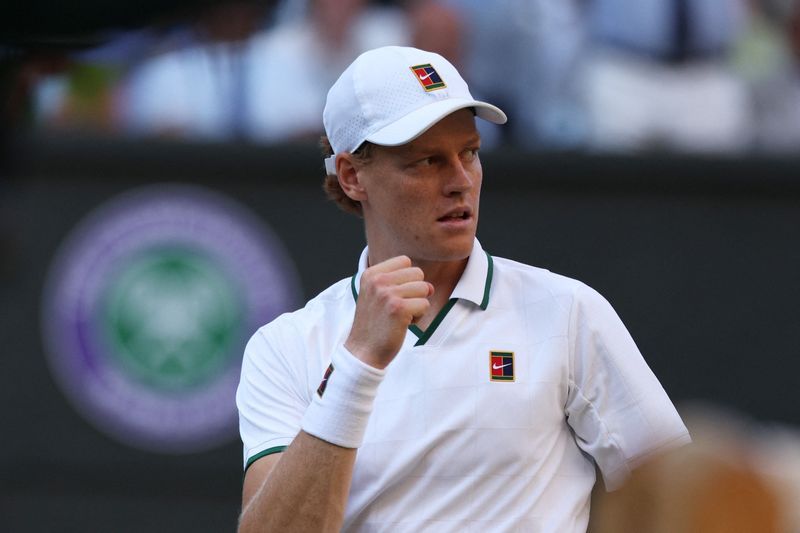
Jannik Sinner cemented his status as one of tennis's elite performers by successfully defending his Wimbledon championship on Sunday, overcoming a determined Alexander Zverev in a closely contested final that stretched nearly four hours. The Italian triumphed 6-7(7) 7-6(2) 6-3 6-4 on Centre Court, a victory that not only secured his fifth major title but also marked his tenth consecutive win over the German, an impressive run that underscores their contrasting trajectories in professional tennis.
The achievement places Sinner in distinguished historical company, making him the tenth player in the professional era to successfully defend the Wimbledon title—a testament to his consistency, mental resilience, and technical mastery on grass. This back-to-back triumph arrives at a pivotal moment in his career as he pursues rival Carlos Alcaraz's seven major titles, suggesting the rivalry between these two young stars will define tennis for years to come. At 22 years old, Sinner's twin Wimbledon crowns represent an accelerated ascent that few players have achieved at such a young age.
The match itself was a masterclass in contrasts, beginning with an extended opening set that saw both players trading blows in sweltering, windy conditions. Neither competitor dominated early proceedings, with both maintaining aggressive all-court games and forcing the issue through powerful groundstrokes. Zverev eventually prevailed in the first-set tiebreak, unleashing a decisive forehand and celebrating with visible emotion after 12 gruelling games, suggesting he sensed an opportunity to finally vanquish Sinner in their head-to-head rivalry.
Sinner's response was characteristically composed. While Zverev appeared energised by his maiden-set success, the Italian regrouped methodically through the second set, gradually asserting greater control over rallies and dictating from the baseline. The momentum shifted perceptibly as the set progressed, with Sinner's cleaner striking becoming increasingly evident. When the second set reached its tiebreak, Sinner displayed superior nerve and precision, winning 7-2 to level the contest and signal that the opening-set loss would not define the afternoon's narrative.
The third set proved pivotal and eventful, introducing a dramatic element that overshadowed the tennis for several minutes. Nearly two and a half hours into the contest, Zverev engineered a break-point opportunity, seemingly positioned to take command of the match. However, a Sinner drop shot caught Zverev off-guard, and the German slipped awkwardly to the turf, falling heavily and immediately clutching his right knee in apparent distress. The Centre Court crowd's gasp reflected the seriousness of the moment, with Zverev initially prostrate on the grass before gradually recovering.
Despite visible discomfort from the fall, Zverev demonstrated admirable courage by continuing play rather than retiring. Yet the incident appeared to disrupt his momentum and composure simultaneously. In the following game, Sinner capitalised ruthlessly, breaking serve and moving to a 5-3 advantage—a lead Zverev never recovered from. The German's frustration boiled over, with racket slams punctuating his mounting distress as Sinner held firm to claim the set and take a commanding two-sets-to-one lead.
The fourth set saw Sinner maintain his ascendancy despite a briefly competitive interval. He manufactured another break in the opening game and subsequently managed the set's remainder with impressive composure, holding serve when pressure mounted and preventing Zverev from generating any genuine comeback momentum. By the time Sinner served out the match, the outcome had become inevitable, and he collapsed to the grass in release and celebration, acknowledging the emotional weight of defending such a prestigious crown.
Zverev's post-match conduct demonstrated sporting grace in defeat, offering magnanimous congratulations to his opponent despite frustration at another Grand Slam final loss—his fourth major final defeat without victory. His self-deprecating humour about their head-to-head record, including an intentional miscount of their losses, suggested he had processed the disappointment with perspective. For Zverev, now 27 years old and chasing his first major title, this loss represents another opportunity missed against tennis's current elite.
For Malaysian and Southeast Asian tennis enthusiasts, Sinner's dominance carries particular significance as the sport continues globalising beyond traditional European and North American strongholds. His youth, aggressive style, and emerging dominance represent a new generation increasingly challenging long-established hierarchies within professional tennis. The intensity and consistency of his performances suggest that Alcaraz's hold on the Grand Slam lead will face sustained pressure, with both young stars likely to define the sport throughout the coming decade.
Sinner himself acknowledged the peculiar pressure and privilege of defending a major title, reflecting in his on-court remarks about never taking opportunities for granted and recognising Wimbledon's singular status within professional tennis culture. His genuine appreciation for the crowd's support and recognition of the emotional weight surrounding a Sunday Centre Court final demonstrated maturity beyond his years. As he continues accumulating major titles and extending his winning streaks against quality opposition, Sinner's credentials as tennis's next potential dominant force appear increasingly concrete and difficult to contest.

