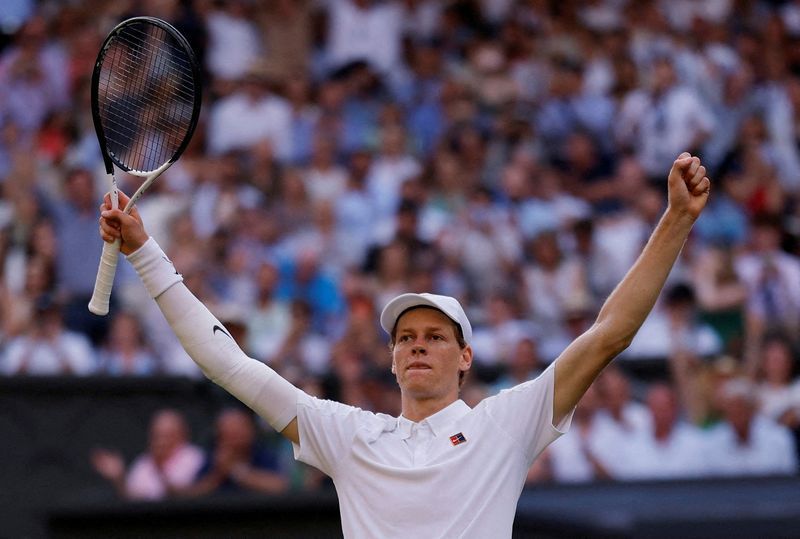
Jannik Sinner returns to Wimbledon this week as the defending champion, yet the Italian's grip on the crown has visibly loosened following a humbling collapse at Roland Garros that has emboldened a cluster of challengers eyeing an upset at the All England Club. The world number one's invincibility has been severely dented, forcing him to recalibrate his approach on grass as he attempts to prove that his recent dominance on clay can translate to the sport's fastest and most unpredictable surface.
The 24-year-old arrived in Paris with a remarkable 30-match winning streak dating back to February, a run that appeared to herald a new era of Italian tennis mastery. That streak unravelled spectacularly in the second round, however, as physical exhaustion and unspecified health concerns left Sinner unable to sustain the intensity required at tennis's most demanding grand slam. His withdrawal from warm-up tournaments before Wimbledon has only deepened the uncertainty about his readiness, with rivals scrutinising every decision for signs of lingering vulnerability.
Mats Wilander, the seven-times grand slam champion turned commentator, attributes Sinner's Paris breakdown to a relentless schedule rather than any fundamental weakness in his game. Speaking to La Gazzetta dello Sport, Wilander explained that inadequate recovery time during the two months preceding the French Open had depleted the Italian's physical reserves precisely when they were needed most. Wilander believes that Sinner has now recovered sufficiently and expects him to return refreshed, though the veteran analyst cautioned that grass remains an inherently unpredictable surface where form and confidence matter less than feel and adaptation.
Notwithstanding Sinner's status as defending champion, no figure looms more menacingly over his title aspirations than Novak Djokovic. The 39-year-old Serbian legend harbours not one but two compelling motivations to seize Wimbledon this fortnight: an eighth title would match Roger Federer's all-time record at the grass-court showcase, while victory would also edge him closer to the elusive 25th grand slam crown that has eluded him throughout his career. Time is patently running out for Djokovic to achieve both objectives, lending an unmistakable sense of urgency to his campaign.
Djokovic's early departure from Paris might ordinarily suggest wavering form, yet former finalist Andy Roddick insisted on his podcast that the Serbian should not be dismissed. Roddick, who has reached three Wimbledon finals himself, articulated a subtle but powerful psychological dynamic: having observed the landscape of contemporary tennis, Djokovic may well believe that his superior movement and grass-court pedigree position him as the tournament favourite despite Sinner's ranking. For a player of Djokovic's competitive hunger and experience, such calculations can prove self-fulfilling, particularly when the draw has been redrawn in his favour.
Alexander Zverev emerges as perhaps the most intriguing alternative champion. The German's maiden grand slam triumph at Roland Garros represents both a watershed moment in his career and substantial preparation for Wimbledon's unique demands. Zverev possesses the heavy serve that forms the cornerstone of grass-court excellence, a weapon that according to six-times major winner Boris Becker can almost single-handedly carry a player to the semi-finals if deployed with consistency.
Becker's endorsement of Zverev as a genuine Wimbledon favourite reflects the changing calculus created by Carlos Alcaraz's injury absence. The Spanish world number three's unavailability removes perhaps the sole contemporary rival capable of imposing his will across all surfaces with the assurance Alcaraz demonstrated during his triumphant campaigns in 2023 and 2024. Without Alcaraz's gravitational pull, the title picture has opened considerably, distributing opportunity across a broader cohort of contenders than would normally be expected at a grand slam.
The American contingent presents another competitive dimension that regional audiences should monitor. Ben Shelton, Taylor Fritz, and Frances Tiafoe each possess the striking power and aggressive tendencies to trouble established stars, particularly on a surface where rhythm and confidence breed success more reliably than defensive consistency. These younger players have demonstrated capability against top-seeded opponents in recent months, suggesting that Sinner cannot afford complacency in early rounds.
Flavio Cobolli's emergence as a serious contender, evidenced by his runner-up finish in Paris, signals the arrival of another player capable of challenging the established hierarchy. The Italian's relatively smooth path to the French Open final indicates not merely a single breakthrough performance but rather a sustained elevation in performance that could persist on grass. For Malaysian and Southeast Asian fans following men's tennis, Cobolli's trajectory represents the kind of generational transition that might reshape the competitive landscape across multiple surfaces.
The broader narrative surrounding this Wimbledon revolves around whether Sinner can stabilise after his French Open trauma or whether the window of opportunity created by Alcaraz's injury will instead be seized by Djokovic, Zverev, or another contender in what appears an unusually open field. Sinner's physical concerns cannot be entirely dismissed, even with Wilander's sanguine assessment, as grass rewards the healthy and punishes those operating at diminished capacity. His skipping of preparation tournaments signals either confident recovery or cautious management, a distinction that only this week's matches will clarify.
For Malaysian observers, this Wimbledon represents compelling tennis precisely because the script has become uncertain. Sinner's dominance promised a period of stylistic clarity, with one player's superior technique and movement reshaping what we expected from elite men's tennis. Instead, the French Open collapse has fractured that certainty, resurrecting Djokovic's twilight hopes, validating Zverev's patient development, and reminding the sport that grass-court tennis remains uniquely resistant to statistical prediction or dominant individual performance. The defending champion arrives as favourite, but the challenge has never been clearer.

