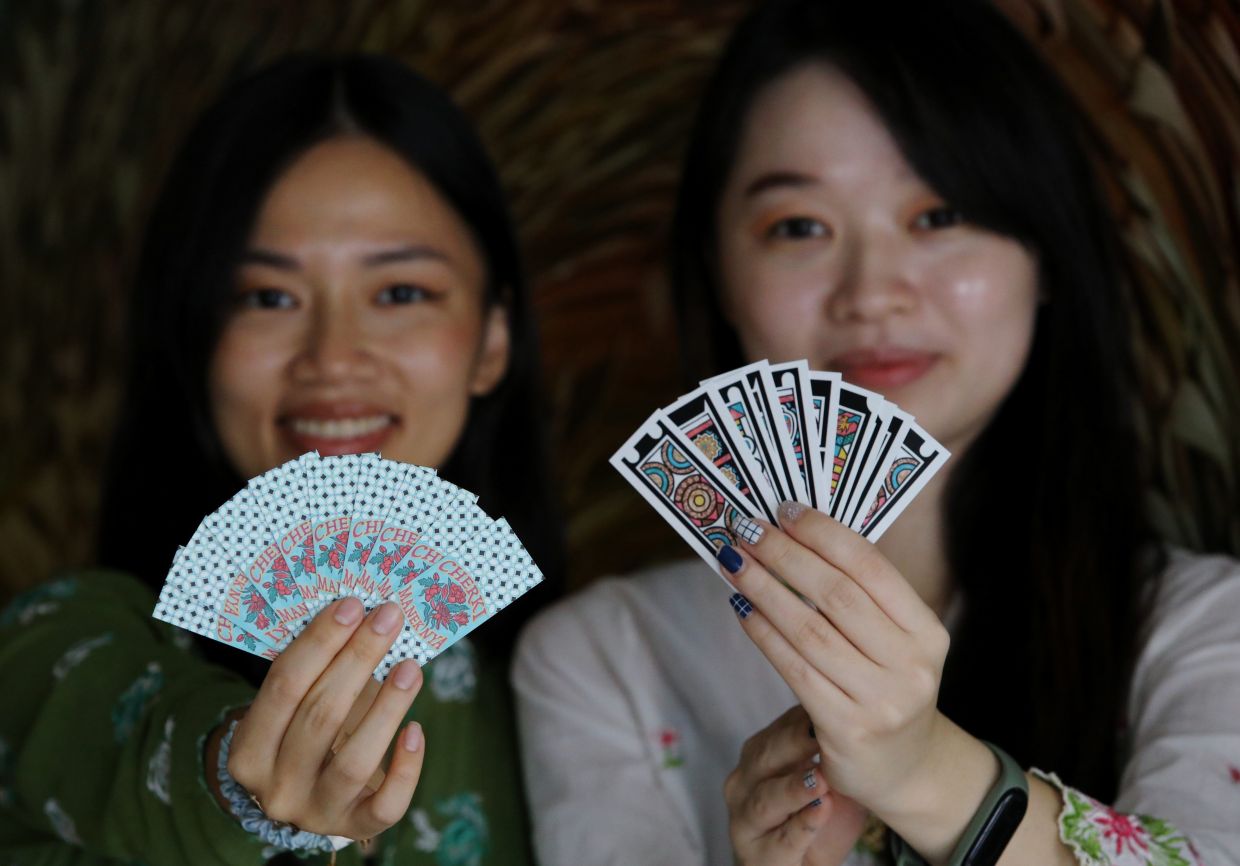
When Lee Swee Lin and Lee Swee May set out to preserve an important piece of their Peranakan heritage, they chose an unlikely canvas: a card game that many in their generation had never learned to play. The Melaka-born sisters, who operate a Kuala Lumpur business focused on traditional Peranakan beaded footwear and decorative items, have redesigned Cherki—a centuries-old card game that once graced Baba Nyonya households throughout the region—with vibrant colours and contemporary visual aesthetics while remaining true to its traditional symbols and structure.
Cherki holds a distinctive place in Peranakan culture, though few today recognise its significance. Known by various names including Ceki, Chi Kee and Koa, the game is believed to have originated in China, with historical records from the Tang Dynasty in the 9th century referring to a "leaf game" that eventually reached Europe via medieval trading routes. The game spread across Southeast Asia, taking root particularly in Singapore, Malaysia, Indonesia and Thailand, where Peranakan communities embraced it as a form of domestic entertainment. The Malay term "daun ceki"—literally "leaf cards"—reflects how the game became woven into local culture, eventually adopted wholesale by Peranakan families who made it their own.
The original Cherki deck consists of two sets of 60 cards featuring 30 distinct patterns, divided into three traditional suits of coins, strings and myriads with numerical values from one to nine, supplemented by three special cards. The gameplay mirrors mahjong in its complexity and social dimension, requiring strategy and skill from players. Yet despite this rich history, Cherki has faded from the cultural consciousness of younger generations, victims of broader societal shifts that have eroded transmission of heritage knowledge within families. Lee Swee Lin, aged 32, articulated the problem plainly: many people in her generation and even her mother's generation no longer understand how to play the game their ancestors enjoyed.
The sisters credit their paternal grandmother, Deo Yeok Kim, as their primary inspiration for undertaking this preservation project. Growing up in Melaka in their grandmother's household, they absorbed Peranakan traditions through daily observation—the preparation of traditional dishes, the speaking of the language, the maintenance of cultural practices that might otherwise have disappeared. When their grandmother passed away recently, the loss prompted reflection on how much of their cultural knowledge originated from her patient transmission across generations. This realisation motivated them to ensure that at least one aspect of Peranakan heritage would not be lost to time and changing priorities.
Their redesigned version, developed in collaboration with a small design team throughout 2024, employs digital tools including Procreate and Adobe Illustrator to introduce colour and contemporary illustration while preserving the game's fundamental identity. The modernised deck contains 30 patterns repeated four times instead of the original twice, retaining the three traditional suits but introducing three new special cards—butterfly, dragon and phoenix—that replace the original white flower, red flower and old thousand. Each numerical value incorporates distinctly Peranakan symbols: the kantan fragrant flower central to Nyonya cooking, chupu porcelain serving vessels, kerongsang ornamental brooches used to fasten the kebaya, and gelang traditional bracelets worn by Nyonya women. This careful integration of cultural elements transforms the deck from a mere game into an educational artefact celebrating material culture.
Beyond aesthetic modernisation, the sisters recognised that contemporary players needed accessible pathways into the game. They developed clearer, more intuitive instructions designed to lower barriers for newcomers whilst preserving strategic depth for experienced players. The visual redesign itself serves this pedagogical function—the vibrant colours and polished illustrations make the game visually compelling in ways that the original black-and-white versions could never match, positioning it as something contemporary players would voluntarily choose rather than view as a museum piece. Lee Swee May articulated their design philosophy simply: they wanted Cherki to feel like a game one would eagerly pull out with friends today, not an artefact confined to history books.
The sisters' initiative addresses a broader crisis facing Peranakan communities across Malaysia and the region. According to research published in 2022 titled "Comparative of Cultural Material Study Between Baba Nyonya Original Descendants and Baba Nyonya New Descendants in Malacca," younger members of the community face increasing exposure to global pop culture and digital entertainment, creating competing attractions that diminish investment in traditional practices. Lee Yuen Thien, deputy president of Persatuan Peranakan Baba Nyonya Malaysia, estimates the association has 3,000 members with potentially 10,000 to 15,000 Peranakans nationwide, yet observes that modern professional commitments and lifestyle changes leave little room for cultural activities that younger generations do not perceive as priorities.
Geographic displacement compounds these challenges. Migration away from ancestral centres in Melaka and Penang, where family-based transmission of traditions once occurred naturally, has fractured the intergenerational knowledge chains. Changing marriage patterns, with Peranakans increasingly partnering outside their community, reshape the cultural environment within households. These transformations mean that knowledge once passed through daily observation—the grandmother teaching the granddaughter to cook, to embroider, to play cards—no longer occurs with the same inevitability or frequency. Without deliberate intervention, traditions evaporate within a generation or two.
Tan, manager of the Baba & Nyonya Heritage Museum Melaka, advocates for allowing culture to evolve while simultaneously building awareness among younger generations. He emphasises that cultural continuity requires active engagement rather than preservation in amber. By creating awareness of ancestry and heritage, communities can spark renewed interest and provide pathways for cultural transmission adapted to contemporary circumstances. The Lee sisters' approach embodies this philosophy—they do not insist young Peranakans play Cherki exactly as their ancestors did, but rather present it in forms that resonate with contemporary aesthetic and entertainment expectations whilst maintaining authentic cultural content.
The Lees' Cherki redesign represents a calculated intervention in the broader struggle to maintain Peranakan identity in an era of rapid cultural change. By combining respectful preservation of traditional elements with contemporary design sensibilities, they demonstrate that heritage need not compete with modernity for younger generations' attention. Instead, heritage can be repackaged, presented and celebrated through modern idioms whilst retaining its essential meaning. For a community increasingly scattered geographically and temporally distant from its sources, such bridging projects become essential infrastructure for cultural survival. Whether through card games, beaded footwear or museum exhibitions, the effort to make heritage visible, accessible and desirable to younger Peranakans becomes not merely nostalgic but foundational to community continuity in an age when such transmission can no longer be assumed.
The success of the Lees' initiative will ultimately depend on whether their modernised Cherki attracts sufficient interest among younger Peranakans to become genuinely playable within families and social groups. If it does, the project may establish a model for other heritage preservation efforts—demonstrating that cultural authenticity and contemporary appeal need not conflict. If it remains primarily a novelty product, the underlying problem of cultural disconnection persists. Yet the sisters' willingness to invest creative energy and commercial resources into preserving a game that few in their generation even knew existed suggests a broader awakening within Peranakan communities about the urgency of such work. In this sense, Cherki's revival, however humble, signals something larger: a determination that this distinctive heritage will not quietly disappear.

