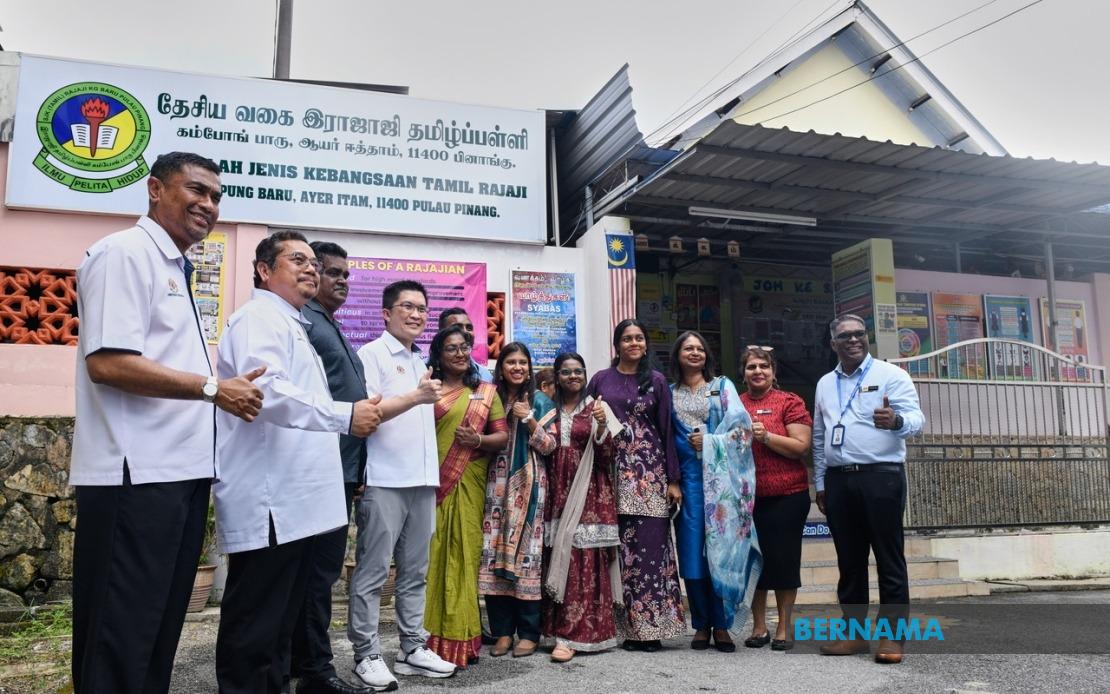
The long-awaited expansion of SJKT Rajaji in George Town has cleared a major hurdle with the Education Ministry's formal approval of an RM8 million construction project that will relocate the century-old Tamil school to a newly developed site in Farlim. Deputy Education Minister Wong Kah Woh announced the milestone on June 15, presenting the official approval letter to school officials and stakeholders gathered at the institution's current location. The initiative represents a pivotal moment for an educational institution that has served Penang's Tamil-speaking community for seven decades but increasingly struggles with spatial constraints and inadequate facilities for its student population.
The existing campus has become a casualty of success and demographic shifts across Penang's urban landscape. Originally designed and constructed to serve a different era's enrolment patterns, SJKT Rajaji now attempts to educate approximately 100 pupils within facilities that were never intended for modern pedagogical requirements. The school's 76-year operational history underscores its integral role within Penang's Tamil community, yet this longevity has simultaneously exposed the limitations of aging infrastructure. Wong emphasised that the relocation will afford the institution a genuine fresh start, enabling comprehensive improvements in teaching and learning environments that the current cramped conditions simply cannot accommodate.
The new campus will occupy a 2.3-acre parcel located roughly 500 metres from SJKT Rajaji's present address, a proximity that ensures community continuity while enabling a complete physical and operational transformation. The Penang State Government initially earmarked this land for Tamil school development in 2022, demonstrating regional commitment to preserving mother-tongue education even as broader trends in Malaysian education shift towards centralised, larger institutional models. The board of governors submitted a formal relocation application to the Education Ministry during 2023, and approval materialised following resolution of all outstanding coordination matters between state authorities and relevant local bodies.
Timeline considerations suggest that the construction phase will demand approximately 18 months once work commences, positioning SJKT Rajaji for operational transition to its new facility by the 2029 academic session at the latest. This extended timeline reflects the substantial nature of the undertaking and the necessity for meticulous planning that accompanies educational infrastructure development. For affected students, parents, and staff, the transition represents both opportunity and temporary disruption, though the phased approach affords flexibility for managing operational continuity during the changeover period.
A particularly noteworthy dimension of the project is its financing structure, which entirely bypasses traditional government expenditure pathways. Wong highlighted that a private developer will underwrite the entire RM8 million budget through corporate social responsibility programming, exemplifying collaborative arrangements between Malaysia's public and private sectors in advancing educational objectives. This funding model proves especially significant for Penang's state administration, which faces escalating pressure to address infrastructure needs across multiple priority areas simultaneously. By leveraging CSR frameworks, the state government can direct limited resources toward other urgent developmental initiatives whilst still advancing Tamil school modernisation.
Penang's broader Tamil school ecosystem comprises 28 institutions dispersed across the state, many contending with comparable infrastructure challenges and spatial limitations. Datuk Seri S. Sundarajoo, the State Housing and Environment Committee chairman and concurrent head of the Penang Tamil Schools Special Committee, contextualised SJKT Rajaji's approval within this wider strategic landscape. He disclosed that multiple Tamil school projects remain in active development throughout Penang, with particular emphasis on securing permanent institutional sites and implementing carefully sequenced capital investments that distribute resources across the educational sector.
Groundbreaking ceremonies for no fewer than three separate Tamil school initiatives are projected to occur within the current calendar year, signalling sustained momentum in infrastructure development despite fiscal pressures confronting Malaysian state governments. Additionally, several heritage institutions including SJKT Sungai Bakap and SJKT Juru are undergoing comprehensive revival programmes, suggesting coordinated, multi-institutional approaches to addressing systemic infrastructure deficiencies. This systematic strategy reflects recognition that individual school improvements, while valuable, require complementary investments across the wider system to ensure equitable educational quality.
For Malaysia's Tamil-language education sector, which has experienced declining enrolment nationally over recent decades, initiatives like SJKT Rajaji's relocation carry symbolic and practical importance. The commitment of substantial financial resources and government approval bandwidth toward modernising Tamil school facilities sends a signal about preserving mother-tongue education pathways within Malaysia's diverse multilingual context. This becomes particularly pertinent given broader discussions about medium of instruction in Malaysian schools and the place of vernacular education within national educational architecture.
The SJKT Rajaji project also illuminates emerging partnerships between government, educational institutions, and corporate entities in addressing infrastructure backlogs. As Malaysian states confront mounting demands for school facilities amid budget constraints, creative financing arrangements leveraging CSR commitments may become increasingly instrumental in sustaining capital development. However, such arrangements simultaneously raise questions about equity—ensuring that schools lacking corporate benefactors receive comparable investment and that reliance on private funding does not create two-tiered infrastructure provision across different communities and regions.
For Penang's Tamil community specifically, the relocated SJKT Rajaji represents tangible validation of their educational priorities within state development planning. The institution will transition from a historic but spatially constrained campus to purpose-designed facilities reflecting contemporary pedagogical standards. Enhanced physical infrastructure frequently correlates with improved learning outcomes, better staff retention, and heightened community engagement, potentially benefiting the approximately 100 pupils currently enrolled and future student cohorts attending this revitalised institution.
Looking forward, the successful execution of SJKT Rajaji's relocation may establish precedents informing similar projects across Penang's remaining Tamil schools and potentially inspire comparable initiatives in other Malaysian states. The integration of private-sector CSR funding, coordinated state planning, and Education Ministry approval demonstrates feasible mechanisms for advancing vernacular education infrastructure without exhausting constrained government budgets. As Malaysia navigates ongoing educational development priorities, such collaborative models warrant close observation and evaluation regarding their effectiveness, sustainability, and replicability across diverse school types and communities throughout the nation.