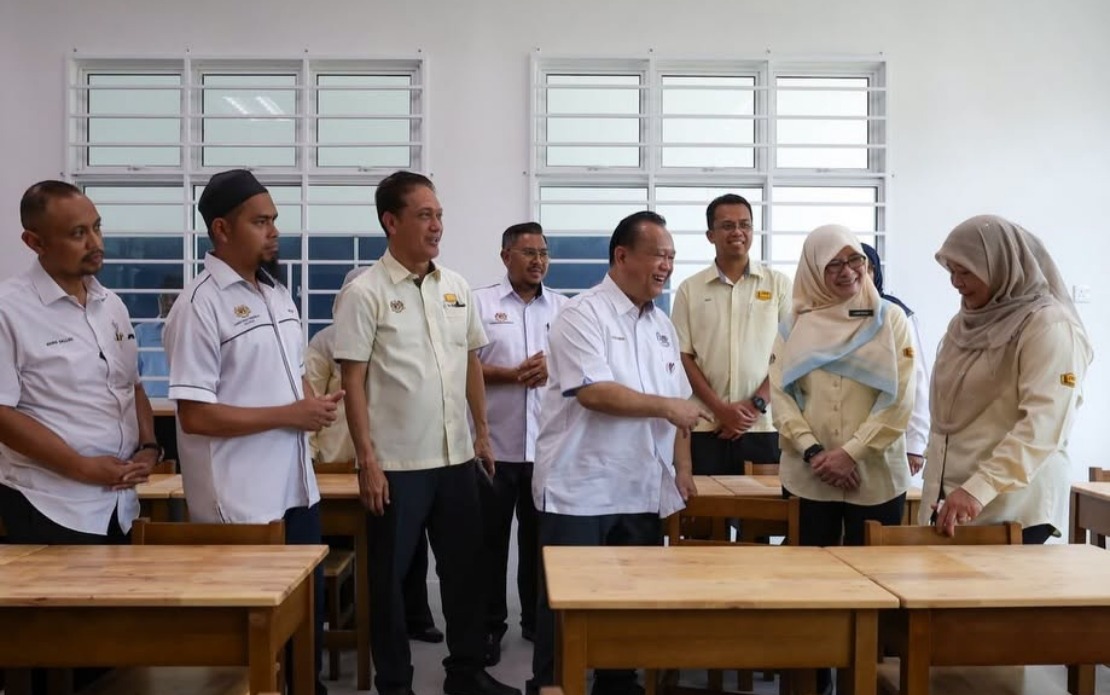
The reconstruction of a deteriorating academic building at SK FELDA Kota Gelanggi 1 in Jerantut has been successfully completed nearly a year ahead of its originally scheduled deadline, marking a significant milestone in the management of government infrastructure projects across Pahang. Works Minister Datuk Seri Alexander Nanta Linggi announced the achievement at a handover ceremony held at the school, highlighting the swift delivery of improved educational facilities without any request for extension of time from the contractor.
The RM7.998 million undertaking commenced on January 13 last year and reached full completion on June 26, substantially outpacing the initial May 2, 2027 target date. This acceleration represents more than 300 days of schedule compression, a performance metric that Nanta emphasized reflects commendable project execution standards and efficient coordination between government agencies and construction firms. The early finish carries particular significance in an environment where infrastructure delays have historically plagued public sector building programmes across Malaysia.
The scope of work encompassed the construction of an entirely new academic block featuring three conventional classrooms, a dedicated science laboratory, and a health clinic facility. Beyond these standard learning spaces, the project also delivered a Special Education Integration Programme (PPKI) block designed specifically to accommodate pupils with special educational needs. The PPKI facility incorporates specialized infrastructure and resources tailored to support learners with disabilities, addressing a critical gap in inclusive educational provision at the institution.
Approximately 17 students with special educational needs stand to benefit directly from the newly constructed PPKI block and its associated support systems. This development aligns with Malaysia's broader commitment to inclusive education, ensuring that children with diverse learning requirements have access to appropriate academic environments within mainstream school settings. The facility represents a tangible investment in equitable access to quality education, a principle increasingly central to the national education agenda.
Nanta's remarks underscored the importance of maintaining rigorous quality standards throughout project execution and beyond handover. He called upon contractors to address all defect reports expeditiously during the defect liability period, emphasizing that post-completion performance remains critical to project success. The minister also directed the Public Works Department to maintain vigilant oversight during the post-handover phase, ensuring that all infrastructure systems and facilities continue functioning safely and meeting stipulated technical benchmarks.
The successful completion of this Jerantut school project reflects a broader pattern of infrastructure renewal currently underway across Pahang state. Multiple construction and rehabilitation initiatives targeting other dilapidated educational facilities are progressing concurrently, suggesting a coordinated regional approach to addressing accumulated maintenance backlogs in the school sector. Nanta expressed optimism that these parallel projects might similarly achieve early completion, potentially establishing new efficiency benchmarks within the public works portfolio.
The acceleration of this project timeline carries wider implications for Malaysia's development agenda, particularly regarding the capacity of government agencies to deliver infrastructure on schedule. Public sector construction initiatives have traditionally encountered delays stemming from contractual disputes, material procurement challenges, and coordination issues between multiple stakeholders. The FELDA Kota Gelanggi 1 outcome demonstrates that streamlined project management, clear accountability frameworks, and effective contractor supervision can produce tangible results within compressed timeframes.
For Jerantut residents and the Pahang education sector more broadly, the early delivery provides extended benefits. Students gain access to improved learning infrastructure sooner than anticipated, enabling enhanced pedagogical delivery throughout the 2024-2025 academic year. The accelerated timeline also reduces overall project costs through shortened financing periods and reduced administrative overheads, delivering better value for public expenditure.
The emphasis on special education facilities reflects evolving recognition of inclusive schooling's importance within Malaysia's educational framework. By embedding specialized support within mainstream school environments, institutions like SK FELDA Kota Gelanggi 1 promote social integration while providing targeted academic assistance. This approach aligns with international best practices and the United Nations Sustainable Development Goals emphasizing quality, inclusive education.
Nanta's directive to the Public Works Department underscores the transition phase between construction completion and long-term facility stewardship. Post-handover monitoring ensures that construction quality persists through actual usage, preventing premature deterioration that historically necessitated costly repairs. This preventative maintenance philosophy, when consistently applied across government infrastructure, can substantially reduce lifecycle costs and extend facility serviceable life.
The project's successful completion also carries significance for contractor accountability and performance management within Malaysia's construction industry. Delivering projects without extension-of-time requests demonstrates discipline in project planning, supply chain management, and workforce coordination. Such performance standards, when widely adopted, could elevate overall efficiency within the public construction sector, potentially reducing the endemic delays that have characterized government building programmes.
Looking forward, the FELDA Kota Gelanggi 1 project serves as a potential template for subsequent educational infrastructure initiatives across Pahang and other states. Replicating the management practices and coordination mechanisms that enabled early completion could systematically improve delivery outcomes across the broader school infrastructure portfolio. As Malaysia continues addressing educational facility gaps, particularly in rural and semi-rural areas, such efficiency gains become increasingly valuable for maximizing public resources.

