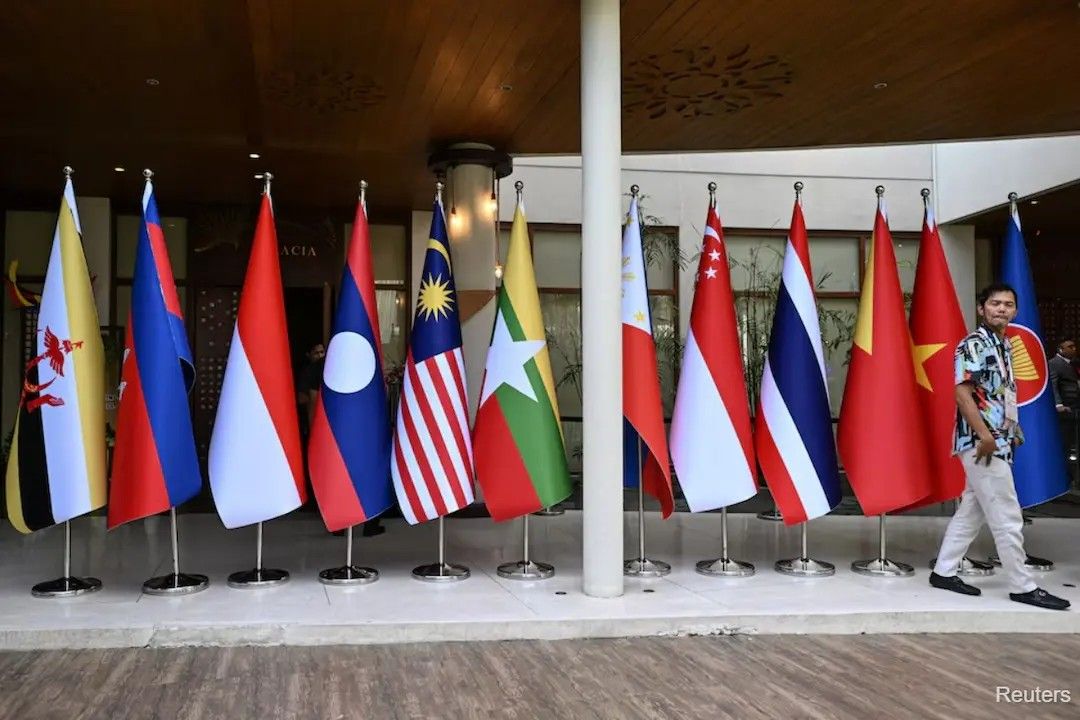
Tensions in the South China Sea threaten to hijack the agenda at a crucial gathering of Southeast Asian foreign ministers in Manila this week, as the United States intensified its warnings about what it describes as reckless Chinese conduct in one of the world's most contested waterways. The arrival of US Secretary of State Marco Rubio in the Philippines coincided with Washington's sharp rebuke of Beijing's maritime behaviour, setting a confrontational tone for discussions that ASEAN nations had hoped would focus on broader regional stability and economic cooperation.
The immediate trigger for escalating rhetoric is a violent encounter that erupted on Monday between Philippine and Chinese personnel at the Second Thomas Shoal, a disputed outcrop that has become a flashpoint for competing territorial ambitions. The Philippines reported that China Coast Guard members physically assaulted Filipino sailors stationed near a grounded vessel that serves as an outpost on the shoal, marking the most serious maritime clash in several months. Beijing presented an alternative narrative, contending that Manila provoked the incident by dispatching personnel in small boats to approach Chinese vessels in the area. These competing accounts underscore the fundamental disagreement between claimant states over basic facts on the ground.
Rubio's presence in Manila carries particular symbolic weight at a moment of heightened US-China strategic competition. Before travelling to the Philippines, the Secretary of State signalled openness to a possible side meeting with Wang Yi, China's Foreign Minister, suggesting Washington has not abandoned diplomatic channels despite rhetorical escalation. Yet in an opinion piece published on Tuesday morning, Rubio articulated the stakes in starkly zero-sum terms, framing the South China Sea not merely as a maritime dispute but as a struggle for regional control with profound implications for global trade and security architecture. His assertion that freedom of navigation in Southeast Asia cannot be taken for granted carried an implicit warning that allowing any single power to dominate the waterway would fundamentally alter the geopolitical balance upon which American commitments and regional prosperity depend.
China's expansive territorial claims over nearly the entire South China Sea have been thoroughly undermined by international legal rulings, yet Beijing continues to assert authority over the waters despite the absence of formal legal foundation. The waterway represents one of the globe's most economically vital shipping corridors, with trillions of dollars in annual trade transiting through its passages. For Malaysia and other Southeast Asian nations heavily dependent on maritime commerce, control over these routes directly affects national economic interests, making the geopolitical struggle far more than an abstract great power rivalry. The spectre of any external power weaponising control of these shipping lanes—by restricting access or imposing tariffs—represents a tangible threat to the region's development prospects.
Rubio's warnings resonated with longstanding Malaysian concerns about external pressure on regional sovereignty and economic autonomy. His explicit reference to a hegemonic power using trade as a geopolitical instrument echoed Malaysia's own experiences navigating great power competition. The Secretary of State's framing of the issue as fundamentally about Southeast Asian freedom of action, rather than positioning it purely as a US-China rivalry, represented a calculated appeal to ASEAN solidarity against any form of regional domination. However, the effectiveness of such messaging depends partly on whether ASEAN members perceive the United States as a reliable counterweight or simply another external power pursuing its own strategic interests at regional expense.
The confrontation at Second Thomas Shoal carries particular significance because it undermines the fragile diplomatic progress ASEAN has attempted to cultivate with China. For years, Southeast Asian nations have pursued negotiation of a Code of Conduct governing South China Sea behaviour, hoping to establish rules that would reduce the likelihood of escalation. Yet observers increasingly acknowledge that such a code, should it ever materialise, will likely lack the enforcement mechanisms necessary to prevent precisely the kind of incident that just transpired. The gap between aspirational diplomatic instruments and the hard reality of competing territorial claims reflects the fundamental structural challenge confronting ASEAN: its members harbour divergent interests and risk tolerances regarding confrontation with Beijing.
Thailand's approach to Myanmar illustrates how internal ASEAN divisions complicate efforts to present a united front on major issues. Bangkok, sharing an extensive border with Myanmar and hosting millions of its displaced persons, has emerged as the most vocal advocate for reintegrating the military junta back into full ASEAN participation. Thai Foreign Minister Sihasak Phuangketkeow recently indicated that Myanmar's leader Min Aung Hlaing would visit Thailand in August, signalling Bangkok's determination to normalise relations despite the ongoing civil war that has devastated the country since the 2021 coup. Thailand's pragmatism reflects the reality that sustained isolation of Myanmar has produced negligible pressure for democratic reform while creating humanitarian catastrophe and regional instability.
Yet Malaysia and other ASEAN members maintain reservations about rewarding Myanmar's military leadership without demonstrable progress toward the bloc's five-point peace plan, which has languished in implementation for years. Malaysian Foreign Minister Mohamad Hasan articulated this position bluntly in May, stating that his government opposes high-level engagement while systematic oppression continues within Myanmar. This disagreement among ASEAN members about how to address Myanmar's internal conflict reflects deeper tensions within the bloc about whether regional solidarity should take precedence over universal principles of governance and human rights. The stakes of this debate extend beyond Myanmar itself, affecting ASEAN's credibility and cohesion as an institution.
The convergence of multiple crises—South China Sea tensions, Myanmar's unresolved civil war, energy insecurity across Southeast Asia—creates a particularly challenging backdrop for this week's foreign ministers' meeting. Russia's Foreign Minister Sergei Lavrov will be present, adding another dimension to great power competition for regional influence. The Philippines, confronting an acute energy emergency declared in March, has begun purchasing Russian oil despite broader Western sanctions, illustrating how energy insecurity can drive countries toward compromises that undermine traditional alignments. For Malaysia and other energy-importing Southeast Asian nations, energy security has become inseparable from geopolitical positioning, making economic desperation a tool through which external powers can reshape regional politics.
ASEAN's Framework Agreement on Petroleum Security offers a mechanism for regional fuel-sharing that could buffer member states against supply disruptions or price shocks. Yet ratification and implementation remain stalled, reflecting both technical obstacles and the political difficulty of asking energy-surplus countries to subordinate economic interests to collective regional benefit. The renewed emphasis on energy security coordination this week suggests growing recognition that Southeast Asia cannot safely assume the benign external environment that underpinned regional prosperity for decades. Climate change, geopolitical conflict, and the energy transition create genuine supply uncertainties that no individual nation can manage alone.
The meeting's ultimate significance will depend on whether ASEAN can move beyond reactive crisis management to articulate a coherent regional strategy. The bloc's traditional consensus-based diplomacy, designed to accommodate diverse interests, increasingly appears inadequate to the accelerating pace of geopolitical change and the magnitude of challenges confronting member states. Yet any drift toward factionalism would further erode ASEAN's relevance as the region's primary institutional framework. The delicate balance between unity and diversity, between principle and pragmatism, will determine whether ASEAN emerges from this week's gathering with strengthened coherence or further fractured along the fault lines of divergent great power alignments.

