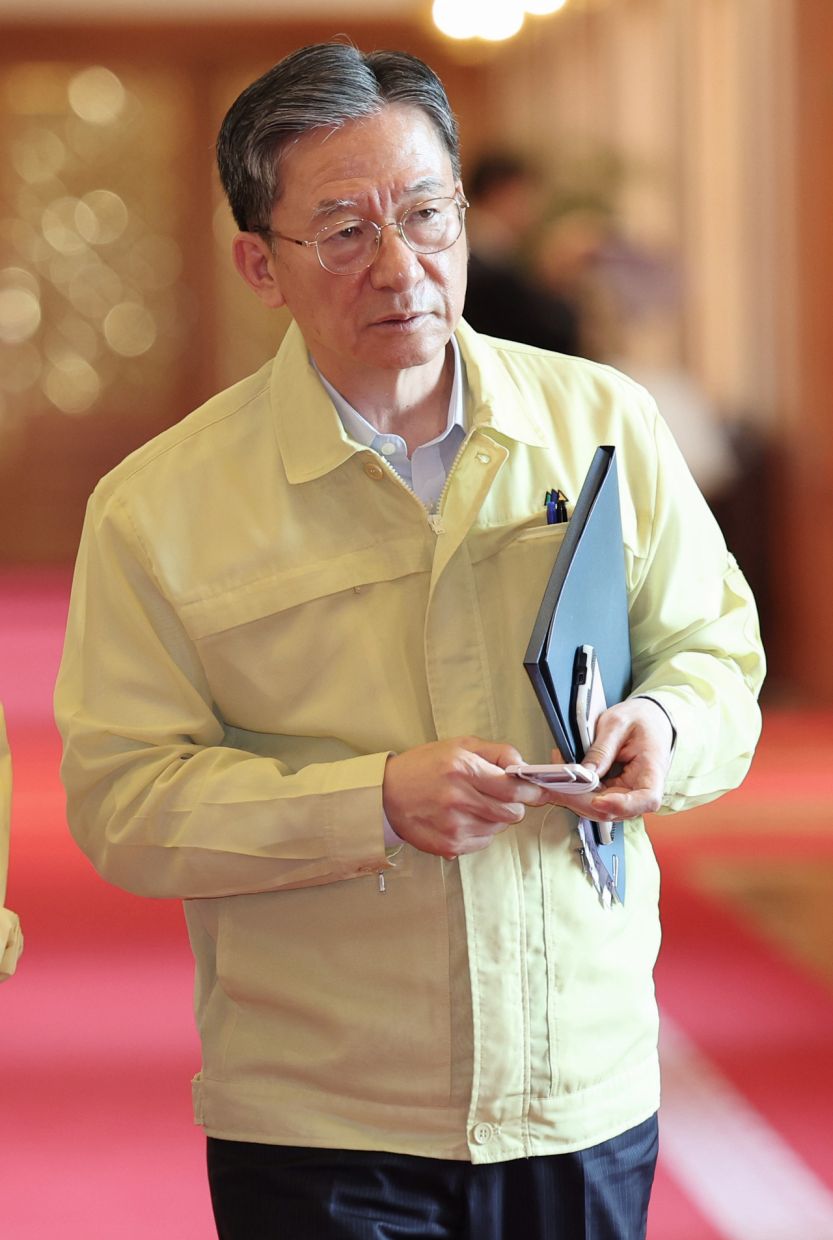
South Korea's Justice Minister Jung Sung-ho has stepped down from his post following a breakdown in consensus with the ruling Democratic Party over the scope of prosecutors' investigative authority. The resignation, submitted on Tuesday afternoon, represents a significant moment in South Korea's ongoing efforts to reshape its criminal justice system and address longstanding concerns about prosecutorial overreach. The departure signals deepening tensions between the executive branch and the legislative majority over how aggressively to restructure the balance of power within law enforcement.
Jung's decision to resign emerged from fundamental disagreements about the direction of recent criminal justice reforms. The justice minister had voiced reservations about eliminating prosecutors' supplementary investigation capabilities—a power that has long allowed prosecutors to revisit cases initially handled by police when they believe the original investigation proved inadequate. This authority has become increasingly contentious in South Korean politics, with critics arguing that it grants prosecutors excessive leverage over the investigative process and creates opportunities for abuse of prosecutorial discretion.
The ruling Democratic Party has pursued an ambitious agenda to fundamentally restructure how investigations and prosecutions function within South Korea's criminal justice framework. Their proposal aims to create a clearer institutional separation between investigative and prosecutorial roles, preventing any single entity from wielding overwhelming influence over criminal cases from initiation through trial. This reform philosophy reflects broader international trends toward checks and balances within judicial systems, as seen in many established democracies where investigative and prosecutorial functions operate with clear jurisdictional boundaries.
Under current law, prosecutors retain considerable discretion to launch supplementary investigations once police have referred a case to them. This mechanism was designed as a quality-control measure, enabling prosecutors to request additional investigative work when they deem the police inquiry insufficient for making informed charging decisions. However, in practice, the power has sometimes operated as a tool that strengthens prosecutors' hand in shaping case outcomes, critics contend, by allowing them to direct investigative resources toward evidence they believe supports prosecution.
When the revised Criminal Procedure Act takes effect on October 2, this landscape will transform dramatically. Prosecutors will lose the ability to independently launch supplementary investigations and instead will operate within a significantly narrowed scope. Their role will pivot toward evaluating investigations conducted by police and other authorities, determining whether sufficient grounds exist to pursue criminal charges, and managing cases once they reach the courts. This represents one of the most substantial shifts in prosecutorial authority South Korea has implemented in decades.
Jung attributed his resignation primarily to health considerations, citing personal medical reasons for stepping down. However, concurrent statements acknowledged the broader context, with his resignation reportedly noting that "it would be desirable for the new criminal justice system to be completed under new leadership," according to reports from Yonhap News Agency and other domestic media outlets. This phrasing suggests Jung recognised that his departure might facilitate smoother implementation of the Democratic Party's vision for criminal justice reform, even if he harboured misgivings about specific aspects of the restructuring.
The timing of Jung's resignation carries particular significance for Malaysia and Southeast Asia more broadly. South Korea has long served as a regional reference point for institutional development and governance innovation. How Seoul handles this transition between investigative and prosecutorial authority could offer lessons—both positive and cautionary—for other countries considering similar reforms. Many Southeast Asian nations maintain prosecutorial systems with substantial investigative powers, and the South Korean experience may inform debate about whether such concentrated authority poses genuine risks to fairness and rule of law.
Vice Justice Minister Lee Jin-soo will assume acting responsibility for the justice portfolio pending Jung's formal replacement. Lee's stewardship during this transitional period will prove critical, as the implementation of the October 2 Criminal Procedure Act changes will require careful coordination between multiple government agencies and the judiciary. The acting minister will need to ensure that police, prosecutors, and courts adapt smoothly to their recalibrated roles and responsibilities.
This episode also illustrates broader political dynamics within South Korea's government. The justice portfolio sits at the intersection of executive power and law enforcement independence, making it inherently sensitive. Justice ministers who voice concerns about major legislative initiatives often find themselves in awkward positions, caught between presidential prerogatives and parliamentary majorities. Jung's departure, whether primarily health-related or politically motivated, underscores how institutional change in the criminal justice system inevitably generates friction among powerful stakeholders with competing visions.
The Democratic Party's determination to proceed with prosecutorial constraint reflects a particular view of democratic governance: that concentrating too much authority in any single enforcement institution risks abuse, particularly when political and criminal investigations intersect. This perspective has gained credibility following several high-profile controversies in South Korean politics where prosecutors were accused of selective enforcement or politically motivated investigations. By weakening prosecutors' independent investigative reach, reformers hope to insulate criminal investigations from political manipulation.
Yet Jung's concerns also merit consideration. Prosecutors argue that supplementary investigation authority allows them to ensure investigative quality and catch cases where police may have missed crucial leads or evidence. Completely eliminating this power could create instances where prosecutors feel compelled to pursue weak cases or decline potentially meritorious prosecutions simply because police investigations fell short of ideal thoroughness. The challenge for South Korea's new system will be balancing these competing interests—preventing prosecutorial abuse while maintaining investigative rigor.
The October 2 implementation date now approaches with Jung's departure creating institutional uncertainty. How his successor navigates the transition will shape whether the new criminal procedure framework functions as intended or encounters unexpected obstacles. For Malaysia and other Southeast Asian observers, the South Korean experience serves as a real-time case study in how nations can recalibrate prosecutorial authority when public confidence erodes or institutional imbalances become apparent.

