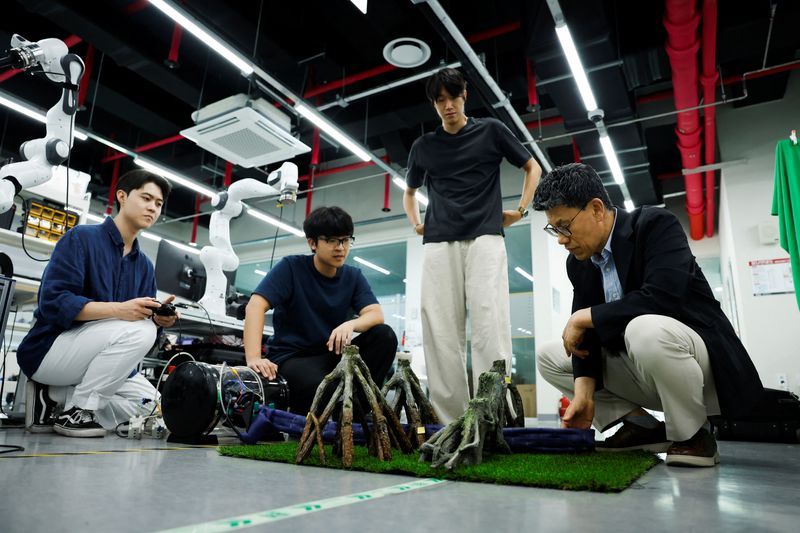
Scientists collaborating between South Korea's KAIST university and Stanford University have presented a novel robotic dressing system that functions independently of the wearer's manual input, potentially revolutionising how protective gear and specialised clothing are donned in time-sensitive or physically demanding situations. The breakthrough, detailed in IEEE Robotics and Automation Letters, relies on pneumatic technology embedded within garments themselves, eliminating the need for conventional fastening mechanisms or assistance from other individuals.
The fundamental mechanism operates through soft, flexible tubular structures—termed "vines" by the research team—that respond to air pressure changes to manipulate fabric across the body's surface. Rather than employing rigid mechanical components, these pressurised channels guide material upward and inward, functioning analogously to ivy creeping up a wall or trellis. The innovation lies not merely in the physics involved but in the elegant simplicity of the control system, which requires neither complex algorithmic programming nor continuous monitoring to function reliably across varied body shapes and movement patterns.
The genesis of this technology emerged from an everyday frustration experienced by lead researcher Kim Nam Gyun, a postdoctoral fellow at KAIST. During a bicycle ride interrupted by unexpected rainfall, he recognised the inefficiency of struggling to don rain protection while remaining mobile. This observation catalysed the conceptual framework for a system capable of clothing the wearer regardless of their activity level or posture. The resulting prototype accomplishes full suit deployment in approximately ten seconds—a timeframe substantially faster than traditional methods while the wearer remains free to continue whatever task they were undertaking.
The engineering breakthrough hinges upon how the robot avoids the pitfall of inflexibility that characterises many mechanical systems. Rather than shifting its entire structural body along the wearer's form, the vine mechanism expands progressively from its tip, similar to how living plants extend through growth at their terminal points. This growth-based progression allows stable navigation across curved anatomical surfaces without requiring the wearer to maintain rigid stillness. The system accommodates the body's natural contours, responding dynamically to variations in shape, texture, and orientation.
According to Ryu Jee-Hwan, who leads the civil and environmental engineering department at KAIST, the technology demonstrates remarkable adaptability to environmental variables. The mechanism successfully traverses narrow passages, conforms to surrounding geometry as it advances, and operates effectively regardless of whether contact surfaces prove slippery, adhesive, or inclined. This versatility distinguishes the system from conventional robotics, which typically require controlled environmental parameters for reliable operation. The pneumatic approach inherently tolerates the unpredictability of real-world deployment scenarios.
For Southeast Asian contexts, the implications prove particularly relevant given the region's rapidly ageing demographics and expanding healthcare infrastructure challenges. Malaysia, like other ASEAN nations, confronts increasing elderly populations requiring assistance with activities of daily living. This technology could substantially reduce caregiver burden in medical facilities and home settings, simultaneously preserving dignity and independence for users who struggle with conventional dressing mechanisms due to reduced mobility, arthritis, or neurological conditions. The hands-free operation particularly benefits individuals with upper limb paralysis or dysfunction.
Beyond elderly care applications, the research team identifies semiconductor manufacturing as a near-term implementation pathway. In cleanroom environments where contamination represents existential risk to precision manufacturing processes, workers must don protective garments rapidly yet flawlessly. The self-dressing robot streamlines this procedure while maintaining the sterile conditions essential for advanced chip production. Emergency response services similarly benefit from accelerated deployment of hazardous materials suits, specialized medical protective equipment, or contamination-control garments during critical incidents where seconds determine outcomes.
The technological framework also reflects broader strategic implications within advanced robotics development. Professor Ryu observes that contemporary focus on artificial intelligence and software-driven automation occasionally obscures the equally vital role of mechanical engineering innovation. While machine learning and algorithmic sophistication command significant research attention and investment, fundamental mechanical breakthroughs can deliver transformative capabilities through elegant simplicity rather than computational complexity. This vine-based system exemplifies how bio-inspired design principles—observing natural mechanisms and abstracting their operational logic—can yield solutions surpassing conventional engineering approaches.
The research trajectory demonstrates the deepening technological partnerships between South Korean institutions and American universities, reflecting broader trends in advanced manufacturing and robotics research clustering around leading academic centres. KAIST's strengths in mechanical systems and materials science complemented Stanford's computational and systems engineering expertise, producing interdisciplinary collaboration unlikely within isolated institutional contexts. For Malaysian and Southeast Asian research institutions, this model underscores the strategic value of international research networks and collaborative frameworks in accessing cutting-edge innovation.
Scalability and commercialisation pathways remain subjects for future investigation. While current prototypes demonstrate functional viability at laboratory scales, translating the technology into mass-producible garments requires addressing materials science questions, miniaturisation of pneumatic systems, and integration challenges with conventional textile manufacturing processes. The involvement of Stanford's engineering faculty alongside KAIST's commercialisation resources suggests serious intent toward eventual market deployment rather than purely academic exploration.
The publication in IEEE Robotics and Automation Letters, a peer-reviewed venue maintaining rigorous standards for methodological validity, validates the scientific credibility of the findings. This formal recognition within established academic frameworks enhances prospects for funding, industrial partnership, and accelerated development toward practical applications. The research community's acceptance facilitates knowledge transfer and collaborative refinement across international research networks.
Looking forward, this innovation exemplifies how mechanical robotics continues generating solutions for genuine human needs beyond entertainment or industrial automation. As demographic trends intensify pressure on healthcare systems throughout Asia and globally, technologies enabling independent living and reducing caregiver dependence gain paramount importance. The vine-robot represents precisely this category of innovation—technically sophisticated yet oriented toward tangible human benefit rather than technological complexity for its own sake.

